

Stephen J Stern PhD
Democracy Is Fragile. American Jewish Women Founders are Holding the Line.
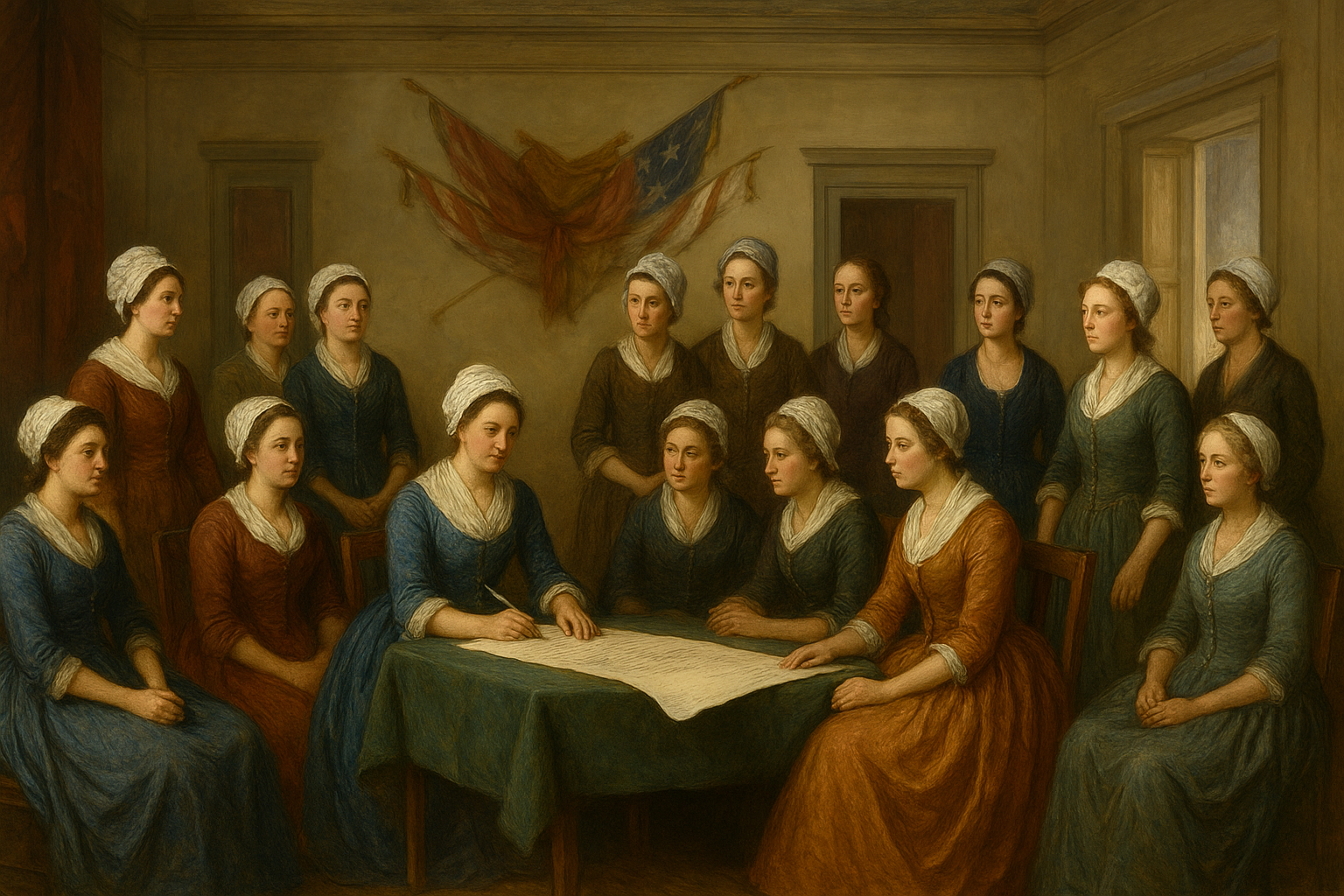
American women signing The Declaration of Independence. Image created by Stephen Ster
Their activism, scholarship, and moral clarity have carried the nation through upheaval before. They are doing it again now.
American democracy is fragile. Jewish women founders show us the work every generation must take on to keep it alive. From Rebecca Gratz to Mandana Dayani, American Jewish women have helped the Republic remember its promises and demand its future.
Every generation “founds” itself on the values of tradition while simultaneously challenging those values with the demands of the present. The founding of this country was not a one-off event, but an ongoing project, continuously reshaped by what earlier generations could not anticipate. Each generation must find America anew, balancing inherited traditions with the novel forces that confront them.
Tradition and modernity have always had a tense, unruly relationship. Tradition often finds modernity profane; modernity often feels held hostage by tradition. Think of Galileo and the Church, which insisted that science showing the earth moves was heresy. Galileo was forced to renounce what he knew to be true, but truth, once discovered, does not usually stay buried. In helping usher in empiricism—now called science—Galileo became a generational founder, one who helped guard the world against the politics of malice.
America’s founders did not expect us to remain children protected by tradition. They expected us to become builders ourselves. And American Jewish women have long stood at the forefront of that work.
American Jew Rebecca Gratz (1781–1869) founded needed Jewish charitable institutions while advocating for women’s education. American Jewish writer Emma Lazarus (1849–1887) championed immigrants and refugees; her words at the base of the Statue of Liberty were once an invitation: “Give me your tired, your poor, your huddled masses yearning to breathe free.”
American Jewish Feminist labor leader Rose Schneiderman (1882–1972), born in Poland before becoming an American, helped found the ACLU, fought for labor protections, women’s rights, and suffrage, and served as President of the Women’s Trade Union League. She demanded dignity, not only subsistence: “The worker must have bread, but she must have roses, too.”
American Jew Clara Lemlich (1886–1982), born in Ukraine, led the 1909 uprising of 20,000 garment workers in New York. Like Schneiderman, she remained a lifelong labor organizer and suffragist.
American Jew Joan Beifuss (1931–1994), a journalist for the Chicago Sun-Times before moving to Memphis in 1966, became an essential activist and documentarian of the civil rights struggle, extending democracy to those living on the margins.
More recently, Stosh Cotler—formerly head of the American Jewish activist group, Bend the Arc—has fought white supremacy, voter suppression, and anti-immigrant politics. Today we also find Ilyse Hogue, a Jewish Texan who was the former president of NARAL. She has mobilized millions for democracy. Another American Jewish founder is Iranian born, Mandana Dayani, of the non-partisan “I am a voter.” She is advancing voting rights and civic participation nationwide. And two of my favorites: legal warrior for democracy, American Jewish attorney and journalist, Dhalia Lithwick, legal analyst at Slate and host of the podcast, Amicus Brief. It’s one of the best podcasts you’ll find. She does not waste your time, but enhances it. And there’s American Jewish comedian Ilana Glazer fighting for American democracy with comedy. Watch her fight! It’s fun.
Imagine all of them at your Thanksgiving or Seder table. Our rituals instruct us to open the door to those in need. And at this open door stand three more American founders: Heather Cox Richardson, a historian at Boston College who is not Jewish, but was invited to the meal because she’s awesome, accompanied by her two Jewish colleagues, Yale historian Joanne Freeman and NYU historian Ruth Ben-Ghiat.
Their work will be central to understanding how we navigated this moment. Richardson began a daily discipline after the 2016 election: a 1,200-word letter on Facebook for us, but also a gift for future historians. Thousands found her on Facebook; the audience exploded. She expanded to Substack and live lectures that drew tens of thousands—today, more than three million Americans read her every day.
HCR may be the most widely followed historian in the country. Never in my lifetime have so many turned to a historian to understand the present. And she offers her work freely: she aims to educate, not profit.
Joanne Freeman’s scholarship on early America is critical for understanding today. Her podcast with Richardson, “Now & Then” as well as their show on YouTube, “What The Heck Just Happened”—has helped millions see the present as part of a long, often surprising, historical arc. Freeman and Richardson are two of the greatest American political historians this country has produced. Find them.
Ruth Ben-Ghiat, meanwhile, is not a historian of America but is one the world’s leading historians on authoritarianism. Her Substack newsletter, Lucid, and her books, interviews, and television appearances analyze threats to democracy with incisive clarity. She’s worth your time. RBG’s work appears in CNN, The New Yorker, The Washington Post, The Atlantic, and The New York Times. You have likely seen her—along with Richardson and Freeman—on MSNBC and other networks. We are fortunate they do this work. They are the needed guides in a world overtaken by the politics of malice. Ben Ghiat’s book “Strongmen” is a must read.
Today’s American Jewish founders remind us that our democracy—250 years of democratic, never ending discussions —is fragile and that our democratic work is never done. They fight so that no person may take ownership of our discussions, which would end US democracy. Through activism, education, or simply showing up, each of us has a chance to help shape the America we aspire to be. The question is not whether we can rise to this moment, but whether we will.