
Middle East Analyst
Democratic Control of Congress Could Strengthen Trump’s Gaza Plan
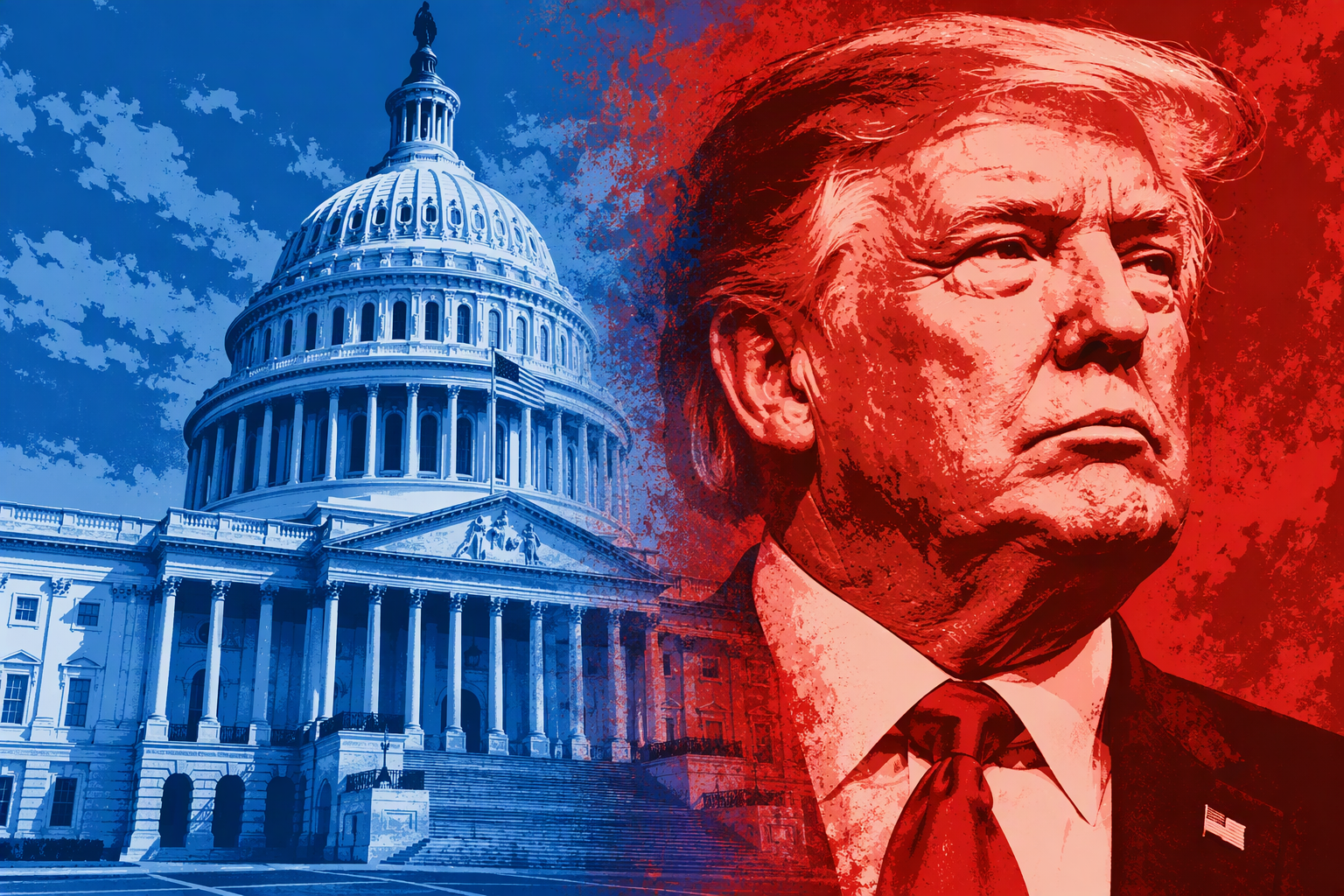
by author (AI)
The Conventional Wisdom May Be Missing the Real Political Story
The dominant interpretation of the recent midterm elections is that President Trump emerged weakened while Democrats emerged strengthened. From that perspective, any major foreign policy initiative associated with the administration would appear less likely to succeed. Many observers have therefore assumed that the future of the Gaza Plan became more uncertain the moment the election results became clear. That conclusion is likely inaccurate.
The central analytical error is the assumption that the Gaza Plan remains primarily a Trump initiative whose fate rises and falls with Trump’s political fortunes. While that may have been true during the plan’s developmental stages, it ceased being entirely accurate when the framework was adopted by the United Nations Security Council as Resolution 2803 on November 25, 2025. The resolution transformed what began as a twenty-point American proposal into an internationally mandated diplomatic framework calling for a conditional, phased pathway toward a demilitarized and deradicalized Palestinian state. Whatever one thinks of the plan’s merits, its political ownership is now far broader than the White House alone.
The implications of that shift have received remarkably little attention. Once a framework becomes embedded within an international mandate, the relevant question is no longer whether a particular president remains strong enough to promote it. The more important question becomes whether a sufficiently large coalition exists to implement it. Ironically, the midterm elections may have expanded that coalition rather than diminished it.
UNSC Resolution 2803 Changed the Political Landscape
Observers continue to describe the initiative as “Trump’s Gaza Plan” because the basic framework originated within the administration. That shorthand, while politically convenient, increasingly obscures more than it explains.
UN Security Council Resolution 2803 established a phased implementation process tied to specific political, security, humanitarian, and governance benchmarks. The resolution did not promise immediate Palestinian statehood, nor did it mandate a rapid final-status agreement. Instead, it created a conditional process under which progress would depend upon verifiable achievements involving disarmament, governance reform, institutional development, deradicalization initiatives, and long-term security arrangements.
The significance of this development cannot be overstated. International actors, donor governments, financial institutions, and regional powers are no longer evaluating an American proposal. They are evaluating an internationally endorsed framework that now serves as the recognized diplomatic roadmap for Gaza’s future.
This distinction matters because it fundamentally alters the domestic political calculations inside the United States. A congressional debate about whether Trump should be supported is very different from a debate about how best to implement an existing UN-mandated framework. Democratic lawmakers who oppose Trump on virtually every domestic issue may nevertheless support aspects of a governance and reconstruction process that now carries international legitimacy.
The midterm elections therefore did not simply affect Trump’s political standing. They altered the composition of the coalition likely to shape implementation.
The Trump 20-Point Gaza Plan Was Never an Annexation Plan
Much of the political resistance to the framework has emerged not from its critics on the left but from some of its potential supporters on the right. American support for Israel is often discussed as though it represents a single political position. In reality, profound differences exist regarding what that support actually means. For many Americans, support for Israel means support for the security, legitimacy, and long-term survival of the Jewish state. For others, particularly among some Christian Zionist and nationalist constituencies, support extends further and includes support for permanent Israeli control over disputed territories and skepticism toward any framework that contemplates Palestinian political institutions.
The distinction is important because Resolution 2803 is fundamentally a transition framework, not an annexation framework. Its underlying logic assumes that Hamas must be disarmed, that Gaza must be demilitarized, that political authority must eventually be transferred to an alternative governing structure, and that progress toward Palestinian self-government must be conditioned upon demonstrable security and governance reforms.
Many conservatives support these objectives. Others remain deeply uncomfortable with them. The idea of a conditional pathway leading ultimately toward a demilitarized Palestinian state is viewed very differently by those who support territorial compromise and those who support permanent Israeli sovereignty over the same territory. As a result, some of the strongest supporters of Trump have never been fully aligned with some of the plan’s most important assumptions. This reality helps explain why a weakened Republican coalition does not automatically translate into a weakened Gaza Plan.
Why Democratic Gains Could Increase Support for Implementation
Many Democrats view the Gaza issue through a completely different lens. While opinions vary widely across the Democratic Party, there is generally stronger support for humanitarian assistance, reconstruction planning, civilian governance institutions, international cooperation, anti-corruption safeguards, and mechanisms designed to ensure accountability. Critics often portray these priorities as bureaucratic obstacles that complicate policymaking. In reality, they address some of the most important practical challenges facing Gaza’s future.
The fundamental problem confronting Gaza is not simply one of physical destruction. Infrastructure can be rebuilt. The more difficult challenge is creating institutions capable of administering reconstruction in a manner that is credible, transparent, and sustainable. Without such institutions, even vast financial resources are unlikely to generate lasting stability.
This is where Democratic political priorities may unexpectedly strengthen implementation of Resolution 2803. Congressional Democrats are likely to demand auditing requirements, transparency measures, anti-corruption safeguards, reporting mechanisms, and independent oversight structures. Those requirements may appear burdensome from a political perspective, but they closely resemble the demands already being made by governments and institutions expected to finance Gaza’s recovery. In this sense, Democratic scrutiny could enhance credibility rather than undermine momentum.
The Donor Community Has Different Priorities Than Washington
One of the recurring weaknesses of American political analysis is its tendency to focus almost exclusively on domestic politics while neglecting the concerns of those who will ultimately determine whether reconstruction succeeds. The governments expected to finance major reconstruction efforts are not located in Washington. They are located throughout the Middle East and beyond. Their concerns are practical rather than ideological.
Potential donors understand that Gaza requires enormous investment. The question is whether conditions exist that justify committing such resources. Before investing billions of dollars, governments naturally want answers to a series of fundamental questions. Who governs Gaza? Who controls security? How will contracts be administered? How will expenditures be monitored? What mechanisms exist to prevent corruption? What prevents reconstruction funding from being diverted? How can infrastructure investments be protected from future conflict? These questions sound remarkably similar to the concerns many Democrats are likely to raise during oversight hearings.
This convergence is politically significant because it creates an unusual alignment between domestic accountability advocates and international funding sources. The very oversight mechanisms that some critics view as obstacles may actually be prerequisites for attracting serious financial commitments. Successful reconstruction requires confidence. Confidence requires credible institutions. Credible institutions require oversight. Viewed through that lens, Democratic gains may strengthen one of the weakest components of previous reconstruction efforts throughout the Middle East: donor confidence.
From Trump’s Plan to Washington’s Plan
Perhaps the most important consequence of the election is that it may accelerate the transformation of the Gaza framework from a presidential initiative into a durable policy consensus. Foreign policy initiatives often begin as projects associated with particular leaders. The successful ones eventually become institutionalized. They cease being identified with a single administration and instead become embedded within the broader policy establishment. UNSC Resolution 2803 appears increasingly likely to follow that trajectory.
Democrats may support accountability mechanisms. International financial institutions may support governance reforms. Gulf donors may support reconstruction frameworks tied to transparency requirements. Israeli centrists may support a post-Hamas administrative structure. Arab governments may support a phased process linked to demilitarization and regional stability.
These actors disagree on countless political issues. Yet their interests increasingly converge around the practical requirements necessary for implementing the framework established by Resolution 2803. Such a coalition would look very different from the coalition that originally developed the plan. It would also be considerably more durable.
A foreign government can often wait out a particular administration. It is much harder to wait out an internationally mandated framework supported by a broad coalition of political parties, donor governments, financial institutions, and regional stakeholders.
Why This Matters for Gaza’s Future
The irony of the midterm elections is that they may have solved a problem that had quietly plagued the Gaza Plan from the beginning.
The coalition that created the framework was not necessarily the coalition best positioned to implement it. The plan’s core requirements, including governance reform, accountability mechanisms, donor oversight, phased implementation, deradicalization benchmarks, and institutional development, depend upon precisely the kinds of structures that many Democrats and international actors have historically emphasized. As a result, Democratic gains may ultimately strengthen the political foundations necessary for implementation.
This does not mean success is guaranteed. The regional environment remains extraordinarily difficult. Israeli coalition politics remain fluid. Hamas remains a central obstacle. Questions concerning regional security, particularly involving Iran, continue to shape the strategic landscape. None of these challenges disappear because of an election. What has changed is the potential governing coalition behind the framework itself.
Related Topics
Related Posts