

Demography in Israel: No Longer an Academic Orphan
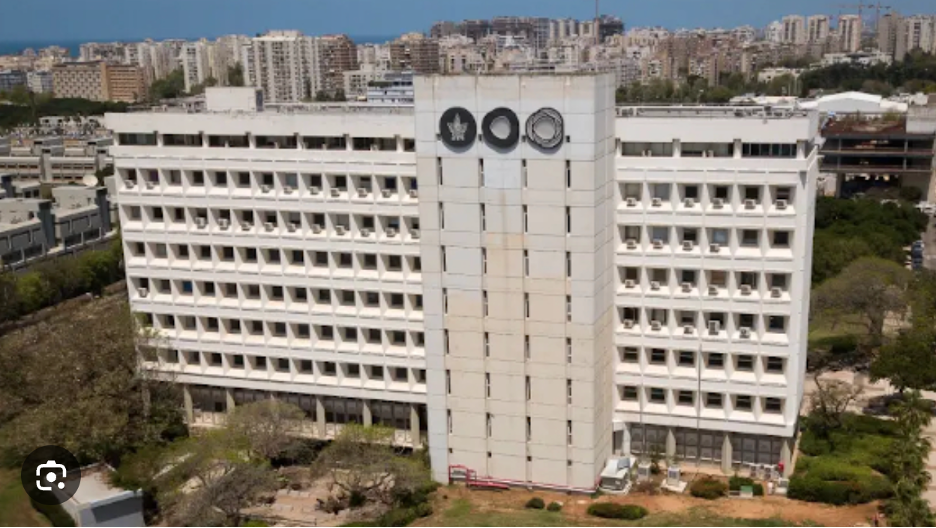
On June 17th, Tel Aviv University will celebrate the opening of a new academic center focused on population sciences. For too long, the many challenges posed by Israel’s idiosyncratic demographic dynamics have gone unstudied. It is critical that social scientists step up and begin systematic research and training. No subject matters more to the country’s future.
There is not a country in the developed world that has a demographic profile even remotely resembling Israel’s. In 1948, the new state counted around one million residents. By the close of 2025, that figure had climbed more than tenfold, to 10.2 million. Today Israel’s population is 77 percent Jewish and 21 percent Arab, with smaller minorities and non-citizens making up the rest.
Children under eighteen number roughly 3.2 million, or 31.5 percent of the population – compared to just 20.5 percent on average in Western societies. Indeed, even though 2025 brought a widely reported net outflow of 20,000 emigrants, Israel’s population still expanded by 110,000 over the year, propelled by 182,000 births – at a time when European and Asian countries shrink.
None of this is new. High fertility has been a constant feature of Israeli life across seventy-seven years of statehood. Far from declining, the Total Fertility Rate among Jewish women climbed 19 percent between 2002 and 2021, moving from 2.64 to 3.1 children per woman. A gradual reversal has followed: by the end of 2024, Israel’s birthrates had slipped to 2.87, dipping just under 3.0 for the first time in many years.
Nonetheless, Israel still towers over every other OECD country, with a rate roughly twice the European average of about 1.5. The contrast holds regionally as well: while much of the Middle East has seen birth rates fall to replacement levels, Israel’s fertility has stayed remarkably high.
Of course, these averages mask profound contrasts between Israel’s different tribes. Haredi women average roughly 6.75 children, while non-ultra-Orthodox Jewish women have a rate of 2.3. Arab-Israeli society is undergoing profound change: during the 1960s, Muslim women had 9.4 children on average; today the rate is only 2.5, with non-religious Muslim women at 2.05, already below replacement levels. Meanwhile, Bedouin women in southern Israel maintain an extraordinarily high birthrate of roughly 5.0. And yet, perhaps as a result of the protracted war, for the first time in the nation’s history, population growth fell below one percent in 2025, to 0.9%.
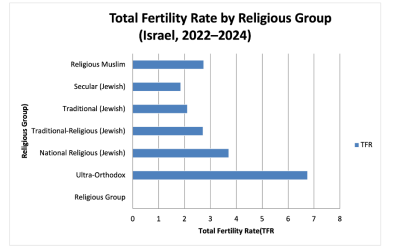 Israel’s Diverse Demographic Profile (Source, Israel Central Bureau of Statistics)
In such a rapidly growing reality, demography shapes every aspect of Israeli life: the long waits in our emergency rooms; the ever-maddening, /ever-expanding transportation gridlock; the delays in court decisions; the crowded classrooms; and half a dozen acute environmental problems, from the solid-waste crisis to biodiversity loss and Israel’s growing carbon footprint.
There was a time when Israel was home to a formidable team of social scientists studying its demographic dynamics. Hebrew University had a renowned academic unit, founded by Roberto Bachi, the brilliant statistician and father of Israeli demography. He recruited a team of experts, most notably Professor Sergio Della Pergola, who came to Israel in 1966 for his Ph.D. and has remained a giant in the field.
But as this first generation retired, for whatever reasons, replacements were not hired. A few population experts trained abroad are now scattered across Israeli universities. But no critical mass existed to build the independent research and training capacity needed to make sense of the many numbers so meticulously recorded by Israel’s Central Bureau of Statistics.
This is now changing.
In a bold decision, Tel Aviv University President Ariel Porat provided seed money for a new Center for Population Sciences. Porat had the perspicacity to bring together two academics who had worked a few floors apart on campus but, owing to the usual academic siloing, had never collaborated.
After a decade of policy research on related topics, I approached him to discuss setting up a research center. He smiled and agreed – on the condition that I work with Sociology Professor Isaac “Itzik” Sasson, arguably the most prominent young demographer in Israeli academia.
Sasson earned his Ph.D. at the University of Texas and was a Postdoctoral Fellow in Population Health at the London School of Economics before returning to Israel. The findings from his many research inititives can be found in the world’s leading demographic journals. As it turned out, Itzik had recently come to the president with the very same idea.
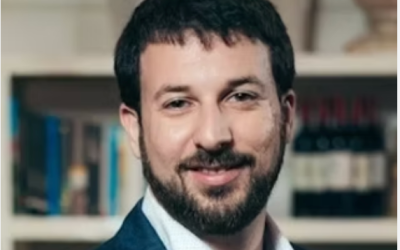 Professor Itzik Sasson: Demographer Extraordinaire (Photo: Tel Aviv University)
Porat’s conviction that “two heads are better than one” has created a wonderful intellectual synergy as we launch the initiative – now run by director Itamar Shachar, a veteran strategic consultant and environmental campaigner who makes things happen. A very talented group of post-doctoral and graduate fellows have joined the team.
The center’s research focuses on five critical areas:
Migration: The central role of immigration and emigration in shaping Israel’s population size, ethnic composition, and economic development, and the implications for the future trends will be analyzed. This has become a source of national concern over the past three years, amid a record “brain drain” of highly trained Israelis, from doctors to hi-tech professionals. Understanding these motivations and dynamics is critical if the country is to address the emerging crisis.
Economics: The center will examine how demographic processes shape employment, inequality, labor-force participation, and economic growth across population groups. Rapid growth drives poverty in many Israeli communities. And with 26 percent of Israeli first-graders in schools that do not teach a basic science, math, and English curriculum, there is legitimate concern for the country’s ability to succeed in an ever-competitive global marketplace.
Mortality and public health: It is important to understand how mortality and population health shape demographic change through the interplay of social, economic, and health factors. Israel ranks fourth among OECD nations in life expectancy, with citizens on average living into their 80s – with many well beyond. This is a blessing. But it creates entirely new challenges for the health and welfare systems.
Sustainability: The center will study the relationship between population growth and environmental challenges, including density, infrastructure, resource use, and quality of life. Israel expects its population to double over the next three decades, making it the most crowded country in the world save perhaps Bangladesh. Adaptation will be critical to ensure that quantity of life does not erode quality of life, and that the Land of Israel’s precious ecological systems are preserved.
Fertility: Surprisingly little research investigates Israel’s exceptional fertility patterns and how social, religious, economic, and cultural forces shape family life. Understanding the influence of education, religion, employment, social norms, and even access to contraception on birthrates is essential to designing policies that can move the country in a sustainable direction.
These topics and many more will be taken up at our upcoming inaugural conference. Attendance is free. We will hear from the country’s demographers and economists. President Herzog will even offer a recorded greeting! It offers a chance for the general public to learn more and become engaged.
Israel’s superb universities need to be harnessed to help decision-makers confront the demographic forces that will define the nation’s future. For too many years, those forces were left uncharted. No longer: the population trends that will shape Israel’s future, along with their implications have finally found a home where they can be studied with the rigor and seriousness they demand.