


Despite A Shocking Crime, the Capital Jewish Museum Remains a Site of Resilience
On the morning of May 20th, I visited the Capital Jewish Museum. I was somewhat familiar with the museum, and thought it would make for an interesting blog.
Seventy-two hours later, virtually the entire world had heard of the Capital Jewish Museum – the place where Israeli Embassy staffers Sarah Milgrim and Yaron Lischinsky were brutally murdered.
Having visited, I can state unequivocally that the Capital Jewish Museum should not be viewed through the prism of a heinous crime, but rather as an important site of reflection, resilience, and hope.
With that in mind, I proudly share the museum’s story.
Chronicling Jewish Life in the National Capital Region
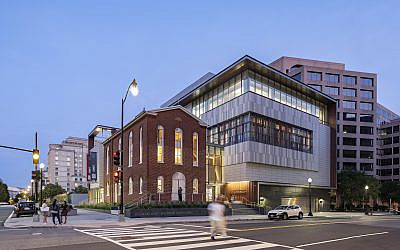
The Lillian and Albert Small Capital Jewish Museum opened to the public on June 9, 2023. Spanning 32,000 square feet in a revitalized downtown area within walking distance of the Capitol and National Mall, the state-of-the-art complex houses permanent and temporary exhibits chronicling the story of Jewish life in the national capital region.
The museum’s impressive collection encompasses more than 24,000 digital and print artifacts, 1,050 objects, and 800 linear feet of archival materials from the 1850s to the present day, comprising oral histories, personal papers, and business and organizational records.
They have been collected in a variety of ways, including a “We Want Your Stuff” initiative, through which individuals can schedule an appointment and review with museum staff personal items they’re interested in donating.
The Capital Jewish Museum’s newest exhibit, which debuted May 16, is an extensive, thought-provoking, five-years-in-the-making examination of the Washington area’s LGBTQ+ community – not just over the last few decades, but dating back to the 1800s.
However, before there was a Capital Jewish Museum, there was the original Adas Israel Congregation, housed in a building that, over the passage of nearly a century and a half, became the museum’s heart and anchor.
The Establishment and Journey of a Historic Building
Adas Israel was founded by German-Jewish immigrants and dedicated in 1876, America’s centennial. Among the dignitaries in attendance for the consecration was President Ulysses S. Grant – the first president to attend a Jewish service.
Although Adas Israel as a place of worship relocated several times throughout the ensuing decades, the original two-story brick building remained at its 3rd and G Streets NW location, becoming home to churches, retail establishments, and even, says museum Executive Director Dr. Bea Gurwitz, “a pork barbeque shop.”
After staying in place for nearly a century, plans for the new Metro rail system threatened the historic building with destruction. “The Jewish community,” Bea explained, “fought to save it. They lobbied Congress for its preservation, and made arrangements for it to be put on wheels and moved down the street,” where it became headquarters for the Jewish Historical Society.
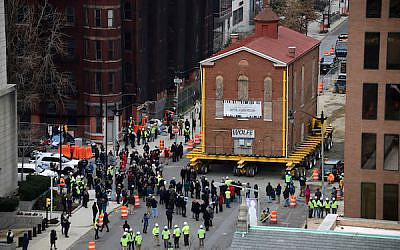
It was subsequently moved another 60 feet, but, once again threatened by development, the building moved to a temporary location in 2016, this time in anticipation of reconstruction and the building of a new Jewish museum. In 2019, it was put on a flatbed truck and moved one last time, to 3rd and F Streets NW, where it was attached to the in-development Capital Jewish Museum as its centerpiece. Parts of the original synagogue remain, with Bea pointing out bricks from the original 1876 structure, as well as pews and a mid-19th century Torah scroll.
Encouraging Visitors to Connect, Reflect, and Act
Taking it in from the street, I was impressed by the seamless integration of a nearly 150-year-old synagogue with a gleaming 21st-century building. Upon entering, I studied the museum’s mission statement: “The Capital Jewish Museum explores the Jewish experience in the national capital region. The Museum inspires visitors to connect, personally and collectively; reflect on the relevance of the past to today; and act on behalf of their communities and values.”
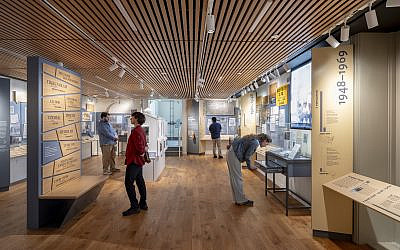
Touring the museum’s three floors – two for permanent exhibits and one for hosting temporary displays – it was clear that the museum’s mission statement is being realized to the fullest. Visitors are initially introduced to What is Jewish Washington, which begins with a display of Jewish values, continuing on with a collection of regional artifacts dating from 1790 to the present day. Among the more unique items is a ketubah carried by a Jewish Civil War soldier.
The second floor enables visitors to enter the historic Adas Israel sanctuary, which, said Bea, continues to be utilized for services and special events. Also on the second floor is an extensive interactive exhibit entitled Connect. Reflect. Act. The exhibit invites exploration, especially through a large interactive map table whereby visitors can visualize the growth of Jewish Washington and search for, and locate, synagogues, Jewish-owned businesses, and organizations.
The idea behind the exhibition, explained communications specialist Maura Scanlon, “is to explore themes of community, to consider one’s own values and experiences, and to reflect on what this history means to you.”
An In-Depth Look at LGBTQ+ Activism and Change
From now until January 4, 2026, the museum’s third floor will be occupied by LGBT Jews in the Federal City, which, the museum promises, will take an in-depth look at “a turbulent century of celebration, activism and change in the nation’s capital.”
Although it opened May 16, just before DC hosted WorldPride, Bea said the timing was a fortuitous coincidence. The actual planning of the exhibit began five years ago, and, she noted, “We could not have put an exhibition of this scope together in such a short period of time.”
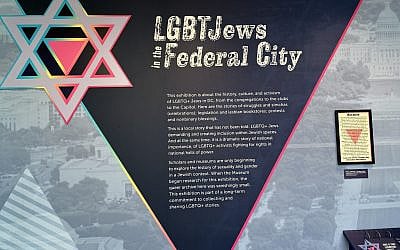
Indeed, the massive exhibit contains well over 120 artifacts and 100+ photos. It is divided into seven sections, one of which enables visitors to post photos of their own experiences as members of Washington’s LGBTQ+ community.
While the Capital Jewish Museum held events specific to WorldPride, Maura said the story of LGBTQ+ life in Washington will be told “through the lens of Jewish activists.” She added: “While the story of gay activism is more widely associated with San Francisco and New York, we are the first Jewish museum to display the evolution of Jewish LGBTQ+ life in the US. It foregrounds DC activism and the role Jewish activists and community members played in effecting change.”
The exhibit highlights the efforts of an extensive number of gay Jewish activists, particularly Frank Kameny, who coined the phrase “gay is good.” Trained as an astronomer, Kameny spent the majority of his life fighting federal discrimination against gay people. The FBI opened a file on him, but Kameny ultimately received an apology from the federal government, and his Northwest DC house is listed on the National Register of Historic Places.
Also on display are items from Bet Mishpachah, DC’s LGBTQ+-friendly synagogue. Founded in 1975, Bet Mishpachah is the fourth oldest LGBTQ+ congregation in the country. On view for the first time, these items document the synagogue’s founding and struggle for acceptance among broader Jewish communal institutions.
A Poignant Remembrance Ceremony
The museum temporarily closed its doors in the wake of the tragedy, reopening May 29 with a poignant remembrance ceremony attended by numerous officials and dignitaries.
At the ceremony, Bea said, “The kind of violence we saw grows out of the dehumanization of the Jewish people.” What the Capital Jewish Museum does, she affirmed, “is tell stories about the Jewish experience and share the richness, diversity, and vibrancy of Jewish life in the DC region. That all made us feel we had to reopen.”
Plans to permanently memorialize the victims are underway.
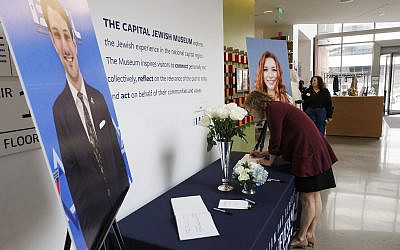
Lischinsky and Sarah Milgrim, which will be given to their families (Capital Jewish Museum)
If you have occasion to visit the Capital Jewish Museum, take a moment to reflect on Sarah Milgrim and Yaron Lischinsky – advocates for peace and understanding, tragically taken from the world they sought to change for the better.
Then, while embarking on a journey through this remarkable facility, be sure to study the display of Jewish values, focusing in particular on one that has enabled our people to persevere throughout centuries of tragedy and heartbreak – Am Yisrael Chai.