Middle East Analyst
Did JD Vance Know What FBI Source Charles Johnson Was Alleging
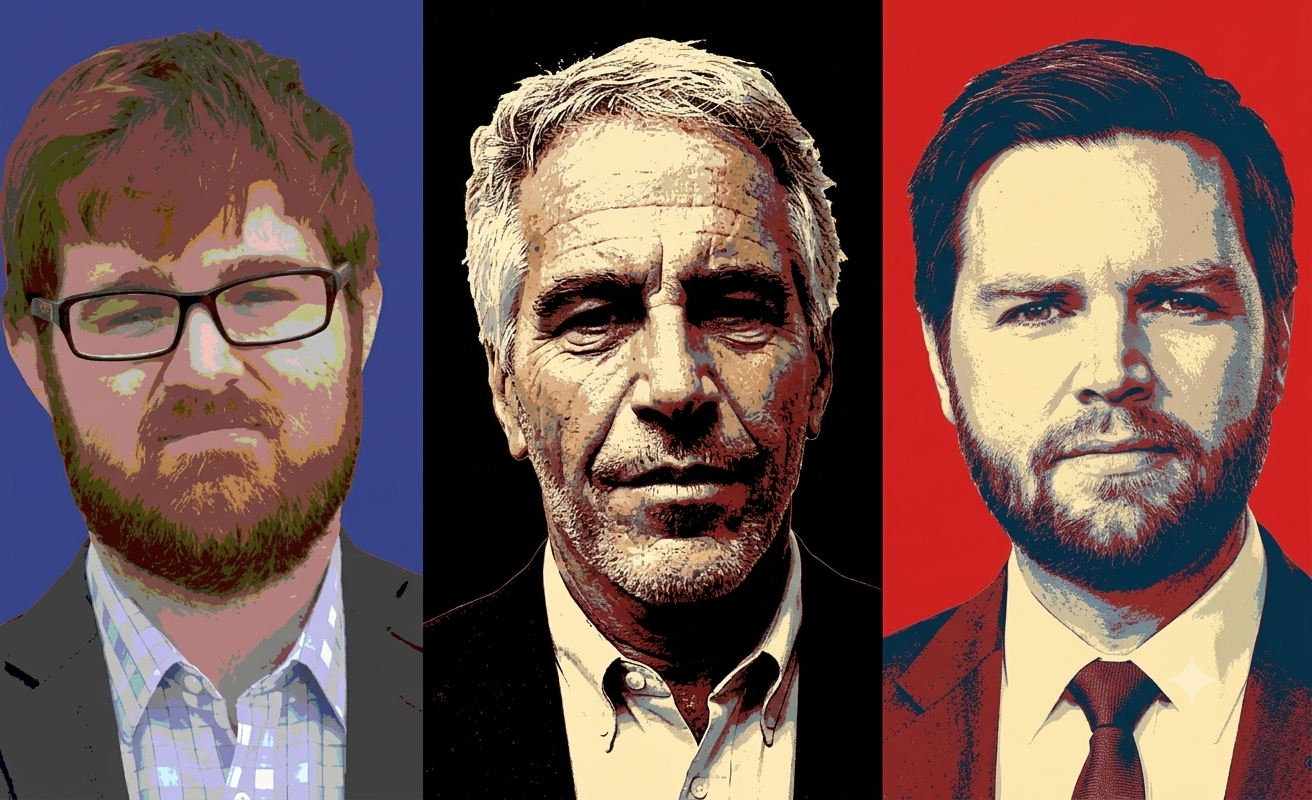
by author (AI)
Part III — When Allegations Become Public Narratives
When the FBI’s Confidential Human Source (CHS) memo alleging ties between Jeffrey Epstein and foreign intelligence services became public, it entered an already volatile ecosystem of speculation, geopolitical anxiety, and partisan narrative warfare. The memo’s contents were allegations, not established facts, but their release had immediate consequences. They fed into a growing public storyline that Epstein’s network, or actors adjacent to it, might have been used to influence or compromise Donald Trump. This storyline was not confined to fringe spaces. It circulated across the populist right, the anti-Netanyahu left, and the broader conspiracy-curious middle. It was amplified by commentators who had long argued that Israel exerted disproportionate influence over American foreign policy. And it landed at a moment when Trump’s own political coalition was fracturing over questions of loyalty, sovereignty, and the future of the Iran conflict.
Into this environment stepped JD Vance, who maintained direct contact with Johnson during the period when Johnson was making these allegations — reporting since the CHS unmasking confirms the two exchanged encrypted Signal messages about Epstein’s death for roughly twenty months. That was not “routine chatter with a campaign supporter,” which is how the relationship has been characterized. It was a sustained channel of communication between the man who is now vice president and the man who in 2020 told the FBI that Trump had been compromised by Israel. And when Vance appeared on the Joe Rogan podcast months after the memo became public, he made comments that directly intersected with — and, in one specific place, directly contradicted — the core allegation Johnson had given the FBI. Whether this alignment is coincidental or meaningful is the question this essay explores.
The purpose here is not to prove that Vance knew what Johnson told the FBI. It is to examine whether the timing, content, and political incentives surrounding Vance’s remarks make the question analytically relevant. In the world of open source intelligence, where allegations, public statements, and political behavior form overlapping patterns, relevance is often more important than certainty.
Johnson’s Allegation and Its Public Impact
Johnson’s allegation to the FBI was stark. He claimed that Trump was compromised, or at least that operations existed with the objective of compromising him. This was not a claim about Trump’s personality or resilience. It was a claim about the existence of efforts to influence or control him through compromising Epstein-related material. Whether Johnson believed the allegation, exaggerated it, or was repeating secondhand information is not the point. The point is that he told it to the FBI, and the FBI recorded it.
When the memo became public, it immediately fed into a narrative that had been building for years: that Epstein’s network, or actors connected to it, had been used to influence powerful figures, including Trump. Some versions of the narrative focused on Mossad. Others focused on American intelligence. Still others framed Epstein as a freelance operator whose network intersected with multiple intelligence services. The details varied, but the core idea was the same: compromising material existed, and it had political implications.
This narrative mattered because it intersected with a broader storyline about Israel’s influence over American foreign policy. Commentators on both the right and left had argued that Trump’s Middle East policies were shaped by pressure from Netanyahu or by pro-Israel donors. The Epstein-Mossad narrative became a way to dramatize those concerns. It suggested not just influence, but control.
The Vance-Johnson Channel: What the Signal Record Adds
The most substantial upgrade to this analysis is evidentiary, not interpretive. Public reporting following the CHS unmasking established that Vance and Johnson communicated over Signal — an encrypted channel, not an open one — specifically about Epstein’s death, for approximately twenty months. This detail changes the analytic weight of the relationship in three ways.
First, duration. Twenty months is not a single exchange or a brief campaign-era interaction. It spans a period during which Johnson’s status as a CHS was active and during which his reporting to the Bureau was being generated and filed.
Second, subject matter. The contact was not generic political chatter. It was specifically about Epstein — the same subject at the center of the Johnson allegations contained in the FBI memo.
Third, channel. Signal is an encrypted messaging platform, typically chosen for communications the parties want to keep outside of standard discoverable records. That choice does not prove concealment of anything improper, but it does raise the evidentiary bar for the “just a supporter reaching out” characterization Vance has offered publicly.
None of this establishes that Johnson briefed Vance on the contents of his FBI reporting, or that Vance internalized Johnson’s specific framing of a Trump compromise operation. Analysts should resist that leap. What it does establish is that the two men were in sustained, encrypted, subject-matched contact during the relevant window — which is precisely the kind of fact that should raise, not lower, the analytic priority of the question this essay asks.
Vance’s Rogan Interview and the Three-Layer Counter-Narrative
Months after Johnson’s memo became public, JD Vance appeared on the Joe Rogan podcast and made a series of remarks that intersected with the allegation Johnson had given the FBI — but not uniformly. Close reading of what Vance actually said shows three distinct layers, and the distinction between them is the analytic core of this essay.
Layer one: the general Epstein blackmail theory. Vance did not deny that Epstein may have blackmailed powerful people. Asked whether anything he’d seen convinced him Epstein “never blackmailed people,” Vance said no — adding that if dispositive evidence of blackmail ever existed, it was probably destroyed years ago. He called himself one of the “OG Epstein conspiracy theorists.”
Layer two: Epstein’s intelligence ties. Vance affirmed this layer as well, saying Epstein “clearly had connections to the highest levels” of both American and Israeli intelligence, and did not push back when Rogan raised the Mossad theory directly — at one point suggesting it could be “both.”
Layer three: Trump himself. Here, and only here, Vance broke sharply from the pattern of affirmation. Asked whether Israel was using the Epstein files, or other compromising material, to steer Trump’s decisions — specifically in the context of Iran policy — Vance said the idea that Trump was being blackmailed was “crazy to me.”
This three-layer structure matters because it is not a blanket denial of the Johnson-adjacent narrative. It is a surgical one. Vance validates almost the entire architecture of the compromise theory — the blackmail, the destroyed evidence, the intelligence connections, even the ambiguity about which service was involved — and draws the line at exactly the point where the theory would implicate Trump’s own judgment and independence. That is a materially different rhetorical move than asserting Trump is simply not the kind of man who could be compromised. It is closer to: the machinery Johnson described may well have existed, and may still exist for other people, but it did not reach the principal.
This does not prove that Vance knew what Johnson told the FBI. But it raises the question of whether Vance’s remarks were shaped by earlier exposure to Johnson’s framing — since a person with no such exposure would have less reason to accept the surrounding architecture of the theory while drawing such a precise line around Trump specifically — or whether the line was simply a politically convenient way to neutralize the one part of the narrative that could not be allowed to stand.
The Iran MOU Split and the Politics of Reassurance
The public split between Trump and Netanyahu over the Iran MOU provided Trump with a rare opportunity to demonstrate independence from Israel. For years, critics had argued that Trump’s Middle East policies were shaped by Netanyahu’s preferences. The Epstein-Mossad narrative intensified those concerns. When Trump broke with Netanyahu on the Iran MOU, it created a moment when Trump and his allies could say: this proves that Israel does not control me.
Vance’s Rogan remarks fit neatly into this moment — and the three-layer structure makes the fit more precise than a general denial would. By validating the broader Epstein-intelligence-blackmail theory while ring-fencing only the claim that it reached Trump’s own decision-making, Vance did not need to relitigate or discredit the entire Johnson-adjacent narrative, which had already gained too much traction on the populist right to be dismissed outright. He only needed to sever the one link — Israel using compromising material to steer Trump on Iran — that would have undercut the independence narrative Trump needed his coalition to believe.
For Trump’s base, increasingly influenced by commentators like Tucker Carlson who argued that Israel exerted undue influence over American policy, this reassurance mattered. Trump does not care about the left. But he does care about the MAGA coalition. And the idea that Israel controlled him on Iran was splitting that coalition. Vance’s remarks — precisely because they conceded so much of the surrounding theory — helped stabilize it without asking his audience to abandon a narrative many of them already believed.
Conclusion: The Analytic Relevance of the Question
The question of whether JD Vance knew what Charles Johnson told the FBI cannot be answered definitively with open source information. But it can be examined. And when examined against the fuller record — the twenty-month encrypted Signal channel between Vance and Johnson on the subject of Epstein, and the precise, three-layer structure of Vance’s Rogan remarks — the alignment is more analytically significant than a surface reading suggests.
Part III does not claim that Vance knew. It asks whether the patterns suggest that he might have. It asks whether Vance’s counter-narrative — one that concedes nearly everything except the single claim that would implicate Trump’s own independence — was shaped by earlier exposure to Johnson’s framing. And it asks whether the political incentives surrounding the Iran MOU split made that particular, narrow counter-narrative useful.
In the world of open source intelligence, where allegations, public statements, and political behavior form overlapping patterns, these questions are not just legitimate. They are necessary.
Related Topics
Related Posts