Yom HaShoah calls upon us all to fight the ‘Jew-as-Nazi’ lie
A horrifying Hamas propaganda video of former hostage Evyatar David being forced to dig his own grave in a Gaza tunnel was chillingly reminiscent of the brutality unleashed on my mother’s father on the eve of the Jewish holiday of Sukkot in 1942. The Nazis stormed their synagogue in Wodzislaw, Poland, and at gunpoint dragged out 10 worshipers wrapped in their prayer shawls. The victims, including my grandfather, were marched to the Jewish cemetery, forced to dig their own graves and shot dead. He was among many family members viciously slain as part of Hitler’s plan to systematically annihilate all Jews.
My parents endured slave labor, starvation and abuse at Buchenwald and at Auschwitz, where gas chambers and crematoria operated around the clock for those selected as unfit. Miraculously reunited after the Holocaust, they felt blessed to immigrate to the US and frequently addressed students as part of a sacred duty they shouldered to educate the next generation of leaders about the Nazis’ atrocities and their consequences.
Those noble efforts are being undermined by a perverse misappropriation of the Holocaust, which is being weaponized to slanderously portray Jews as modern-era Nazis. Known as Holocaust inversion, the narrative already had seeped into US schools’ Holocaust curricula and other lessons even before the Hamas-led massacre in Israel on October 7, 2023. But since then, this grotesque distortion of the Holocaust has gained dangerous respectability among educators. Under the banner of scholarship, they have co-opted the term genocide to describe Israel’s defensive war against Hamas, a terrorist group that embedded itself within civilian infrastructure and vowed to repeat October 7 “again and again.”
Normalizing Holocaust Inversion
With schools throughout the US reflexively turning to Holocaust or genocide education as a Band-Aid for surging antisemitism, and activists spuriously equating Israel’s actions with the Nazis’, Holocaust inversion is primed to be mainstreamed in school lessons that will grossly mislead students.
Illustrating the distortion promulgated by these false-equivalency warriors is a magazine piece titled, “What’s Missing in Holocaust Education,” published recently by the education outfit Rethinking Schools. The authors argue, “In a comparative curriculum, students could learn of the cycle of abuse — Germany exterminating Jews, Zionist militias slaughtering Palestinians — and the inherent danger in a state defined by ethnic superiority.”
The authors likewise take issue with the widely used Echoes & Reflections Holocaust education program — a partnership of Yad Vashem, the World Holocaust Remembrance Center; the ADL; and the USC Shoah Foundation — and particularly object to its unit on contemporary antisemitism.
Among their numerous grievances: They are riled by an Echoes objective that students identify current features of antisemitism, “including Holocaust denial and distortion, and demonization of Israel.” And the program, they protest, “hammers home the idea that Zionism has been an essential part of Jewish identity.”
Rethinking Schools is a coordinator of the revisionist Zinn Education Project, which has the capacity for broad classroom influence with its claim of more than 175,000 registered teachers accessing its “free people’s” history lessons. The Project’s many activist pursuits include accusing Israel of genocide. Its clout is further amplified by its collaboration on programming with the National Education Association, the largest US teachers union with 3 million members, which itself pledged in its 2025 Handbook to “educate members about the difference between anti-Zionism and antisemitism.”
Similarly taking aim at Echoes & Reflections was United Teachers of Los Angeles, which urged the Los Angeles Unified School District to drop the Holocaust program. The 35,000-member union charged, among other complaints, that the curriculum “conflates anti-semitism with anti-Zionism to suppress classroom debate over human rights…”
The erasure of any connection between Israel or Zionism and Judaism, coupled with accusations that the state of Israel is an illegitimate colonial enterprise, is a common refrain in Holocaust inversion. But it obscures inconvenient truths: the Jews’ continuous presence in the land for more than 3,000 years, its deep roots in ancient Jewish text, prayer, and ritual practice, and a bond captured by a recent study of US Jews finding that 88 percent who describe themselves as Jewish when asked about their religious identity said that caring about Israel is an essential or important part of what being Jewish means to them.
We’re in a ‘Feelings Fight’
What’s driving this campaign is enmity toward Jews, Holocaust scholar Alvin Rosenfeld told me. “We are in a ‘feelings fight,’ and in the fight about feelings, facts don’t matter,” said Rosenfeld, director of the Center for the Study of Contemporary Antisemitism at Indiana University, Bloomington, where he is a professor. “People want to see Israel gone, not just reformed. And they’re doing whatever they can to blacken its name. And one way to do that? There’s no crime greater than the crime of genocide.”
Holocaust distortion is far more dangerous than denial, renowned Nazi hunter and historian Efraim Zuroff told me. “There is so much evidence, so many testimonies, that denial falls into the category of ludicrous,” said Zuroff, former director of Simon Wiesenthal Center’s Israel office and Eastern European affairs. “But if you accuse the victim of being a perpetrator, it robs them of any empathy and waters down the Shoah, which is such an opportunity for antisemites.”
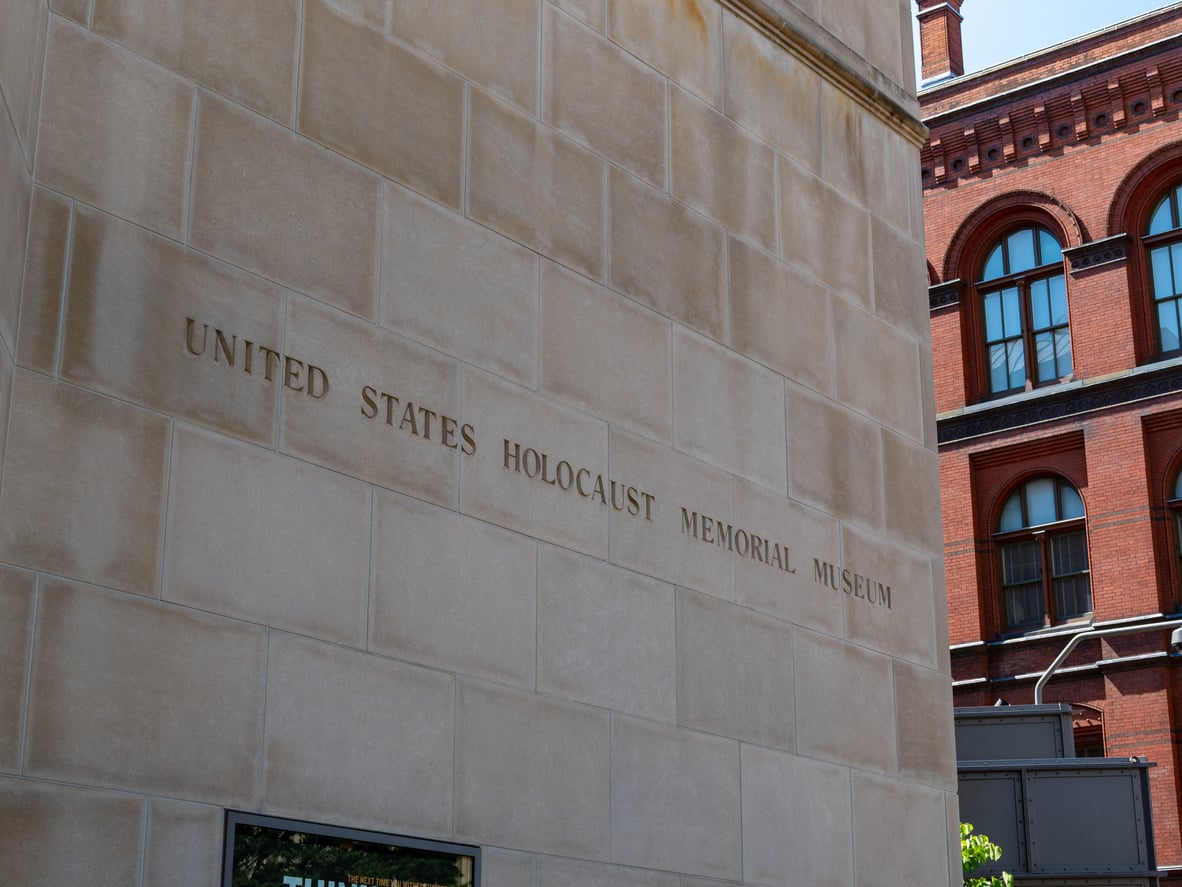
Another activist group similarly poised to disrupt curricula, the Genocide and Holocaust Studies Crisis Network, accuses Israel of genocide in Gaza, excoriates Yad Vashem and the US Holocaust Memorial Museum in Washington, DC, and promises to “provide new resources and syllabuses.”
The Crisis Network and its “allies” called on universities to reject the widely adopted International Holocaust Remembrance Alliance’s working definition of antisemitism, an internationally recognized standard. They disingenuously condemned it as stifling free speech regarding Israel, even though IHRA explicitly states that “criticism of Israel similar to that leveled against any other country” is not antisemitic. Notably listed in IHRA’s examples of antisemitism: “Drawing comparisons of contemporary Israeli policy to that of the Nazis.”
Among the 1,100 signatories of the Crisis Network’s petition are members of an academic group that attacked the work of a Massachusetts state commission on combatting antisemitism; alongside other objections, they lashed out at the commission because it rebuked the state teachers’ union leadership for providing its members a list of resources with an overwhelmingly demonic portrayal of Israel, Zionism, and Jews.
Significantly, the academic group called for a commission-proposed state Advisory Council on Holocaust and Genocide Education to “include scholars across the whole range of Genocide Studies, including an expert on the Palestinian people of Gaza” and pressed for the right of Massachusetts educators to teach about genocide, the Holocaust and antisemitism “without the threat of punishment.” These same academics endorsed the widely discredited International Association of Genocide Scholars resolution, which accused Israel of genocide while ignoring steps Israel took to reduce casualties such as forewarning Gazan civilians of strikes.
Opportunities to Exploit the Holocaust
Those are deeply troubling signs for already vulnerable Massachusetts schoolchildren. Students there have reported being exposed to content and curriculum containing “inaccurate, decontextualized, and harmful material regarding Israel and the Jewish people,” according to the antisemitism commission’s final report, and the term “Zionist” has been used harassingly “as a replacement slur for ‘Jew.’”
But the state’s genocide education law itself lacks adequate safeguards to protect students from corrupt curricula: It allows school districts to partner with “community-based” organizations in developing and implementing genocide-education programming, and even encourages such collaborations through the grants process — an ideal opening for those aiming to insert falsehoods into impressionable youngsters’ lessons.
Compounding those concerns is the latitude US teachers have over selection of classroom materials within a very locally controlled educational system. That autonomous structure makes it easier for Holocaust inversion to be platformed under the guise of human rights, including in professional development by contract providers, said Marci Lerner Miller, director of legal investigations at The Louis D. Brandeis Center for Human Rights Under Law.
And with TikTok often the sole news source for a young generation that has scant knowledge of the Holocaust, genocide, or the situation in Israel, any distorted curricula on these subjects likely would go unchallenged, Robert Rozett, senior historian emeritus at Yad Vashem, told me. The prospect of Holocaust inversion gaining a credible foothold in classrooms represents part of what he terms “a terrible crisis in education”: the loss of “evidence-based analysis,” with bias being the prism through which more people seek to understand all matters.
Without meticulous vetting and established guardrails to ensure that lessons — for students and teachers — are accurate, genocide education will accelerate the antisemitism it is meant to curb. That Holocaust survivors are expressing alarm over their experiences being hijacked to propagandize children adds to the urgency regarding this necessary remedial work in education.
Rabbi Joseph Polak, imprisoned in the Westerbork and Bergen-Belsen concentration camps as a very young child, is among the last living cohort to have borne witness to the barbarities that resulted in six million Jews slaughtered. He views protecting the historical record as a broad civic mandate to build an informed, rather than indoctrinated, citizenry.
“Part of a civil society is to know what’s true,” said Polak, an author and adjunct assistant professor of health law, ethics and human rights at the Boston University School of Public Health. “Schools should not pollute minds; schools should give kids skills so they can go through life and create a civil society. Without truth, it’s creating a society that thinks it’s at a football game and cheers for its favorite team.”
Hints of this worrisome trajectory already had emerged decades ago, prompting my parents then to engage with students when schools reached out. But such endeavors are no match for today’s well-oiled propaganda machine. As we commemorate Yom HaShoah and honor the memory of those who perished, we must commit to vigorously challenge this erosion of truth. Our success in doing so will be consequential to future generations of students, educators, and ultimately, our leaders.