
An Aging Jewish Feminist
Do Not Pardon the Sinner: Parshat Va-Yishlach
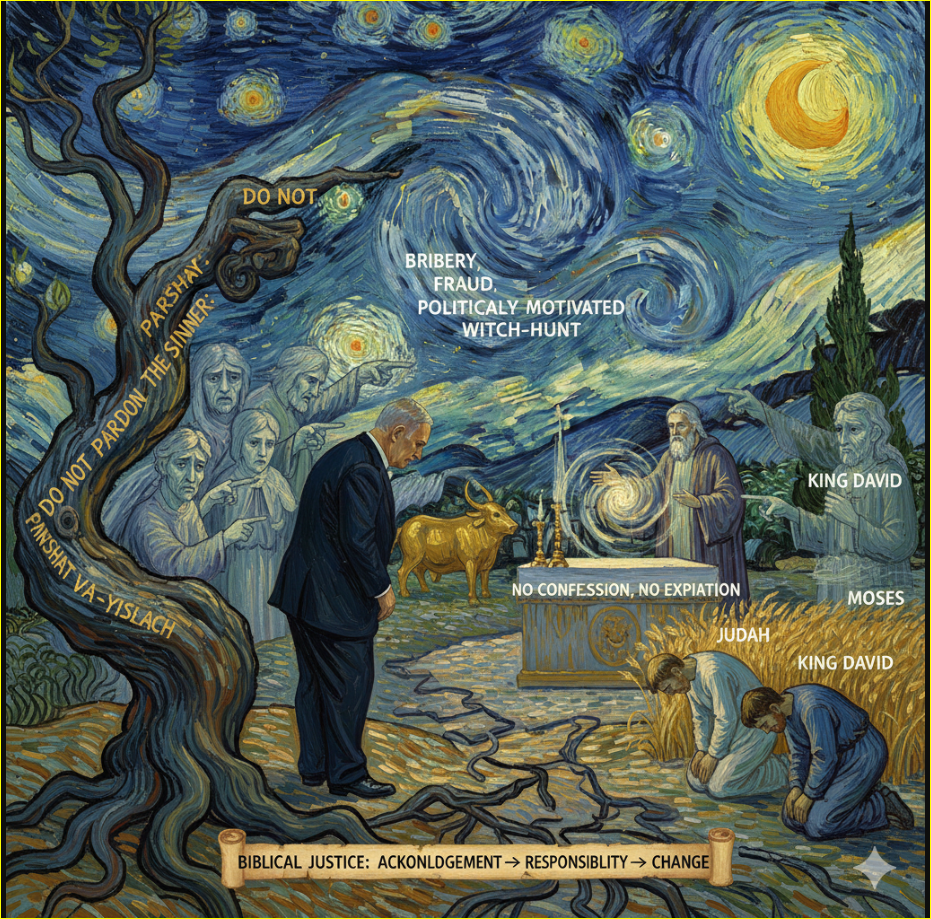
The Prime Minister of Israel is seeking a presidential pardon despite his denying wrongdoing, citing national interest. Netanyahu, charged with bribery, fraud and breach of trust, claims it is a politically motivated witch-hunt. Critics argue that his request implies guilt and threatens the rules of law. So far, he has maintained that he is innocent, has refused to resign, and has shown no willingness to admit guilt.
The Torah sets out a clear path in which forgiveness follows acknowledgment of wrongdoing, not the other way around. In Leviticus 5, the procedures for a guilt offering (asham) repeatedly emphasize that a person who has committed a trespass—whether knowingly or unwittingly—must first recognize guilt, then make restitution or reparation, and only then may the priest perform the ritual that brings expiation, forgiveness and pardon.
The priest cannot simply erase the moral ledger on behalf of an unrepentant person.
When a person commits a trespass, being unwittingly remiss about any of the Lord’s sacred things: One shall bring as a penalty to the Lord a ram without blemish from the flock, convertible into payment in silver by the sanctuary weight, as a guilt offering. That person shall make restitution for the remission regarding the sacred things, adding a fifth part to it and giving it to the priest. The priest shall make expiation with the ram of the guilt offering on behalf of that person, who shall be forgiven. And a person who, without knowing it, sins in regard to any of the Lord’s commandments about things not to be done, and then realizes guilt: Such a person shall be subject to punishment. That person shall bring to the priest a ram without blemish from the flock, or the equivalent, as a guilt offering. For the error committed unwittingly, the priest shall make expiation on behalf of that person, who shall be forgiven. It is a guilt offering; guilt has been incurred before the Lord. the Lord spoke to Moses, saying: When a person sins and commits a trespass against the Lord —by dealing deceitfully with another in the matter of a deposit or a pledge, or through robbery, or by defrauding another, or by finding something lost and lying about it; if one swears falsely regarding any one of the various things that someone may do and sin thereby— when one has thus sinned and, realizing guilt, would restore either that which was gotten through robbery or fraud, or the entrusted deposit, or the lost thing that was found, or anything else about which one swore falsely, that person shall repay the principal amount and add a fifth part to it. One shall pay it to its owner upon realizing guilt. Then that person shall bring to the priest, as a penalty to the Lord, a ram without blemish from the flock, or the equivalent, as a guilt offering. The priest shall make expiation before the Lord on behalf of that person, who shall be forgiven for whatever was done to draw blame thereby (Leviticus 5: 15-26).
President Isaac Herzog today is like the priest of ancient times. He has to make a decision. But he can only expiate/pardon the person for his sin, if that person realizes his sin and guilt and admits to it. Without bringing a guilt offering to the priest, he cannot forgive, i.e. pardon the sinner. Netanyahu is trying to get away with his “trespasses”, his being remiss about his responsibilities as leader. He is on trial and not willing to admit to guilt and wants to be pardoned.
PARSHAT VAYISHLACH
A similar principle appears in this week’s parsha. After Simeon and Levi destroy an entire town in response to Dinah’s rape, Jacob confronts them with the moral and practical gravity of their actions. Yet they refuse to express remorse; they justify themselves instead. Their refusal to accept responsibility leaves us with unresolved questions about the (im)morality of their act.
On the third day, when they were in pain, Simeon and Levi, two of Jacob’s sons, brothers of Dinah, took each his sword, came upon the city unmolested, and slew all the males. They put Hamor and his son Shechem to the sword, took Dinah out of Shechem’s house, and went away. The other sons of Jacob came upon the slain and plundered the town, because their sister had been defiled. They seized their flocks and herds and asses, all that was inside the town and outside; all their wealth, all their children, and their wives, all that was in the houses, they took as captives and booty.
And note their reaction when they are confronted by their father who says:
“You have brought trouble on me, making me odious among the inhabitants of the land, the Canaanites and the Perizzites; my fighters are few in number, so that if they unite against me and attack me, I and my house will be destroyed.”
They answered, “Should our sister be treated like a whore? (Genesis 34)
They have an opportunity to admit guilt, to expiate their sin, yet they refuse to admit their culpability by justifying their act. We have seen this behavior throughout Netanyahu’s tenure as prime minister. He constantly justifies his acts, belittles the accusations and claims that there is a deep state against him. His hypocrisy, and his getting away with it for so many years is amazing. He may be following many of our biblical characters, who when facing a moment where they could admit wrongdoing, restore trust, and repair relationships, instead justify themselves, deflect blame, or deny responsibility. Here are a few examples:
- Adam and Eve (Genesis 3): When God confronts Adam about eating from the forbidden tree, he does not admit fault. He blames Eve: “The woman whom You put here with me—she gave me of the tree, and I ate.” Eve also deflects: “The serpent deceived me, and I ate.” Instead of acknowledging wrongdoing, each one blames someone else.
- Cain after murdering Abel (Genesis 4): God asks Cain, “Where is your brother Abel?” Cain replies: “I do not know. Am I my brother’s keeper?” He does not confess; he hides the truth and justifies his denial with sarcasm.
- Pharaoh in Exodus: Pharaoh repeatedly hardens his heart and justifies his refusal to release the Israelites—even after admitting momentarily, “I have sinned this time.” But even those brief admissions lack genuine repentance..
- Aaron and the Golden Calf (Exodus 32): When Moses confronts Aaron about the golden calf, Aaron gives an evasive and implausible explanation: “I threw the gold into the fire and out came this calf!” He avoids admitting his serious leadership lapse. Aaron’s refusal to acknowledge responsibility nearly leads to the destruction of the people. Yet, like our prime minister, he gets away with it; and is even known as the great peacemaker!
In each case, a wrongdoing occurs; The person is confronted. Instead of admitting guilt, the person deflects, justifies, or reframes the action as righteous or unavoidable, and the consequences intensify. Biblical justice requires transparency, confession, and accountability before any form of absolution can occur. A society cannot grant meaningful forgiveness where there has been no admission of wrongdoing. To pardon without repentance is not mercy, but a distortion of justice.
COUNTEREXAMPLES
The Bible also provides powerful counterexamples—stories in which individuals do confront the truth of their deeds. These moments of honest self-recognition open the door to forgiveness, transformation, and renewed relationship. They establish the biblical ideal of teshuvah (repentance): acknowledgment → responsibility → change. Some of the examples that come to mind are:
- Judah in the story of Tamar (Genesis 38): When Tamar presents evidence that Judah is the father of her child, Judah publicly admits his wrongdoing: “She is more righteous than I.” He confesses that he failed in his obligations to her. Later, Judah becomes the brother who offers himself in Benjamin’s place (Genesis 44), proving that awareness of sin leads to transformation. Thus Judah becomes the ancestor of Israel’s kings (David) precisely because he learned to confront his deeds.
- King David after Nathan’s rebuke (2 Samuel 12): When the prophet Nathan confronts David about Bathsheba and Uriah, David does not justify himself. He responds immediately: “I have sinned against the Lord.” This is a direct acknowledgment of sin without an excuse. David’s willingness to face his sin preserves his relationship with God and maintains the Davidic covenant—though there are still consequences.
- Moses after the striking-the-rock incident (Numbers 20): Though Moses does not verbally confess in the narrative, he accepts God’s rebuke and consequences without protest. It is an example of accepting responsibility even in silence. This implicit admission of guilt, allows him to continue to be the leader of the people.
It is time for our prime minister to “man up” and admit to his wrongdoings. If not, he has no right to ask for pardon. Our president is not obliged to pardon him. To do so would be a clear travesty of justice. If President Herzog gives Netanyahu a pass on a trial, he’ll further damage Israeli democracy. He’d be validating all the shady political bullying and criminal stunts, and giving politicians even more permission to control our government institutions. By pardoning him, he will be signing up for the Netanyahu way of thinking: Might makes right, forget the rules! This won’t just be a mistake on his part, but a huge, historic betrayal.”
Shabbat shalom.
Related Topics