Does anyone still read newspapers today? About the Independent Media Conference
On Friday, January 30, I went to the all-day “Independent Journalism Conference: The Struggle for Truth in the Age of Social Media” held at Beit Ariella, the main Tel Aviv municipal library. I thought I would just stay for a while, but in the end stayed for all of the plenaries from 9 a.m till 2 p.m. because they were so interesting and relevant to the challenges we are all facing today. They included sessions on “The battle for truth in social media: How do we agree about the facts in a reality of polarization and incitement? ” (which dealt with the problem of the proliferation of “fake news”), “Is the Israeli media still the watchdog over Israeli democracy?”, “Behind the scenes of the Qatargate Scandal” and “The problem of self-censorship: How did the Israeli media cover Israel’s longest war?”
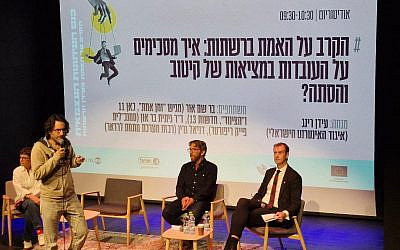
Panelists dealt with the fact that the Israeli government is trying to limit freedom of the press and to control it in the spirit of Likud Minister Miri Regev’s comment about how “it’s inconceivable that we’ll establish a corporation (for public TV and radio) that we won’t control. What’s the point?”, along with the attempt to arrange for friendly oligarchs to gain control of most of the electronic and print media. The playbook is clearly what Hungarian Prime Minister Orban has done in Hungary, and what President Trump is doing in the US Netanyahu is trying to gain control over the Israeli media in the same way. That is one of the topics that his ongoing trial deals with.
When it comes to the question of fake news, the Israeli right has a team of people constantly promoting fake news, which a significant minority of the Israeli public believes. TV Channel 14, which originally got its license to be a station devoted to Jewish Heritage, ended up being a vehicle simply for the distribution of right-wing propaganda, with no connection to what journalism is supposed to do. One example that was cited is the claim that the Biden government donated millions of dollars to anti-government protests. Personally I was once asked by a taxi driver how much I was paid to go to the protests! There was a warning that there will be a lot of fake news promoted by fictitious bots as the election campaign draws near. And there is a need to identify it and to know how to counteract it.
Another observation at the conference was that the younger generation in Israel (and in much of the world), people under 30, no longer read newspapers or watch TV news, and get all of their information from social media, particularly Instagram and TikTok. I know that when I take the train from Tel Aviv to Jerusalem, I am the only one who takes out and reads a physical newspaper. Everyone else is either on their laptop or their mobile phone.
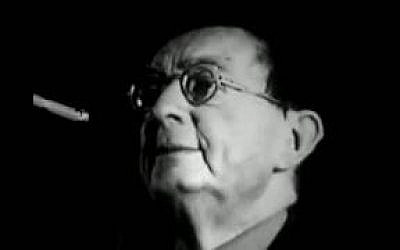
As a journalist, my mentor and role model for what it means to be a good journalist is the legendary I.F. Stone, the American journalist who after years in the progressive American media published his own I.F. Stone’s Weekly from his home in Washington DC from 1953 to 1971. He believed in what he called “critical reading” as a key to understanding what was happening around the world and reporting on it. Reading what is called today “open source” material that is available in all the major media, both to be a good journalist and as a reader, to gain an understanding of developments. https://en.wikipedia.org/wiki/I._F._Ston
Following that approach, I receive and read on a daily basis the Israeli daily Ha’aretz and the International Edition of The New York Times, and on weekends the Yediot Ahronot and Ma’ariv dailies, and also periodically look at the right-wing Adelson-run freebee Yisrael Hayom. Today this is also reinforced by select webinars, Zoom discussions and Substacks. If the younger generation only gets it’s information via Instagram and TikTok, I really wonder how it’s understanding of the world is formed.
When it comes to the question of self-censorship, it was mentioned that although there are approximately 7 million Jewish Israelis and 7 million Palestinians “between the river and the sea”, the overwhelming majority of the Israeli media just covers the Jewish Israelis, and the Palestinian voice and reality is simply not heard and seen. And then the average Israeli wonders why there is so much anti-Israeli feelings around the world. They simply don’t see the images coming out of Gaza that most of the rest of the world sees. The only exceptions to this situation that were described were the liberal daily Ha’aretz and the Hebrew on-line Sicha Mkomit (Local Conversation) associated with +972. It was noted that Yuval Abraham, who has done some important investigative work for Sicha Mkomit about the procedures of the IDF during the Gaza war, won the Oscar for co-directing the film “No Other Land”. And longtime Ha’aretz Jerusalem correspondent Nir Hasson described how he became the correspondent for humanitarian affairs in Gaza during the war, and how difficult it has been to rely only on WhatsApp conversations with Palestinian sources in Gaza, since the government has not allowed Israeli or foreign correspondents to enter Gaza unless they are embedded with IDF units, supposedly for their own protection. Both the Israeli Journalists Union and the Foreign Press Association have applied to the Israeli Supreme Court to allow them to cover the reality in Gaza, and a decision has been delayed for another two months to allow the Israeli government to respond to the petition.
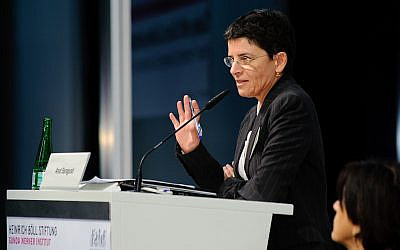
Anat Saragusti, who as Chair of the Freedom of the Press department of the Union of Israeli Journalists, one of the sponsors of the conference, noted that she began her career in journalism with Uri Avnery’s maverick, independent weekly Haolam Hazeh (This World). She recalled that it’s masthead contained the phrase “Without fear, without prejudice”. And she concluded that is what Israeli journalism and Israeli journalists need today.