
From Kibbutz to the global stage
Does Copper Scroll Section 46 Describe the Ramat Rachel Mystery Tunnel?
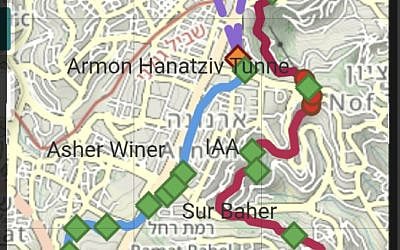
The GIS map shows the Upper Aqueduct (blue, 770–780 meters above sea level) and the Lower Aqueduct (red, approximately 750 meters above sea level), forming a broader spatial envelope around Ramat Rachel. The tunnel discovered in May 2026 is located northeast of the palace complex, below the letter “U” in the Sur Baher label on the map, near the northern convergence of the system.
Does Section 46 of the Copper Scroll Describe the Giant Tunnel Discovered at Ramat Rachel in May 2026?
Section 46 of the Copper Scroll refers to Beit HaKerem, identified by a number of scholars with present-day Ramat Rachel. Could its description correspond to the giant tunnel discovered north of Kibbutz Ramat Rachel in May 2026?
During July, we published two articles presenting a research hypothesis that may lead to a reassessment of the water systems at Ramat Rachel and in the Judean Desert. In my more recent articles, published in August, I introduced new hypotheses concerning the Copper Scroll as well.
As Prof. Yoav Sagi noted in a Yad Ben-Zvi podcast, ancient water engineers were the “high-tech” experts of their time. Water was the most critical resource for survival, and according to the hypothesis proposed here, groups associated with the Bar Kokhba Revolt may have seen a need to preserve their infrastructural knowledge by inscribing it on copper for future generations.
The hydro-engineering hypothesis I propose does not claim to provide a complete solution to the mysteries of the Copper Scroll. Rather, it offers a conceptual breakthrough intended to stimulate scientific and public discussion and open new avenues of investigation.
In this article, I point to a possible correspondence between Section 46 of the Copper Scroll and the water infrastructure of biblical Beit HaKerem — a site identified by archaeologists, including Prof. Yohanan Aharoni, with the palace complex at Ramat Rachel. Beit HaKerem is mentioned in Jeremiah 6:1 as a location for raising a signal.
Section 46 of the Copper Scroll
Section 46 of the Copper Scroll (Column 10) states:
“Ba-ashuah she-Beit HaKerem, bevo’akha li-smolo, amot eser, kesef kikkarin shishim u-shnayim.”
This text may perhaps be read as a navigational and engineering specification for water infrastructure at the site:
“The Ashuah”: In the interpretation proposed here, and on the basis of biblical parallels, the term Ashuah may refer to a substantial rock-cut water installation — a storage tunnel or administrative reservoir designed to regulate runoff ( Silver) — rather than an ordinary domestic cistern.
“When you come to its left”: This may indicate a defined entrance and an organized approach. Descending northeast from the Ramat Rachel palace complex leads toward the tunnel entrance, which lies to the left.
“Ten cubits”: Ten cubits are equivalent to approximately 4.5–5 meters — a measurement that closely corresponds to the excavators’ estimate of the height of the chamber.
“Sixty-two talents of silver”: According to the model proposed in my previous articles, 62 talents represent a water volume of 620 cubic meters, based on the hypothesis that one unit in the Scroll corresponds to 10 cubic meters.
A planned net volume of approximately 620 cubic meters is compatible with the Ramat Rachel excavators’ estimate of a gross excavated volume of approximately 750 cubic meters for the giant tunnel discovered in early May 2026 north of Ramat Rachel — even before the accumulated sediment inside the tunnel has been removed.
At the same time, a new interactive map of Jerusalem’s ancient aqueducts, prepared by Avi Kleiman and updated in July 2026, shows the Upper Aqueduct at approximately 770–780 meters above sea level passing around Ramat Rachel from the west, while the Lower Aqueduct, at approximately 750 meters above sea level, passes around it from the east. The two systems come spatially close to one another to the north and south.
Four correspondences therefore deserve particular attention:
The dimensional correspondence: Ten cubits equal approximately five meters, closely matching the excavators’ estimate for the height of the Ramat Rachel chamber.
The volumetric logic: Approximately 620 cubic meters of proposed net water capacity versus approximately 750 cubic meters of gross excavated volume.
The spatial topography: The spatial convergence of the Upper and Lower Aqueducts may support the hypothesis of a broader water-system envelope surrounding Ramat Rachel.
The type of water: Kesef (“silver”), according to the proposed model, represents runoff or floodwater — consistent with the proposed function of the tunnel as a facility for collecting, regulating and storing surface runoff.
The conclusion is that the internal excavation and clearing of the tunnel north of the kibbutz should be advanced as soon as possible. Exposing its entrances, exits, internal levels and possible connections could allow researchers to examine whether — and how — the tunnel functioned as an anchor for water regulation and storage within a broader system surrounding the hill.
Related Topics
Related Posts