
Don’t Be Too Late: A Plea to Help the People of Iran
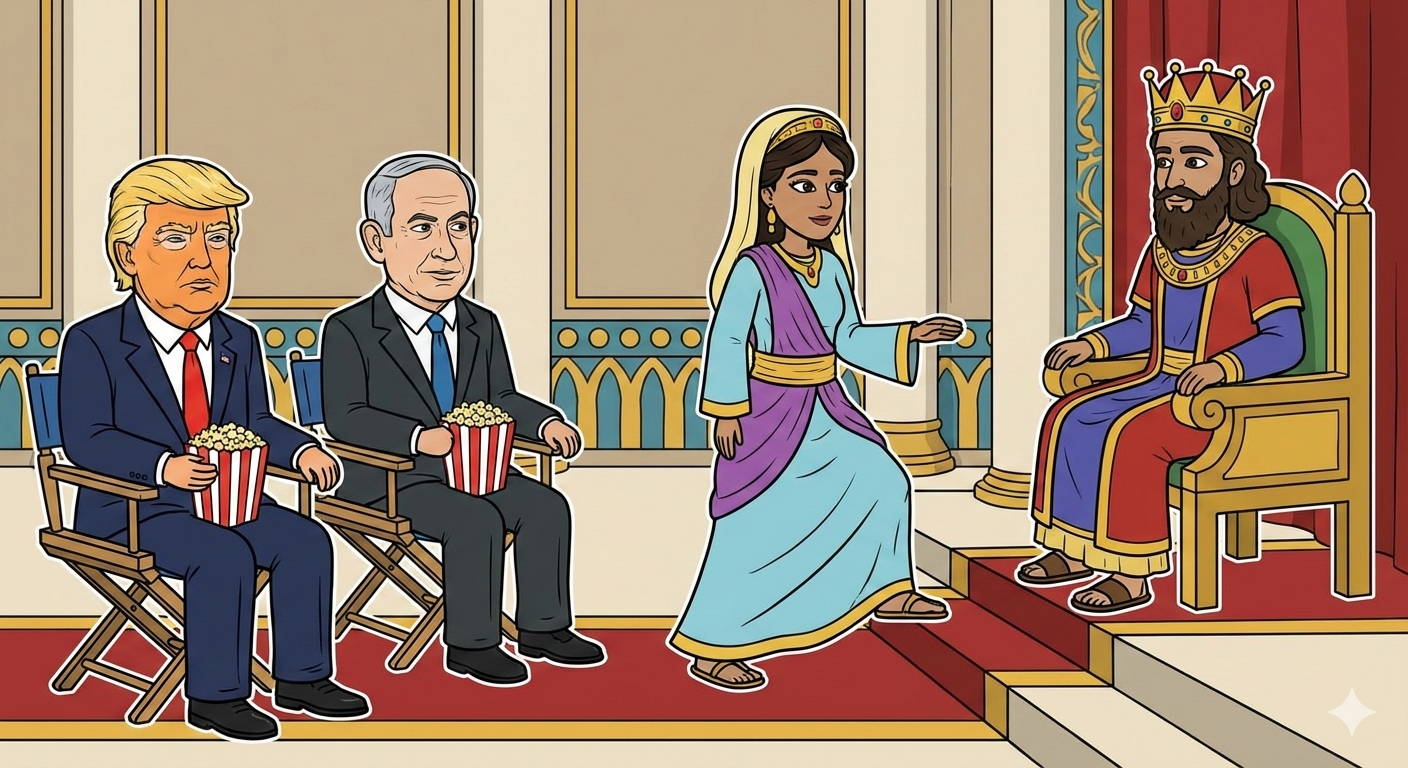
In March 2013, at Israel’s Yad Vashem Holocaust Memorial, Rabbi Israel Meir Lau shared a powerful story with President Barack Obama. He recounted meeting Leo Hymas, one of the American soldiers who liberated Buchenwald concentration camp where the young Rabbi Lau had been imprisoned. Decades after that liberation, Hymas, with tears in his eyes, told Rabbi Lau: “I asked permission to meet with you before I give my soul to the lord of the universe. I am asking you for forgiveness for being late. We came too late.”
Rabbi Lau then looked directly at President Obama and said: “Yesterday, Mr. President, you promised us that we are not alone. Don’t be too late.”
This plea echoes through the ages, resonating powerfully with another story of intervention and moral responsibility—that of Queen Esther. When Mordechai urged his cousin to use her royal position to save the Jewish people from annihilation, Esther hesitated, fearing for her own life. Mordechai’s response was both a challenge and a call to conscience: “Do not think that you will escape the fate of all the Jews by being in the king’s palace. For if you will remain silent at this time, relief and salvation will come to the Jews from another source, and you and the house of your father will be lost. And who knows if it is not for just such a time that you reached this royal position.”
The message was clear: help will come from somewhere—the question is whether history will credit you for using your power when it mattered most.
Today, the people of Iran face their own existential crisis. For weeks, thousands have taken to the streets protesting economic collapse, government oppression, and decades of abuse. The Iranian regime has responded with brutal force. While casualty figures vary—from approximately 2,000 according to Iranian officials to as many as 36,000 reported by opposition sources—what is undeniable is that the regime is killing its own citizens by the thousands.
Both Israel and the United States have promised to help.
On December 29, 2025, Israel’s Mossad issued an extraordinary public message in Farsi directly to Iranian protesters: “Go out into the streets together. The time has come. We are with you. Not just from a distance or through words. We are also with you on the ground.”
Days later, on January 2, 2026, President Donald Trump made an even more explicit commitment, writing on Truth Social: “If Iran shots and violently kills peaceful protesters, which is their custom, the United States of America will come to their rescue. We are locked and loaded and ready to go.”
These are not mere words of sympathy—they are promises of action. The Mossad’s message suggested operatives on the ground. Trump’s declaration that America is “locked and loaded” is unambiguous military language, indicating preparations are complete and weapons are ready for use.
The Iranian people heard these promises. They drew courage from them. They believed that this time would be different—that when they risked their lives for freedom, the free world would stand with them not just in words, but in deeds.
Yet as the death toll has climbed into the thousands, hopeless protesters are left wondering: Will these promises be kept? Or will history record another tragic case of help arriving too late—or not at all?
This moment represents more than a moral imperative—it is a strategic opportunity. Since the Islamic Revolution of 1979, the Iranian regime has not confined its tyranny to its own people. What began as brutal oppression at home metastasized into an existential threat to Israel and America. For decades, Iran has waged proxy wars through Hezbollah in Lebanon, Hamas in Gaza, the Houthis in Yemen, and militias in Iraq and Syria. Iran has directly attacked American forces, Israeli territory, and shipping in international waters. The regime that kills its own citizens by the thousands is the same regime working relentlessly toward nuclear weapons capability to threaten the very existence of Israel and America.
History teaches us that tyranny never remains contained. A regime that brutalizes its own people will inevitably turn that violence outward. The Islamic Republic has proven this truth for 47 years. Helping the Iranian people overthrow this evil regime is not charity—it is self-defense. It is the rare convergence of moral duty and strategic interest, where doing the right thing also serves vital national security objectives.
An open window now exists. The Iranian people are rising. The regime is vulnerable. The infrastructure for change is forming in the streets of Tehran, Isfahan, and Mashhad. Supporting this movement costs infinitely less in blood and treasure than decades more of proxy wars, terrorism, nuclear brinksmanship, and regional instability. This is the moment when relatively modest support for the Iranian resistance could accomplish what no amount of sanctions, military strikes, or diplomatic pressure has achieved—the removal of the world’s leading state sponsor of terrorism.
The parallel to Rabbi Lau’s story is haunting. American soldiers did liberate Buchenwald, but Leo Hymas carried the weight of arriving too late to save millions. He could never forgive himself for the delay, even though the liberation he participated in saved thousands, including young Rabbi Lau himself.
Similarly, Esther could have remained silent in the palace. Mordechai told her that deliverance would come from another source if she did nothing. But her legacy—indeed, the entire celebration of Purim—exists because she chose to act when it mattered, using her position to save her people at great personal risk.
The people of Iran are fighting for their freedom against one of the world’s most brutal regimes. They are not asking us to fight their battle for them—they are doing that themselves with extraordinary courage. They are asking us to keep our promises. To provide the support we said we would. To ensure that when this chapter of history is written, we will not be the ones asking for forgiveness for being too late.
Israel and America have the power to help. The question Mordechai posed to Esther now confronts both nations: “Who knows if it is not for just such a time as this that you reached this position?”
The Iranian people will be rescued—if not by us, then from another source, through their own determination and sacrifice. But let us not be absent from this moment. Let us not arrive too late. Let history record that when freedom called, when people risked everything for liberty, and when our own security interests perfectly aligned with justice, the free world stood with them.
Don’t be too late.