
The views expressed herein are solely mine.
Don’t Bet on Spain’s Right to Fix Ties With Israel
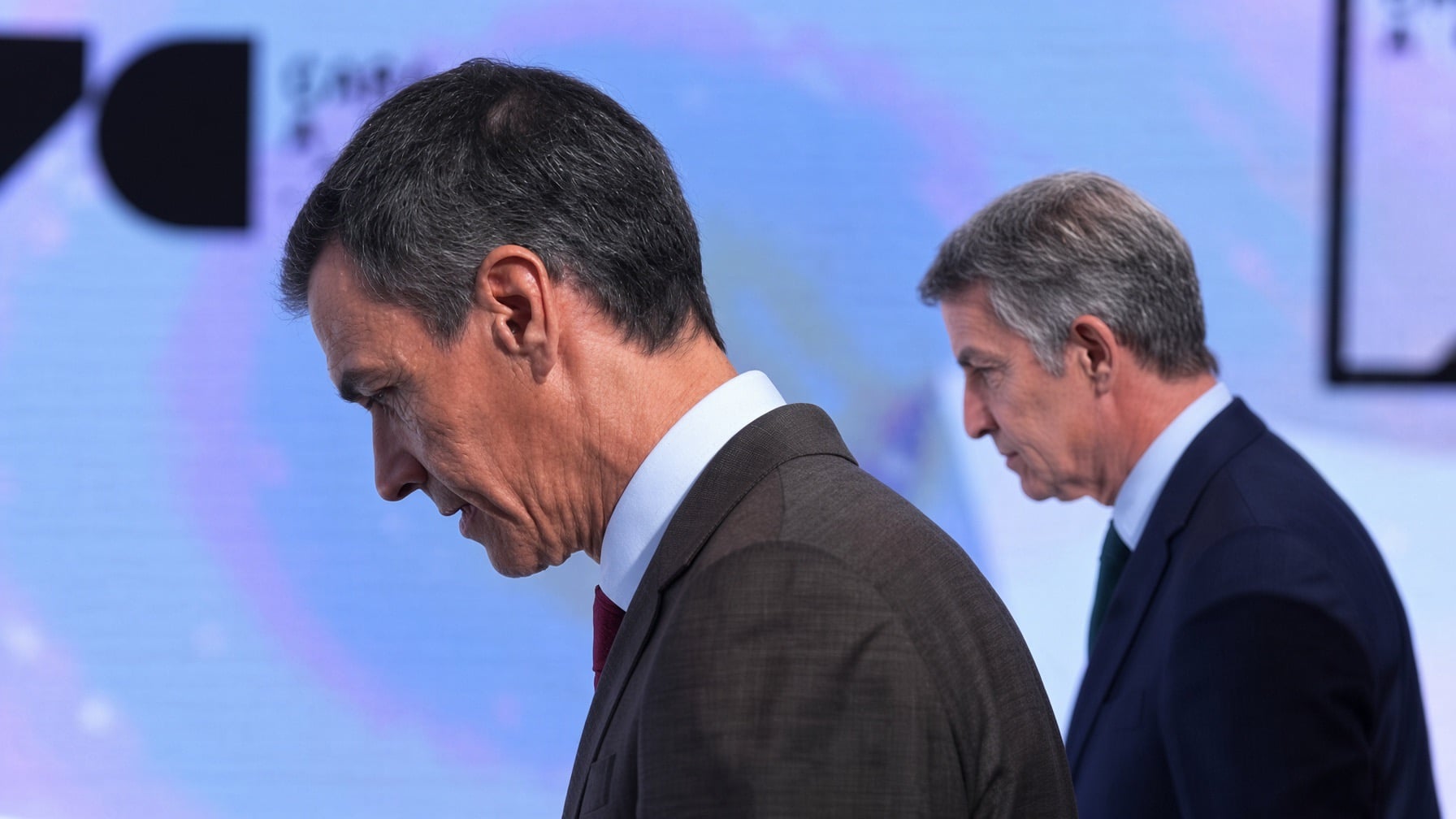
Spain’s Prime Minister Pedro Sanchez (L) and Popular Party candidate Alberto Nunez Feijoo stand together at the start of a live televised debate in Madrid, Spain, November 19, 2026. (AP Photo/Manu Fernandez).
Wishful thinking is a poor substitute for strategy, yet many in Washington and Jerusalem treat Spain’s November 29, 2026 election as a silver bullet. Even if Santiago Abascal’s conservative Vox and Alberto Núñez Feijóo’s center-right People’s Party win enough seats to oust Prime Minister Pedro Sánchez, celebrations will be premature. Ousting Sánchez may end Madrid’s anti-Israel theatrics, but it will not automatically shift foreign policy in a country where 85% of citizens believe Israel is committing “genocide” in Gaza.
At first glance, the prospective coalition’s rhetoric looks promising. For a long time, Abascal voiced explicit support for Israel; shortly after Sánchez recognized a fictitious Palestinian state in 2024, he visited Jerusalem, met Prime Minister Benjamin Netanyahu, and pledged that a Vox-led government would reverse the move. Feijóo has been more measured, criticizing civilian casualties in Gaza without adopting the “genocide” framing while favoring Atlanticism and restored ties with Washington and Jerusalem over isolation. Still, neither leader has translated these postures into firm campaign commitments to lift the arms embargo or restore canceled military contracts.
Behind this hesitation is a clear cooling in Vox’s public line since Abascal’s 2024 meeting with Netanyahu. That shift tracks the influence of El Toro TV, the channel whose staff founded Vox and that remains the main platform shaping the party in its current form. Within its orbit, El Yunque and Falangista currents—heirs to the Spanish fascist movement José Antonio Primo de Rivera founded in the 1930s—have amplified skepticism of American and Israeli priorities, narrowing the space for Abascal’s sharper rhetoric. Appearing mid-campaign on the popular left-leaning TV show La Revuelta, Abascal defended parts of Israel’s military response while conspicuously dialing back his earlier, full-throated support. Vox’s leader calculated the pivot to court younger right-wing voters who, much like the Spanish left, harbor little sympathy for Israel.
Nor can Israel expect bold leadership from Feijóo’s People’s Party. Whereas José María Aznar’s 2003 decision to join the U.S.-led coalition in Iraq proved that a Spanish center-right government could prioritize the Atlantic alliance over European caution, today’s People’s Party lacks that nerve. Indeed, with senior figures like Cuca Gamarra openly praising the U.S. Democratic Party and Kamala Harris, the Popular Party’s foreign-policy instincts mirror Washington’s Democrats: formally Western, operationally cautious, and unwilling to absorb political costs on the Jewish state’s behalf.
Should a People’s Party–Vox coalition take power, Jerusalem must treat it as a continuity problem rather than an automatic opportunity. Five lines of action should guide Israeli policy going forward.
First, Jerusalem must deepen direct channels with principled Spanish right-wing figures who break from the Popular Party’s “European consensus.” Deputy Cayetana Álvarez de Toledo’s record of defending liberal constitutionalism in Latin America against populism and separatism gives her rare standing within her party. Madrid’s regional president, Isabel Díaz Ayuso, has similarly broken ranks by consistently defending Israel. To align with her focus on attracting capital and expanding healthcare capacity, Jerusalem should offer the Community of Madrid an economic package centered on joint hospital technology, medical-device investment, and dual-use health infrastructure.
Simultaneously, Israeli officials must rebuild ties with presumptive Vice President Santiago Abascal and his longtime advisor, Kiko Méndez-Monasterio—the hard-nosed realist behind Abascal’s every political move. Cultivating these figures will create internal pressure points that formal diplomacy alone cannot match.
Second, Jerusalem must push to revive canceled defense contracts Spanish forces urgently need. Sánchez scrapped the €287.5 million Spike LR2 program—168 launchers and 1,680 fifth-generation anti-tank missiles slated for licensed production by Rafael’s subsidiary, Pap Tecnos, for the Army and Marine Corps—leaving units with obsolete hardware and eroding allied interoperability. Madrid likewise canceled the €700 million SILAM rocket-launcher program, built around Elbit’s PULS system. Pre-election reports from November 23, 2026, confirm SILAM remains paralyzed—stripped of its original design and without a timeline—despite being ready for live-fire tests before the veto. Spanish artillery now lacks modern mobile precision fire just as Moroccan rearmament accelerates and hybrid threats to Ceuta and Melilla mount. Restoring both contracts returns workshare to Spanish firms, salvages training pipelines, and closes capability gaps European substitutes cannot fill on schedule.
Third, Israel must offer to pivot as a practical bridge to end Spain’s NATO ‘pariah’ status while accommodating Moroccan sensitivities. While the annual African Lion exercises already include American and Moroccan forces, Spanish participation remains politically constrained. A discreet, technical arrangement focused on counter-drone defense, coastal surveillance, and rapid-reaction coordination—directly bolstering Ceuta and Melilla—would let Madrid join a premier U.S.-led drill without a public diplomatic reset with Rabat or forcing Israel to take sides on Western Sahara.
Fourth, Israeli intelligence should help the incoming government rebuild the Centro Nacional de Inteligencia (Spain’s intelligence services) after the July 30–31, 2026 Ceuta disaster and recover the full Pegasus records from Pedro Sánchez’s Morocco-hacked phone. Since the Sánchez regime took power in 2018, officers have called the service “politically colonized.” Discreet Israeli support on hybrid migration threats and border early-warning systems would restore professional capacity without fanfare, while authenticating the complete Pegasus archive would expose foreign leverage and clear the path for reform.
Fifth, if the new coalition delivers no real shift on Israel, Jerusalem should appeal to creative measures through Catalonia’s pro-independence right. Out of power, Spain’s far left will stay mobilized to deflect from its massive debt, deficit, corruption scandals, and ties to EH Bildu—the political heir to the Basque terrorist group ETA, dissolved in 2018 after killing hundreds. Replicating its “Maricarmen” eviction playbook—blaming its own housing failures on the opposition—the left will weaponize street protests to destabilize the government, sparking chaos that Catalan separatists will exploit. Israel can thus leverage this turmoil by cultivating Catalonia’s nationalist right through quiet academic and cultural exchanges on minority-language preservation and federal models, while amplifying voices that reject both Madrid’s centralism and radical secession. Backing economic ideas that reduce Catalan reliance on central transfers builds durable leverage without requiring public alignment or endorsing independence.
Although this election might end Pedro Sánchez’s premiership, it will not erase the institutional and domestic constraints that have defined Madrid’s posture toward Israel since 2024. Serious statecraft means abandoning wishful thinking and maximizing the limited leverage that actually exists.
Related Topics
Related Posts