Don’t Let ‘Islamophobia’ Shut Down the Argument!
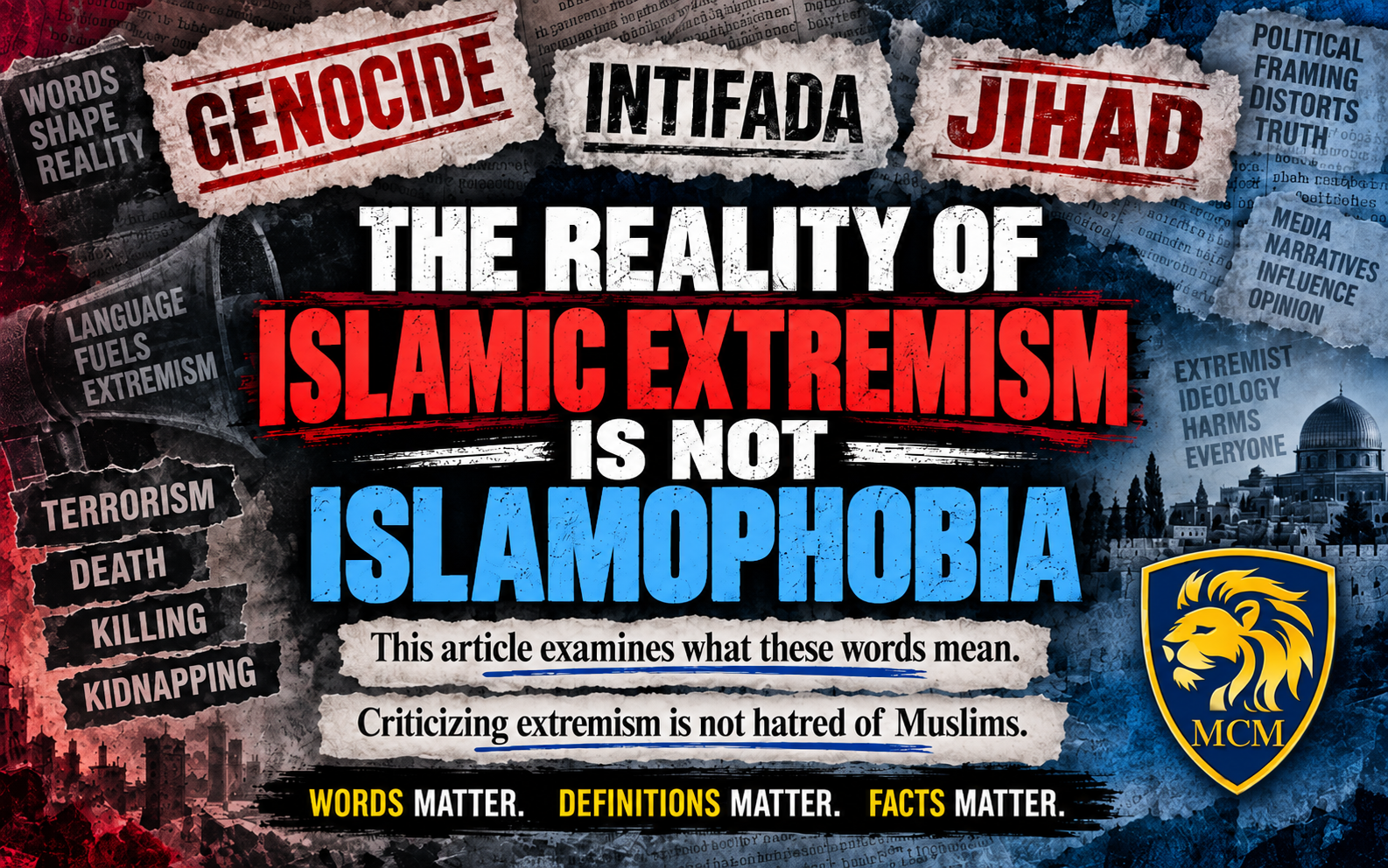
Words matter. So do definitions, history, context, and who is teaching us what those words mean.
There is an important difference between irrational fear and rational concern.
A phobia is generally understood as an irrational or excessive fear. But fear can also come from experience, history, evidence, violence and observable threats.
That distinction matters when we use the word Islamophobia.
Hatred or discrimination against Muslims because they are Muslim is wrong. Treating an entire religious community as responsible for the actions of extremists is wrong.
But criticism of Islamist extremism is not automatically Islamophobia.
Concern about jihadist terrorism is not automatically Islamophobia.
And calling an argument “Islamophobic” does not answer the argument.
We Need to Start With Definitions
Islam is a religion practiced by nearly two billion people.
A Muslim is someone who follows Islam.
Islamism is different. It generally refers to political movements seeking to organize government and society according to a particular interpretation of Islamic law or political ideology. Not every Islamist advocates terrorism.
The same distinction applies to jihad, which has several meanings within Islam, including spiritual struggle.
But jihadism has developed a distinct modern political meaning describing extremist movements that justify violence in pursuit of ideological goals.
Al Qaeda, ISIS, Palestinian Islamic Jihad and Hamas are real. So was September 11, along with decades of suicide bombings, shootings, kidnappings and massacres.
Recognizing those facts does not require hostility toward Muslims. Indeed, Muslims themselves have been among the greatest victims of Islamist extremist violence.
We should be capable of holding two thoughts at the same time: anti-Muslim bigotry is real and should be opposed, and Islamist extremism is real and should be opposed.
The Threat Is Real
This distinction is not academic.
According to the 2024 study Islamist Terrorist Attacks in the World 1979–2024, published by France’s Fondation pour l’innovation politique, researchers identified 66,872 Islamist terrorist attacks worldwide between 1979 and April 2024, resulting in at least 249,941 deaths.
Because incomplete records make an exact count impossible, their broader estimate places the death toll between 300,000 and 400,000, with another 192,598 recorded wounded.
Those aren’t imaginary dangers.
Those aren’t phobias.
Those are dead and injured human beings.
But another statistic may be even more important.
The study found that 88.9 percent of recorded deaths occurred in countries it classified as Muslim countries. In other words, most people killed by Islamist terrorism have themselves been Muslims.
Islamist extremism is not simply Muslims attacking “the West.” Muslims themselves have borne an enormous share of its brutality.
The five deadliest organizations identified in the study were the Taliban, ISIS, Boko Haram, al-Shabaab and al-Qaeda. Together they accounted for more than three-quarters of the deaths recorded.
Opposing those movements is not anti-Muslim.
Their Muslim victims would be a strange group to describe as beneficiaries of our silence.
When “Islamophobia” Becomes a Conversation Stopper
The problem arises when Islamophobia stops being used to identify genuine prejudice and becomes a way of shutting down debate.
When a pro-Palestinian activist, DSA member, political candidate or anyone else responds to an argument simply by calling the speaker “Islamophobic,” that does not address the evidence.
If my facts are wrong, correct them. If my history is inaccurate, show me better history. If my reasoning is flawed, challenge it.
But attaching the word “Islamophobic” to me does none of those things.
Calling an argument Islamophobic does not answer the argument.
This matters when discussing Hamas, Palestinian Islamic Jihad, Hezbollah, Al Qaeda, ISIS or Iran’s network of proxies.
Criticism of those organizations is not criticism of every Muslim.
Yet in some corners of activist politics, criticism of Islamist ideology is treated as though it were an attack on Muslims as people.
I Am a Liberal. That Is Why This Bothers Me.
I am not writing this from the political right.
I am a liberal. I believe strongly in civil rights, minority rights, religious freedom and protection against discrimination.
Those values are exactly why liberals should confront religious extremism wherever we find it.
Religious fundamentalism does not become progressive because the fundamentalists are fighting people Western activists view as powerful.
Authoritarianism does not become liberation because somebody puts the word “resistance” in front of it.
Terrorism does not become progressive because its victims are Israelis.
And propaganda does not cease to be propaganda because those repeating it sincerely believe they are participating in a social justice movement.
I have watched slogans move through demonstrations, campuses and social media with extraordinary speed.
Soon they sound as though thousands of people independently reached the same conclusions and somehow chose the same vocabulary.
But sometimes the language arrives first.
Then people are taught what the language supposedly means.
The Genocide Accusation Appeared Almost Immediately
Consider the word genocide.
Genocide is an extraordinarily serious accusation involving intent to destroy, in whole or in part, a national, ethnic, racial or religious group.
It is not simply another word for war or civilian casualties.
Yet the accusation against Israel appeared with astonishing speed.
On October 7, 2023, Hamas began a war by invading Israel.
Thousands crossed the border from Gaza. A later Israeli military probe reported that roughly 6,000 Gazans crossed into Israel during the attack. Israeli civilians were being horribly murdered, kidnapped and brutalized while Israeli forces were still trying to regain control of their communities.
Yet by October 8, at a pro-Palestinian rally in Times Square, a demonstrator was already holding a sign declaring “Zionism is genocide.” The rally also included chants of “Globalize the Intifada” and “Resistance is justified.”
Think about that chronology.
Israel was still counting its dead. Families were still trying to determine who had been murdered, kidnapped or was missing. Israeli forces were still pushing attackers out of Israeli territory.
And Israel was already being described as genocidal.
Whatever one believes about particular Israeli military decisions in the war that followed, I reject the accusation that Israel has committed genocide in Gaza.
There was no genocide taking place on October 8, before or after. Israel had not launched a campaign to destroy the Palestinian people. It was still fighting the forces that had invaded Israel the previous day.
Nor do I believe the war that followed became genocide. A devastating war, enormous civilian suffering or even allegations of unlawful military actions do not by themselves establish an intent to destroy a people.
The genocide accusation appeared almost immediately and soon became one of the central organizing words of the movement.
Hearing “genocide” repeatedly creates an image that Israel simply decided one day to begin massacring Palestinians.
That erases what happened first.
Hamas invaded Israel.
Hamas murdered civilians.
Hamas kidnapped hostages.
Israel went to war against Hamas.
None of that means every Israeli military decision was correct or that Palestinian civilian suffering should be minimized.
But there is an enormous difference between arguing that Israel conducted parts of the war badly or even unlawfully and asserting that Israel launched a campaign whose purpose was to destroy the Palestinian people.
This Was Not the Vietnam Anti-War Movement
Students protesting Israel sometimes compare themselves to the anti-war students of the Vietnam era.
I lived through that era.
The comparison does not work very well.
The Vietnam anti-war movement developed over years as the war escalated, troop levels increased, draft notices arrived and casualty reports came home. Public opinion changed gradually, and protests grew in response to an unfolding war.
What happened after October 7 looked very different.
The political infrastructure and much of the language were ready almost immediately.
National Students for Justice in Palestine announced a coordinated National Day of Resistance for October 12, just five days after the massacre.
Its materials described October 7 as a “historic win for the Palestinian resistance” and distributed organizing material calling for mass mobilization.
Students across America did not independently wake up after October 7, research a century of Middle Eastern history and coincidentally arrive at identical terminology.
There were organizers, toolkits, talking points and slogans, supported by an existing activist network capable of distributing them extraordinarily quickly.
Most students did not consciously believe they were participating in propaganda.
And that is precisely what concerns me.
“Globalize the Intifada”
Imagine being a 19-year-old student.
Someone tells you that intifada simply means “uprising,” “resistance” or “shaking off oppression.”
Your friends are marching. People are wearing keffiyehs. There are signs, chants and crowds.
Maybe somebody compares you to students who protested Vietnam or marched for civil rights.
You feel like part of something historic.
We are the new anti-war generation.
We are standing against injustice.
We are the rebels.
And, yes, putting on the scarf and joining thousands of other people can make a young person feel pretty cool. I do not say that sarcastically. That feeling of belonging is one reason political movements are powerful.
Now imagine being the Jewish student standing twenty feet away.
You hear:
“Globalize the Intifada.”
You do not hear a romantic word for rebellion.
You remember the Second Intifada: buses blown apart, restaurants and cafés bombed, shootings, stabbings, suicide bombings and families murdered.
More than a thousand Israelis were killed during those years.
So perhaps the student chanting it thinks:
“Globalize the rebellion.”
But the Jewish student hearing it may hear:
“Bring the violence here and kill Jews.”
Intent matters.
Impact matters too.
I am not saying every college student shouting “Globalize the Intifada” consciously meant “kill Jews.” I don’t believe that.
Some probably had very little understanding of the history of the words they were repeating, but they thought it was cool.
That is precisely my point.
Who taught them the words?
Who told them falsely what those words meant?
And who didn’t tell them what those words meant to the Jewish student standing beside them?
Imagine being that Jewish student, perhaps with relatives in Israel, perhaps knowing somebody murdered on October 7, perhaps with family called into the Israeli military.
You are already frightened and grieving.
Then you walk across your campus and hear hundreds of classmates chanting about an intifada.
When Jewish students reported harassment, intimidation and exclusion during protests and encampments, they were sometimes told they misunderstood the language.
“You don’t understand. Intifada just means uprising.”
Imagine how condescending that sounds.
The Jewish student may understand the word better than the person chanting it.
This Is How Language Can Be Manipulated
Manipulation does not require somebody secretly sitting in a room issuing orders.
It can be much simpler.
Create a vocabulary and attach positive moral meaning to it:
Resistance. Liberation. Decolonization. Intifada.
Then attach negative terminology to anyone who challenges the narrative:
Colonialist. Genocidal. Racist. Islamophobic.
One side becomes the oppressor. The other becomes the victim.
Once those roles are established, almost anything can be interpreted through them.
Even October 7.
Reversing October 7
I founded an active Facebook group weeks after October 7 called “We Are Progressive, Liberal, Woke and Pro-Israel.” It has now grown to more than 12,300 members.
Members sometimes repost outrageous claims from the broader anti-Israel movement so others can see what is circulating.
I have seen posts describing October 7 as though it were an Israeli or IDF invasion of Gaza.
To be clear, I am not suggesting this is an official position of the Democratic Socialists of America or part of a coordinated DSA strategy. These may be fringe activists or voices within the broader anti-Israel movement.
But the fact that such revisionist claims circulate at all should concern us.
The chronology is simple.
On October 7, Hamas-led attackers crossed from Gaza into Israel, attacking communities, a music festival and military positions.
Approximately 1,200 people were killed and 251 taken hostage. Not all survived.
Israel did not invade Gaza on October 7. Its large-scale ground operation began weeks later.
Reversing that chronology turns history upside down.
The invaded become the invaders.
The attackers become the resisters.
The victims become the aggressors.
Mass murder becomes “decolonization.”
That is the power of language.
Hamas Doesn’t Need Every Protester to Support Hamas
Hamas does not need to turn American college students into jihadists.
It needs something easier: people in the West repeating a narrative favorable to Hamas.
Hamas calls terrorism “resistance.” Someone repeats “resistance.”
Hamas frames the conflict through occupation and colonialism. Someone repeats that language.
Meanwhile, Hamas’s Islamist ideology fades from the conversation.
Palestinian suffering remains visible, as it absolutely should. But Hamas’s responsibility for helping create and perpetuate that suffering fades into the background.
That does not require a conspiracy.
Ideas travel. Propaganda travels. Political organizations distribute materials. Social media accelerates everything.
We Should Not Let Extremists Define Islam Either
Islamist extremists should not be permitted to define Islam for the world’s Muslims.
Hamas does not speak for every Palestinian. ISIS does not speak for every Muslim. Al Qaeda does not speak for Islam. Iran’s theocratic government does not speak for nearly two billion Muslims.
Most Muslims are simply living their lives, raising families, working, worshipping and participating in their communities.
That is why accurate language matters.
If we refuse to distinguish between Islam and Islamism, we unfairly implicate ordinary Muslims.
But if we refuse to distinguish between Muslims and Islamist extremists because we fear being accused of Islamophobia, serious discussion of extremism becomes almost impossible.
Words Matter
Palestinian Arabs deserve dignity, opportunity and political rights.
Israelis deserve security, national self-determination and the ability to live without terrorism.
Those ideas are not mutually exclusive.
You can care deeply about Palestinian Arab civilians and believe Hamas must be defeated. You can criticize an Israeli government and still believe Israel has the right to exist and defend itself. You can advocate for Palestinian rights and reject terrorism. You can oppose anti-Muslim bigotry and confront Islamist extremism.
We have reached a point where words that should help us understand one another are increasingly being used to prevent discussion.
Islamophobia. Genocide. Intifada. Resistance. Colonialism.
Each has a meaning, a history and an image it creates in the mind of the person hearing it.
Liberals should never tolerate hatred of Muslims. Genuine Islamophobia should be confronted whenever we see it.
But protecting Muslims from prejudice does not require pretending Islamist extremism does not exist.
Criticism is not hatred.
Scrutiny is not bigotry.
An accusation is not evidence.
And a label is not an argument.
The same progressive principles that require us to defend Muslims from discrimination should require us to defend Jews from antisemitism, Israelis from terrorism and Palestinian Arabs from extremists who sacrifice their lives for political and religious goals.
We can recognize Palestinian suffering without rewriting October 7.
We can criticize Israel without erasing Jewish history.
We can defend Muslim civil rights without sanitizing Islamist extremism.
Sometimes people are repeating words they were given.
Our responsibility is to ask what those words mean, where they came from, what history they carry and what they sound like to the person standing on the other side of the crowd.
Words matter. History matters. Definitions matter. And facts have to matter too.
Genocide. Intifada. Jihad.
But are they being used honestly?
My new article examines how these words are being framed, misused, and politicized and why fear of Islamist extremism is not Islamophobia.