Won't Be Silent
Dorothy Only Wanted To Go Home
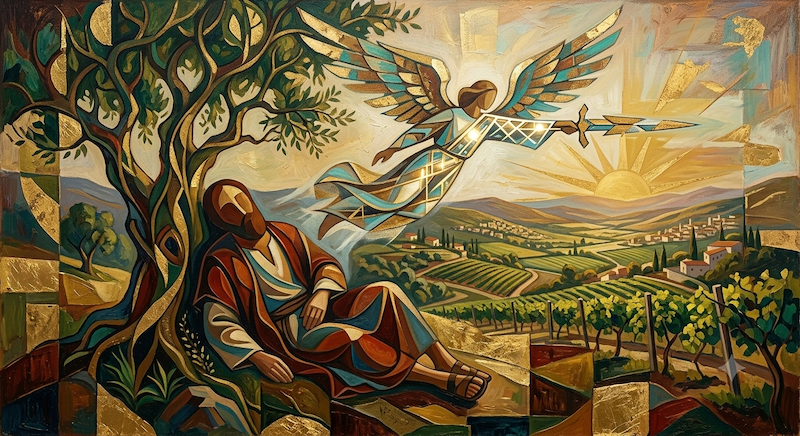
AI tribute inspired by Leo Durmashkin’s lost painting The Return to Zion.
So Did My Mom — As Did Countless People After the Holocaust.
My mom was a survivor of Dachau. Twenty years after she passed, I discovered a journal she had kept — written, I imagine, in the hope that one day it would be published exactly as she wrote it—in the third person. Awww. She was the best.
It’s an unbelievable story of strength, detailing how she survived countless horrific situations and horrific people in a world that had become unrecognizably horrific.
My recollections of growing up weren’t of my mother speaking much about being a Zionist. My dad surely was. But in her writings, she talks about her commitment to Israel, which was not born out of the ashes of the concentration camps. It was woven into the very fabric of her childhood through her family’s connection to the arts and music.
In her journal, she wrote about her Uncle Leo:
Uncle Leo was an artist. He wore his hair shoulder-length, a style no one in Vilna—or anywhere in Europe—wore at that time. When Hennie was just eight, Uncle Leo had taken her to Warsaw and to buy very special oil paints. She often went to his studio, where he worked on a tremendous painting called “The Return to Zion”—a canvas so large he had to stand on a ladder to paint the fluffy clouds at the top.
A reproduction hung in their dining room, and Hennie often found herself gazing at it for hours, remembering the stories Leo had told her. The painting depicted a Jew—the everlasting wanderer—falling asleep beneath a shady tree and dreaming a vision: the return of the Jews to Zion. Against the painted sky, an angel pointed eastward with a sword.
Not only had Hennie inherited her love of art from Leo, but her deepest Zionist beliefs were rooted in his teachings.
Reading those words now—considering the state of rising antisemitism and anti-Zionism—is deeply moving. Her connection to Israel was rooted in love, history, and a lifelong connection to a place she believed was home.
After liberation, while staying in Saint Ottilien, a displaced persons (DP) camp near Landsberg, Germany, she told a friend how excited she was to settle down in Israel.
My mom was originally from Vilna, Poland—a place she had no interest in returning to because it had become one of the most historically catastrophic environments for Jews during and after the war.
So, her heart was set on Israel instead. She was finally going home.
For most Jews—especially those who survived the Holocaust—the idea of Israel was a dream.
Zion is the origin of our faith, where Abraham walked, where our story began. It represents our commitment to inhabiting the land we came from, returning to the homeland that was not only promised to us, but was ours for thousands of years before history repeatedly scattered us from place to place.
If my mother sounds a lot like Dorothy Gale in The Wizard of Oz, well, if the ruby slipper fits…
It’s the purity and simplicity of wanting to go home after you’ve been uprooted, tortured, starved, beaten, and deprived of every ounce of human dignity by monsters.
In a strange, bittersweet way, I’m glad she isn’t alive today to witness the return of such uncivilized antisemitism unfolding right here in the United States—the place she came to love. My mom and her sister, Fanny, who also survived Dachau, emigrated to America in 1949.
I’d hate for my mom to be reminded daily of the nightmare she survived.
They did not survive Dachau so that decades later the word “Nazi” could be casually thrown at Jews and be accused of genocide for believing that the Jewish people have a right to a homeland—and for fighting for that very right.
The importance of Uncle Leo’s painting remains as relevant today as it was through every pogrom, every Inquisition, every Holocaust—and now, during this current resurgence of vile rhetoric and hatred.
This new wave of anti-Zionism is built around a dangerous idea: that Jews do not belong. That our connection to our ancestral homeland is somehow illegitimate. That after thousands of years of history, exile, persecution, and survival, the Jewish people should once again be told where we are allowed to exist.
My homeland is now facing a rising tide of antisemitism and anti-Zionism. Call them what you will. I see it as a movement that too often denies Jews the same right to national identity, self-determination, and belonging that other peoples are allowed to claim.
And within that movement are, in my view, some of the most tragic figures of all: Jews who have turned against their own people’s connection to a homeland, lending their voices to those who would deny it.
[SIDEBAR]
We Jews are a minority. When you attack a minority because of who they are, you are engaging in the very definition of racism. I don’t care what color you are, where you’re from, or what’s in your pocket—if you deny a people’s identity, history, or right to belong because of who they are, that is prejudice. Pure and simple.
This applies to everyone from Zohran Mamdani, his diabolical wife to Elizabeth Warren, AOC, the Squad, Bernie Sanders, parts of Hollywood, and the Democratic Socialists who, in my view, are spreading ideas that are infesting our politics, our schools, our cities, and our country.
And people like my mother?
My mother was Dorothy.
All Jews who simply want to claim their ancestral homeland as their rightful home are the Dorothys of this story.
Because after everything Jews have endured, wanting a home cannot and must not be controversial.
There really is no place like home.