
An Aging Jewish Feminist
Dreams, Deception, and Moral Awakening in Parshat Miketz
Parshat Miketz divides naturally into two themes. The first, long and repetitive, revolves around dreams: Pharaoh dreams, Joseph interprets, and Joseph rises swiftly to become second-in-command in Egypt. Though important, this section feels largely preparatory. The second half of the parsha is where the narrative is more interesting.
DECEPTION
The turning point comes when “all the world came to Joseph in Egypt to procure rations, for the famine had become severe throughout the world” (Genesis 41:57). Jacob hears that there is food in Egypt and sends his sons—without Benjamin—to buy grain. What unfolds is a charged encounter between Joseph and the brothers who once sold him into slavery.
Joseph immediately recognizes his brothers; they do not recognize him. Remembering his dreams, he accuses them of being spies and confines them for three days. When they reveal—too freely—that they have a younger brother at home, Joseph seizes the opportunity to test and manipulate them. Simeon is bound before their eyes; their money is secretly returned to their sacks; and when they discover it on the road home, they are terrified: “What is this that God has done to us?” (42:28).
Back in Canaan, Jacob refuses to send Benjamin. Only when the famine worsens does he relent. Significantly, the brothers misrepresent events, claiming Joseph extracted information about Benjamin rather than admitting they volunteered it. Concealment continues to shape the story.
When the brothers return to Egypt with Benjamin, Joseph treats them lavishly—yet once again orchestrates deception. He orders his steward to place his silver goblet, a vessel associated with divination, into Benjamin’s sack, along with the money. The brothers are pursued, accused, and swear that whoever possesses the goblet should die, while the rest will become slaves. The search proceeds from oldest to youngest; the goblet is found in Benjamin’s bag. They tear their clothes in despair.
The parsha ends on a cliffhanger. Joseph tells the brothers that only Benjamin will remain as his slave; the others may return home “in peace” to their father. Beneath the surface, however, a powerful motif has emerged: hiding and concealment—of objects, of intentions, of truth, and even of God.
Joseph’s planting of the goblet unmistakably recalls the earlier episode: Rachel’s theft of her father Laban’s terafim. The parallels are striking, extending even to shared vocabulary. Rachel hides (va-tesimem) the household gods—objects of special power—inside a camel cushion. Laban searches from tent to tent, from oldest to youngest, but does not find (lo matzah) them. Jacob, unaware of Rachel’s guilt, declares that whoever is found (timtzah) with the terafim shall die.
In Joseph’s story, the steward puts (tasim) the goblet—also a sacred object, associated with divination—into Benjamin’s sack. The brothers swear death upon the guilty party. The search again proceeds from oldest to youngest, and this time the object is found (va-yimatzeh).
Both stories end with reconciliation and border-crossing: Jacob and Laban make a treaty; Joseph and his brothers will soon be reunited as a family in Egypt. Yet the differences are just as telling. Laban never recovers the terafim, and Rachel’s theft goes undiscovered—though tragically, Jacob’s vow will later cost her life in childbirth. In the Joseph story, Benjamin is innocent; the word “steal” (ganov), which appears repeatedly in the Rachel narrative, is absent in this week’s parsha. Joseph told Pharoah’s servants ganov gunavti: For in truth, I was stolen from the land of the Hebrews; nor have I done anything here that they should have put me in the dungeon” (Genesis 40:15). Still, the emotional resolution is delayed, and suffering continues.
GOD IN DREAMS
Dreams themselves are acts of concealment. They hide meaning and demand interpretation—by a psychiatrist, or by a Joseph. Strikingly, God never appears directly in the Joseph saga. There are no visions, no angels, no divine speech. Is God hiding too?
The irony is sharp. At Joseph’s birth, God was vividly present: “God remembered Rachel… and opened her womb… and she named him Joseph” (Genesis 30:22–24). Yet in Joseph’s adult life, God works invisibly, behind the scenes. From Joseph’s perspective, divine providence is real but hidden. Only at the end of the story will he articulate this truth: “It was to save life that God sent me ahead of you” (45:5). For now, his brothers must live with the consequences of their secrets.
AWAKENING
This theme of recognition versus misrecognition runs deep. When Joseph sees his brothers, he recognizes them (va-yakirem) but disguises himself as a stranger (va-yitnaker aleihem). The wordplay is chilling. Recognition, haker, echoes through Genesis with moral weight. Tamar challenges Judah: “Please recognize (haker–na) whose seal and cords these are,” forcing him to admit, “She is more righteous than I.” Earlier still, the brothers used the same word to deceive Jacob: “Please recognize— is it your son’s tunic or not?” Jacob recognizes the garment and draws the wrong conclusion. The savage beasts who tore apart his family were, in truth, his own sons.
MORAL CONTRAST
Parshat Miketz suggests a moral contrast between Reuben and Judah. Reuben, the eldest, offers his two sons as collateral if Benjamin is harmed—an empty, grotesque promise that inspires no trust:
“You may kill my two sons if I do not bring him back to you. Put him in my care, and I will return him to you” (Genesis 42: 37). Of course Jacob refuses: “My son must not go down with you, for his brother is dead and he alone is left. If he meets with disaster on the journey you are taking, you will send my white head down to Sheol in grief” (vs. 38).
But when they are in dire straits and no food is left, Judah, by contrast, pledges himself:
““Send the boy in my care, and let us be on our way, that we may live and not die—you and we and our children. I myself will be surety for him; you may hold me responsible: if I do not bring him back to you and set him before you, I shall stand guilty before you forever” (vss. 8-9).
Jacob accepts Judah’s responsibility, not because the family is starving—they still have delicacies to send as gifts—but because Judah has learned accountability.
The parsha closes with Judah stepping forward as leader. When Joseph confronts them, Judah declares, “How can we prove our innocence? God has uncovered the crime of your servants.” His words echo his earlier confession to Tamar—tzadkah mimeni, “she is more righteous than I.” Joseph is deeply moved. The transformation is complete: Judah, once complicit in selling Joseph, now offers himself in place of Benjamin.
CONCLUSION
In Miketz, nothing is quite what it seems. Objects are hidden, identities masked, God concealed. Yet through deception and suffering, truth emerges. Recognition—of guilt, of responsibility, of divine purpose—comes slowly and painfully. The story pauses just before revelation, leaving us suspended between concealment and clarity, waiting for the moment when Joseph will finally say, “I am your brother.”
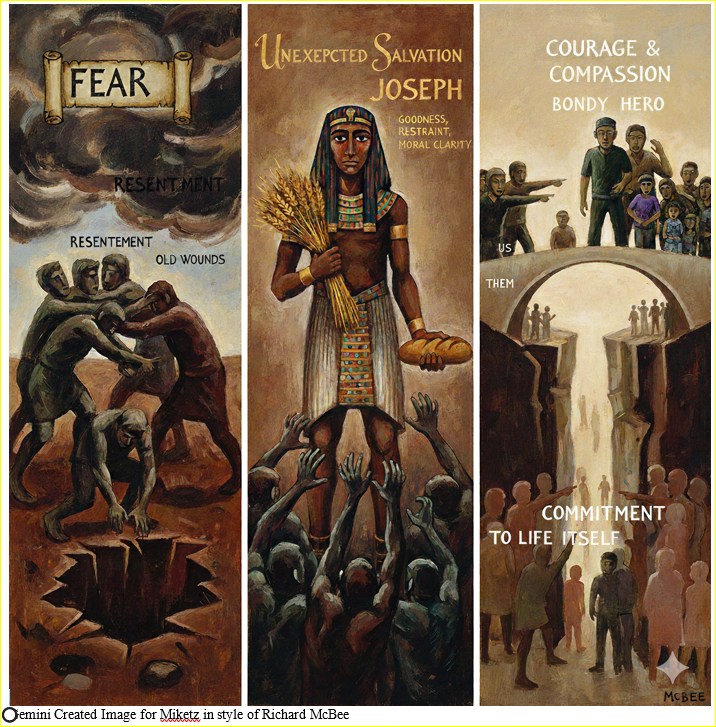
The relevance of this parsha to our own moment is painfully obvious. Miketz is, at its core, a story about brothers who cannot recognize one another as brothers. Fear, resentment, and old wounds distort perception until kin become enemies. The Torah does not shy away from the tragedy that follows when internal divisions harden into moral blindness. The “other” is no longer seen as human, let alone as family.
That is why it is so jarring—and so instructive—when salvation comes from an unexpected place. In the Joseph story, the one who preserves life, who feeds the world and ultimately saves his own family, is the brother who was rejected, sold, and erased. He is unrecognizable not only because of his Egyptian clothes and power, but because the brothers cannot imagine that goodness, restraint, and moral clarity could come from the one they wronged so deeply.
The same irony confronts us today. At a time when political and social discourse is increasingly framed in terms of “us” versus “them,” when brothers—literal and figurative—attack one another across ideological, religious, and national lines, acts of courage and compassion often come from those whom society has been taught to fear.
And now we come to today’s ironic hero; the bystander who tackled one of the gunmen was a man named Ahmed el Ahmed, age 43.
“Ahmed is a real-life hero,” Chris Minns, the premier of New South Wales said. “Last night, his incredible bravery no doubt saved countless lives when he disarmed a terrorist at enormous personal risk.”
The fact that the person who saved so many lives during the Bondi massacre was a Muslim of Syrian origin exposes the poverty of our assumptions. Like Joseph in Egypt, he did not fit the narrative we expect. And like Joseph, he acted not out of tribal loyalty, but out of a commitment to life itself.
Miketz reminds us that moral vision depends on recognition. When we fail to recognize one another—when we allow fear, ideology, or past trauma to obscure the human face before us—we repeat the brothers’ sin. Reconciliation begins when we admit, as Judah does, “How can we prove our innocence?” and accept responsibility for the harm caused by our blindness. Only then can hidden goodness emerge, and only then can fractured families, societies, and nations begin to heal.
Related Topics
Related Posts