Dublin, 1984
It is perhaps fitting that Dublin is a UNESCO World Heritage City of Literature. After all, one of the most famous lines in literary history — “who controls the past controls the future; who controls the present controls the past” — from the Orwell masterpiece 1984 feels chillingly at home here.
Dublin today is more than a city of literature. It is a city where history is manipulated, where memory is reshaped to fit a narrative — and where the Arab–Israeli conflict has been repurposed as both a mirror for Ireland’s own trauma and a call to mass moral panic. The Orwellian warning of historical manipulation for the purposes of engendering rage and destroying truth may have originated in his fear of Soviet and Fascist authoritarianism in the mid-20th century, but appears no less relevant in a Western democracy of today. For Jews — and everyone else on the outside of the present ideological purity — Dublin has become not only a place where the past remains unburied, but a harbinger of what the future may hold for Jewish communities across the West.
A Viral Moment, an Old Hatred
Last week in Dublin, a video went viral: a drunken man berating a Jewish passenger on a city bus, calling him “genocidal” and accusing him of “ethnic cleansing.” When a woman intervened, she was sneered at for “white knighting for a Jew.” The encounter never turned physical — but its emotional violence was palpable, a form of thoughtcrime enforcement in the public square.
If the words feel familiar, that’s because they are. They echo the antisemitic refrains of Europe’s past — Soviet harassment, medieval Christian tropes — now laundered in the vocabulary of social justice.
This is not an aberration. It is the outcome of Irish social institutions that filter its understanding of Jews and Israel through the dual lens of Catholic theology and nationalist trauma, recasting its own history as a moral template not only for the Middle East but for their own society. The public square has become an open-air propaganda office where doublethink reigns: terrorism is resistance, October 7th and the history of anti-Jewish violence committed by Palestinians is erased, and when genocide is declared despite ample evidence to the contrary, the institutions are simultaneously judge, jury and executioner.
A History of Trauma
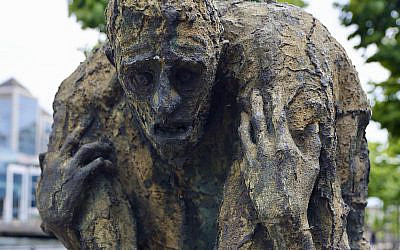
Ireland found itself under Norman and British rule, in some capacity, circa the 12th century, but the experiences of the 18th – 20th centuries were particularly traumatic. In the aftermath of the Jacobite rebellions, Ireland — as a Catholic country — came under strict control by the British. The British crown began importing British Protestant settlers and aristocrats to maintain its political and religious dominance, with the large and deeply impoverished Irish Catholics often paying the price for being part of a larger religious conflict. British antipathy to said population reached its zenith during the 19th century potato famine (1845-1852), when the potato blight led to widespread crop failures. While the crop was destroyed across Europe, it was devastating for the poor Irish, whose diet was almost entirely comprised of potatoes and buttermilk. When the crop failed for its second year in a row, mass starvation set in — but the British crown was initially unmoved, continuing crop and livestock exportation and refusing to intervene due to both a policy of non-intervention in grain markets and a belief that the famine was divine retribution for remaining Catholics. Between a huge death toll and forced emigration, the population of Ireland decreased by 3 million, more than one-third of its population at the time. The famine did nothing but increase the sectarian conflict between Catholics & Protestants, Republicans & Loyalists. In 1916, when England was at war, the IRA launched the Easter Rising attempting to drive out the British. It failed, but had a significant impact on support for the Republican movement. When the British allowed for Home Rule in 1921, a bloody civil war broke out. Ireland finally became a republic in the late 1940s, but the Six Counties of Northern Ireland remained a part of Britain. Decades of civil unrest followed, now known colloquially as the “troubles.” That period ended officially in 1998 with the signing of the Good Friday agreement — but while the bombs have stopped, splits in the country remain very real. When I arrived in Belfast on July 12th, when the Orange Order marches take place, our server made clear that it was the reason the city was closed down; they “don’t like” having anything to do with the Protestants, even now.
Catholic Roots, Clumsy Colonial Parallels
Modern Irish identity still draws heavily on two powerful legacies: the Catholic Church and the long shadow of British imperialism. These legacies profoundly shape Irish perceptions of Jews and of Israel.
A 2024 Boston University study found that nearly half of Irish Catholics believe Jews are “not loyal to Ireland.” Over a third believe Jews have “too much power” in business; a third say Jews are “only hated because of their behaviour.” One-third also believe Jews “focus too much on the Holocaust.” These beliefs, largely absent among Irish Protestants, particularly in Northern Ireland — who tend to be more pro-Israel — mirror medieval Christian imagery and centuries-old antisemitic myths. Much like in the United States and Canada, Jews & Israel is becoming yet another issue drawn down traditional party lines, another source for political scorekeeping.
Supersessionist theology remains strong: many Irish Catholics apparently still hold Jews responsible for Jesus’ death, despite Vatican II’s official repudiation of this belief. As in medieval Christendom, Jewish suffering is often viewed as self-inflicted — even the brutal massacre of civilians on October 7th. This mindset bleeds into politics. Jews have always been cast as the avatar of evil in Western society, constantly evolving to represent whatever is most hated; for the Catholic Church, of course, the Jew was always the “Christ Killer.” Ireland did not establish diplomatic ties with Israel until 1963 — a full year after the Vatican finally absolved Jews of deicide. These legacies seem to also fuel Ireland’s role in pushing the ICJ “genocide” case against Israel.
Indoctrination by (text)book
If antisemitism in Ireland were limited to rhetoric and abhorrent posters, it would be bad enough. But it is institutional.
In Catholic schools — which the majority of Irish children attend — the watchdog IMPACT-se has documented “profound distortions” of Judaism, Jewish history, Israel, and even the Holocaust.
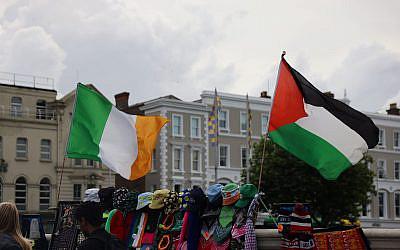
Textbooks depict Jesus as “Palestinian,” cast Jews as those who “did not like Jesus,” and present Judaism as a religion that “believes violence and war are sometimes necessary to promote justice.” Meanwhile, Irish schoolchildren are taught allegories of the Good Samaritan illustrated with a boy attending an anti-Israel rally waving a Palestinian flag, and even early-year pupils are given Palestinian-themed art assignments. Auschwitz, in these same books, is described simply as a “Prisoner of War camp.”
A nationwide “Talk About Palestine!” initiative — backed by the Education Minister — urges students to join “Palestinian justice networks.” Despite official claims to bipartisan peace efforts, its resources erase October 7th, romanticizes Hamas’ violence as “blood sacrifice,” and frames Israel as a colonial oppressor akin to Britain during the Great Famine. Its resources range from Al Jazeera clips to essays from the fringe blog Mondoweiss. To claim these as reliable or credible sources is beyond educational absurdity, and yet its backing by the Ministry of Education indicates the clear lack of need for impartial or historical fact.
The same country whose historical identity is so closely related to the Bible, a book about the Jewish history in the land of Israel, now invests in doublespeak that sees Jewish settlement all but erased from the Holy Land. The school curricula is effectively a Ministry of Truth project, where Jewish history disappears down the memory and is replaced with Palestinian fable. A brief study of 40 different bookstores in Ireland (by author) demonstrated that not one apolitical historical book about the conflict or current events was to be found across Dublin. Even when a book about Israel was requested, employees were unable to come up with one. In any single bookstore across the Dublin City centre. 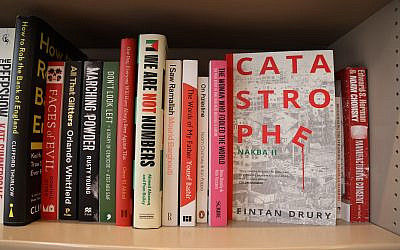
Ireland and Palestine: A Manufactured Parallel
In Irish public life, one narrative dominates: Ireland-Palestine, Britain-Israel.
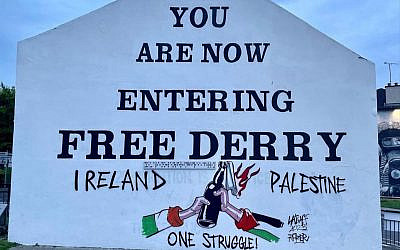
From murals equating Hamas with the IRA to pubs covered in “Two Nations, One Struggle” stickers, the Palestinian cause has been absorbed into Irish Republican mythology. Hamas’ war on Israel is cast in the same moral light as the Easter Rising, the Gaza blockade likened to the Great Famine.
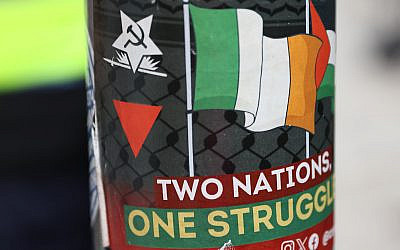
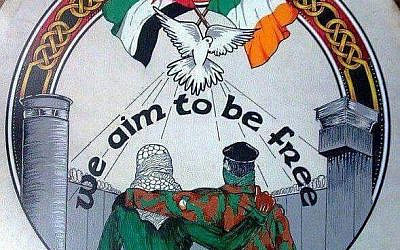
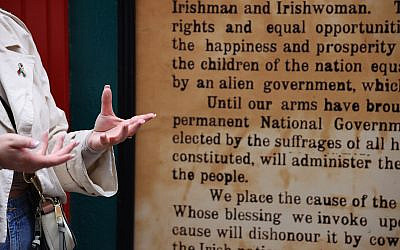
Even walking tours have become political sermons. On a recent 1916 Easter Rising tour, my guide — wearing a Palestinian-Irish flag pin — spent as much time on Gaza as on the ICA, reframing Irish independence as a template for Palestinian “liberation” and applauding the heroism of those who paid the “blood sacrifice” — from the IRA to Hamas. I took the same tour in 2018; none of these narratives were present.
This is no coincidence. Irish Republicanism has been intertwined with Palestinian nationalism for decades, influenced by a heavy dose of traditional Catholic anti-Judaism. Sinn Féin’s founders justified attacks on Jews as retaliation against “usurers” in the late 19th and early 20th century. Gerry Adams met with PLO leaders in the 1980s, later embracing Hamas figures like Ismail Haniyeh — himself directly involved in October 7th. Perhaps unrelated to the IRA, but speaking to the legitimacy of such beliefs, a Dublin City councillor openly claimed “the US economy is ruled by Jews” in October of 2024.
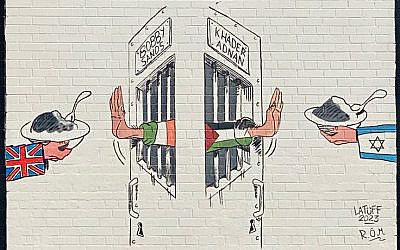 How ironic considering that in the 1940s, the IRA and Lehi (also known as the Stern Gang) found common cause and sentiment, both fighting the same colonizer. Yitzchak Shamir’s code name in the group was Michael, so named after Michael Collins, director of the IRA intelligence in the 1920s.
Why It Matters
The result is a society where antisemitism and antizionism are not fringe positions but moral imperatives. From the church to the classroom, from bookstores to the street, alternative narratives are almost nonexistent.
This is what makes Dublin so frightening: it is a warning.
In Toronto, London, New York, you can still walk into a bookstore and find competing perspectives on Zionism. You can still take a university course on Jewish nationalism without it being led by a self-declared antizionist (at least if you’re not a student at Columbia University). But the walls are closing in. Dublin shows what happens when one narrative colonizes every cultural and intellectual space: Jews are left with two options — to assimilate as “good Jews” or to leave.
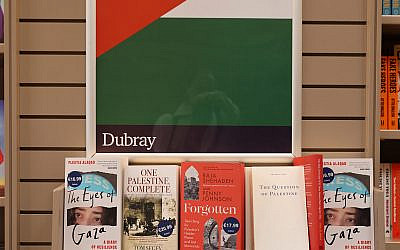
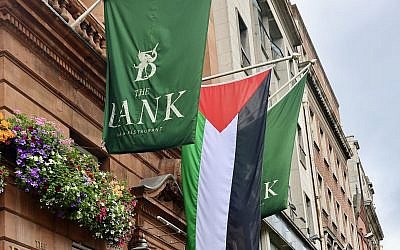
When I was there last in 2018, Dublin still felt like a city wrestling with its past. In 2025, it feels like a city weaponizing it.
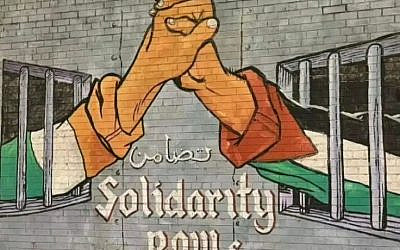
Dublin remains a port city on the continuum of history, where the past is at once unburied and alive, constantly being reborn to prove the necessary narratives of today. It is beyond just a city of literature now, it is literature come to life.
Like Orwell foresaw, its manipulation of history does not simply falsify or carefully curate the past — it dictates the present and seeks to create a blueprint for the future. When Ireland’s colonial trauma is repackaged as a Palestinian story, it leaves the historical transcription of fact and is reborn as a fever dream where Hamas is noble, Jewish deaths are justified, and Jewish suffering is deserved. In a country simultaneously seemingly influenced by traditional Catholic anti-Judaism, Soviet-style anti-Zionism, and a wholly unrelated conflict taken up as common morality, the forced and clumsy correlations between Ireland-Palestine are a perfect exercise in doublethink, holding two contradictory histories as one: Ireland’s trauma as victim, and its comfortable role as judge of the Jewish state and arbiter of its history. It is a cultural Ministry of Truth, training ground for a West where history is re-written, reality is inverted, and Jews once again find themselves on the wrong side of the “right side of history.”
Anyone who is not scared is not paying close enough attention.