

Philosophy, kabbalah, screenwriting...
Earthquake Diplomacy: The Unexpected Thaw Between Caracas and Jerusalem
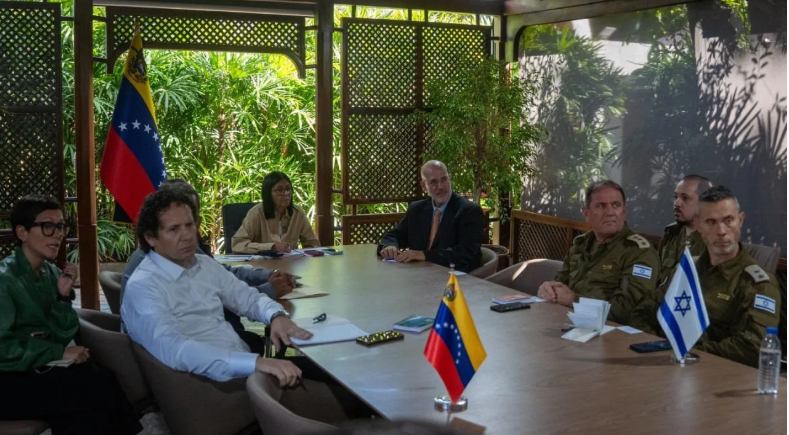
President (I) Delcy Rodríguez with the Israel delegation in Caracas (Foreign Ministry Press Office)
The devastating earthquakes in Venezuela have opened a channel for humanitarian diplomacy with Israel, burying nearly two decades of ideological estrangement. The deployment of rescue teams and local community mediation mark a strategic pivot toward reconciliation between Caracas and Jerusalem, reconnecting a shared history and the resilience of a brave community.
The current momentum redefining relations between Caracas and Jerusalem is a Copernican shift forced by geology and humanitarian urgency, leaving behind nearly two decades of hostile rhetoric and severed diplomatic ties.
Following the devastating earthquakes that shook Venezuela, the arrival of Israeli rescue and technical assistance teams not only introduced the principle of mutual guarantee (Arvut) on the ground in the face of tragedy, but also shattered the outdated ideological dogmas that had long stifled local foreign policy.
The historic and pragmatic official reception granted by the President of the Republic, Delcy Rodríguez, to the Israeli delegations formalizes an unprecedented thaw, where the diplomacy of the rubble becomes the bridge to reconfiguring the bilateral chessboard. In this new landscape, the imperative of national reconstruction and logistical cooperation in the wake of disaster have ultimately buried the isolation of the past, paving the way for a strategic realignment where direct humanitarian aid has proven more efficient and real than the rigid geopolitical alignments of the last century.
To grasp the magnitude of this shift, one must examine the historical and spiritual undercurrents of this fracture. The radical disconnect from Israel and the United States was a highly personal architecture of Hugo Chávez, driven by an incurable megalomania inspired by Nasser’s Pan-Arabism.
The climax of this ideological confrontation occurred when Chávez, during a public broadcast, famously cursed the State of Israel from his very core—a discursive milestone that many analysts and believers remember with a sense of mysticism, given his subsequent and unexpected passing due to illness in 2013. Under that legacy, 2009 marked the formal rupture of bilateral diplomatic relations, forcing an institutional and political exile that isolated Venezuela from its natural sphere of influence in the Western Hemisphere, dragging it into alliances with radical Middle Eastern regimes.
Despite the state’s aggressive rhetoric, an official antisemitic campaign targeting local Jewish citizens never materialized. Nevertheless, the Venezuelan Jewish community suffered a brutal demographic toll: of the 20,000 members who once comprised this prosperous and vibrant collective, barely 3,500 citizens remain in the country today. This mass exodus was not a response to active persecution, but rather the result of a generalized institutional and socioeconomic collapse that forced more than six million Venezuelans to seek a viable future elsewhere.
Those who chose to stay demonstrated formidable resilience, keeping synagogues, schools, and communal bonds alive, becoming the custodians of an irreplaceable cultural heritage that today serves as a golden bridge for rebuilding binational dialogue.
Incongruous identity paradoxes existed even within the ruling elite. Nicolás Maduro himself publicly acknowledged his Sephardic heritage on several occasions, tracing his surname back through the migratory records of the Maduros of Curaçao—a Caribbean Jewish dynasty rooted in the Dutch Antilles that eventually settled in Venezuelan territory.
However, power dynamics and the commitments of the old guard prevented this historical undertone from being leveraged for years. The inertia of surrounding themselves with partners hostile to the West trapped foreign policy, until recent political shifts in the hemisphere and the urgency of national economic reconstruction began to compel a pragmatic return toward the American geopolitical axis, distancing the nation from the orbit of radical actors like the Tehran regime.
Geology ultimately accelerated what traditional diplomacy had been quietly maturing in secret. Following the severe earthquakes that struck the nation, the State of Israel immediately activated its rapid response mechanisms for global crises. A highly sophisticated technical vanguard arrived at Maiquetía International Airport, comprising structural engineers, search and rescue specialists for collapsed structures, and emergency medical units from IsraAID—Israel’s leading international humanitarian non-governmental organization—alongside logistical delegates and experts from the official Israeli cooperation agency.
In the areas hardest hit by the catastrophe, these technical contingents worked side-by-side with local Civil Defense teams, assessing building safety, rescuing survivors, and deploying state-of-the-art water purification plants. They were received with deep warmth by the exhausted citizens of La Guaira and Caracas.
Furthermore, students at the Central University of Venezuela—where I am currently pursuing a doctorate in Social Sciences—welcomed them with chants of “Am Israel Jai, Am Venezuela Jai…” This took place at a university where many members once staunchly supported Chávez and Maduro, and more recently accused Israel of genocide due to the war in Gaza.
On the local front, the institutional and logistical framework required to coordinate the arrival and distribution of this complex humanitarian aid was immediately organized by the Confederation of Israelite Associations of Venezuela (CAIV) directed by my friend Miguel Truzman, in close alliance with the volunteer network of the Israelite Association of Venezuela (AIV) and the Israelite Union of Caracas (UIC). These solid communal institutions acted as cultural facilitators, technical translators, and direct logistical liaisons between the foreign rescuers and executive branch ministries. This synchronicity demonstrated the true value of citizen diplomacy, proving that the organic bonds of an established community can move faster and more efficiently than heavy, traditional bureaucratic channels in times of dire need.
The ultimate catalyst to untie the diplomatic knot and expedite entry permits in record time was the intervention of a figure commanding immense moral authority in the country. In her official address to the nation, the President of the Republic made an explicit public acknowledgment of the mediation of Chief Rabbi Isaac Cohen, Head Rabbi of the Israelite Association of Venezuela. Throughout the last two decades of institutional freeze, Rabbi Cohen has remained a permanent channel of spiritual communication and mutual respect with the civil authority. His standing and prestige helped build the indispensable mutual trust required for the Israeli relief delegations to step onto Venezuelan soil without the ideological hurdles that would have blocked any cooperation with Jerusalem in the past.
As a corollary to these advancements on the ground, President Delcy Rodríguez held a historic formal meeting at the government palace with the executive leadership of CAIV and representatives from the IsraAID liaison teams. In this momentous gathering, which yielded a photograph unthinkable just months ago, the president formally expressed her gratitude for the Israeli technical deployment in the disaster zones and discussed long-term cooperation plans regarding risk management, earthquake engineering, and the reconstruction of critical infrastructure. This gesture breaks the isolation and returns Venezuela to a path of international relations guided by national interest, humanitarianism, and pragmatic sanity.
Israel’s Minister of Foreign Affairs made it explicitly clear that for Jerusalem, human life transcends old ideological grievances. Gideon Sa’ar outlined the official stance of the foreign ministry with a definitive statement:
“Assistance to people in these difficult times is not related to politics; it is a humanitarian act.”
This declaration has been pivotal, as it strips the matter of ideological weight and demonstrates that Israel did not condition its technical support, marking a sharp contrast with the “bloc diplomacy” of the past.
Prime Minister Benjamin Netanyahu was even more explicit regarding the long-term impact of this mission. In an official videoconference with the commander of the field assistance delegation, Brigadier General Elad Edri, and Ambassador Yoed Magen, Netanyahu delivered two remarks that define the social, political, and human momentum:
“You are doing something unique: you are rebuilding ruins, and you are also rebuilding relations. You are showing the people of Venezuela, and also the government of Venezuela, the true face of the State of Israel.”
“We did not ask questions about who and what; we simply asked, ‘What needs to be done to help.”
The political and social reactions to this turning point have been immediate, dividing the national landscape into three distinct camps.
On one side, pragmatic government officials defend receiving the aid under the premise of unconditional solidarity in the face of tragedy, arguing that preserving human lives supersedes any dogmatic line inherited from the past.
For their part, the international community and sectors of the civil opposition view this shift with optimism, interpreting it as a rational and inevitable step toward the country’s international normalization and its re-entry into Western assistance and technical cooperation networks.
Finally, the radical ideological old guard has expressed a muted bewilderment and unease on social media, watching as the raw reality of the rubble dismantled years of official anti-Israel narrative in a single afternoon. Earthquake diplomacy has proven that when the earth roars, dogmas fall and humanity prevails.