
Historian, Librarian, Educator, and Artist
Economic Inequality in Israel the Unspoken Problem
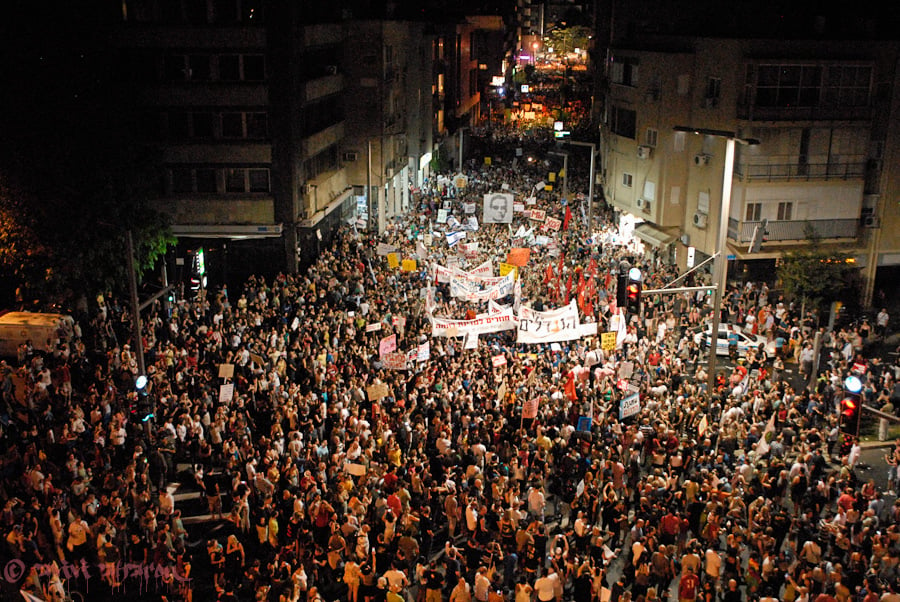
Housing protest tents line Rothschild Boulevard during Israel’s 2011 social justice protests in Tel Aviv. The demonstrations focused public attention on the cost of living and housing insecurity, tensions that continue to shape daily life long after the tents were cleared. (Source: Wikipedia Commons)
Why Olim, Women, and the Working Poor Are Judged Instead of Supported
By Bonnie K. Goodman, BA, MLIS
Walk through the streets of Israel’s major cities and the impression is unmistakable: prosperity. Cafés are full at all hours. Designer handbags hang from strollers. Restaurants charge prices comparable to Paris or New York. The visual language of affluence is everywhere, projected confidently onto sidewalks, shop windows, and social media feeds.
Yet alongside this public display exists a different daily reality, one that is less visible, less discussed, and rarely photographed. It is the reality of those who rent without leverage, who work full time in socially “essential” professions that do not pay a living wage, who navigate two legal systems without capital, and who live one unexpected expense away from collapse. These lives do not exist on the margins of Israeli society; however, they are often treated as though they do. In practice, they exist within it, frequently hidden in plain sight.
The divide between these two realities is not simply economic. It is interpretive. Those who move comfortably through Israel’s high-cost landscape are generally presumed competent, stable, and deserving. Those who struggle in the same environment, however, are more likely to be read as disorganized, unstable, or personally at fault. Depending on who experiences them, and what resources they have access to, the same conditions—financial stress, housing insecurity, legal exposure—are interpreted differently.
Double standards take root in this interpretive gap. Survival tactics are recast as instability or failure, while similar behaviors, under different circumstances, are framed as adaptability or resilience. Financial precarity is mistaken for poor judgment. Stress becomes evidence of pathology. Structural pressure disappears behind moral judgment, and once it does, responsibility quietly shifts from institutions to individuals.
These assumptions do not arise accidentally. They are reinforced through cultural narratives, political ideologies, and deeply gendered expectations about how competence, responsibility, and belonging are supposed to look. Over time, they harden into stereotypes that perform subtle but effective work. They justify inequality while placing those most affected by it under unusually close examination.
It is within this landscape that the experiences of olim, women, and the working poor must be understood. Not as isolated stories of individual difficulty, but as reflections of how power, money, and legitimacy are unevenly distributed—and unevenly interpreted—in Israeli life.
The Core Double Standard
When a man navigates instability, he is often described as ambitious or principled. When a woman does the same, the language shifts. She is more likely to be labeled difficult, emotional, or unstable.
When someone with wealth lives across two countries, the arrangement is praised as cosmopolitan flexibility. When someone without financial backing does so out of necessity, it becomes evidence of being unsettled or irresponsible. The behavior itself has not changed; however, the assumptions attached to it have.
Popular culture sometimes captures this truth more clearly than policy debates. In The Man, Taylor Swift articulates the gendered double standard with blunt precision: “I’m so sick of running as fast as I can, wondering if I’d get there quicker if I was a man” (2019). The lyric resonates not because it is poetic, but because it is accurate. Identical effort, filtered through gender and class, produces opposite judgments.
Olim Between Two Worlds: Choice vs. Necessity
Living between Israel and the Diaspora is often romanticized, but only when it is optional.
For olim with assets, stable income, or property, mobility signals freedom and control. For olim without capital, guarantors, or secure employment, however, the same reality is treated as proof of instability. This distinction has little to do with commitment. It has far more to do with power.
Organizations such as Nefesh B’Nefesh exist precisely because aliyah is shaped by structural barriers, including employment gaps, language acquisition, housing shortages, and bureaucracy. Yet public discourse frequently assesses olim morally rather than materially. The question becomes whether someone is “settled enough,” rather than whether the system itself offers meaningful pathways to stability.
This disparity is most visible in the housing market. Olim with money can buy, renegotiate, or exit. Olim without money face one-sided contracts, inflated damage claims, and landlords who understand exactly how little leverage tenants have. Legal inequality produces predictable stress. However, that stress is often misread as personal instability rather than recognized as the outcome of structural exposure.
Capital, Context, and Selective Blindness
Public commentators often urge context when discussing Israel’s political or cultural challenges. In a recent column, Gil Troy cautioned against simplistic narratives, arguing against both romanticized fantasy and harsh demonization, and calling for an understanding of Israel’s challenges “in context” (Jerusalem Post, January 2026). The argument is reasonable. However, the context invoked is rarely economic.
Troy’s lived reality in Israel is materially different from that of many others, particularly olim without capital, stable housing, or legal insulation. When disparities among olim are discussed—especially between those with resources and those without—the same contextual rigor often disappears.
Olim with resources are praised for resilience. Olim without resources are scrutinized for how they cope. The difference is not values or effort. It is insulation.
Ownership confers control. Renting confers exposure. Treating these positions as equivalent erases the legal and economic realities that shape daily life.
Women Who Speak Become the Problem
Double standards sharpen when women refuse silence.
In professional settings, assertive men are described as leaders. Assertive women are more often described as abrasive. In communal life, men who challenge authority are framed as principled; women who do the same are accused of provocation. The experience of Women of the Wall illustrates how identical claims are filtered through gendered suspicion rather than evaluated on their substance.
Cultural shorthand captures this contradiction clearly, even when explicit language is stripped away. In the late 1990s, Meredith Brooks’s song B*tch became an anthem precisely because it rejected the demand that women present a single, orderly self. The song’s insistence on multiplicity—emotional, relational, contradictory—pushed back against a culture that disciplines women for complexity and rewards them for containment. Its popularity reflected a widely felt frustration with being judged not for one’s actions, but for failing to conform to a narrow script of acceptable behavior.
That same discomfort with female complexity appears much earlier in American literature, most famously in Margaret Mitchell’s Gone with the Wind. Facing famine and ruin, Scarlett O’Hara makes a vow that has unsettled readers for generations: “As God is my witness, I’ll never be hungry again.”
Her declaration is not framed as virtue, and it is rarely treated as wisdom. Instead, it is often read as moral failure, even though it emerges from extreme constraint. Scarlett’s refusal to accept starvation on society’s terms exposes a lingering double standard: survival is admired when it is quiet and self-denying, but condemned when it is forceful, unapologetic, or unwilling to perform gratitude.
What links these moments across time is not rebellion for its own sake, but resistance to a moral framework that punishes women for refusing simplicity. When women insist on complexity—economic, emotional, or ethical—they are rarely praised for realism. More often, they are disciplined for refusing to be manageable.
Competence without Permission: The Erin Brockovich Standard
The double standard governing women’s behavior is not new. Erin Brockovich—both the real environmental activist and the film character was widely criticized for her demeanor even as her work succeeded. In the 2000 film, she states plainly, “They’re called boobs, Ed.” The line is comic. The message is not.
Brockovich refused to perform respectability in order to earn legitimacy. Her effectiveness was undeniable. However, her style was treated as a liability. Substance alone was not enough; likability was demanded. This remains the standard applied to women who advocate without deference.
Poverty and the Illusion of Pathology
Perhaps the most damaging double standard is economic.
Poverty is routinely mistaken for incompetence, irresponsibility, or mental instability. Homelessness is pathologized. Welfare dependence is moralized. Structural hardship is rebranded as personal defect.
Research consistently shows that economic disadvantage is misinterpreted as individual failure rather than structural inequality (Joseph Rowntree Foundation). Eldar Shafir has demonstrated that people living in poverty make the same kinds of decisions as everyone else. However, the consequences are harsher because they have fewer buffers.
Poverty can increase psychological distress due to chronic stress. However, this does not mean poverty itself is mental illness (Mental Health Foundation). However, public narratives often collapse this distinction, using mental-health language to avoid confronting inequality directly.
When “Essential” Work Is Priced Below Survival
Another dimension of the double standard, particularly for women olim, appears in the systematic underpayment of professions dominated by women and publicly described as essential, nurturing, or values-driven.
Teaching, caregiving, early childhood education, and social services are praised in moral language while compensated at levels that fall at or near the poverty line. This contradiction is not accidental. It reflects a long-standing assumption that work associated with women is supplementary, vocational, or sustained by personal sacrifice rather than wages.
In Israel, the contradiction is especially stark. Education is repeatedly described as central to national identity and future security. Yet many educators earn salaries that do not cover basic living costs in one of the most expensive countries in the developed world. The work is framed as meaningful. The pay signals disposability.
The consequences are predictable. When a profession is structurally underpaid, those who perform it are placed in permanent precarity. Financial stress becomes normalized, and the resulting strain is then misread as personal instability or lack of professionalism, rather than recognized as the outcome of institutional choices.
When Ideology Becomes an Amplifier
In Israel, double standards are not applied in a vacuum. They are magnified by political and cultural ideologies that define who is deserving and who is suspect.
Economic hardship is filtered through ideological lenses. In conservative frameworks, struggle is framed as a failure of discipline or faith. In liberal frameworks, it may be acknowledged rhetorically while still individualized in practice. In both cases, sympathy is conditional.
Women bear the brunt of this judgment. A woman who is visibly struggling is not simply poor. She is read as having failed at womanhood itself. She did not marry correctly, plan correctly, align correctly, or comply quietly enough.
Seeing What Is Actually There
This essay is written in the tradition of Jacob Riis’s How the Other Half Lives, grounded in the belief that justice begins with accurate seeing. Riis neither romanticized poverty nor pathologized it. He documented conditions and forced society to confront what it preferred not to notice.
The same discipline is required now.
Olim are not unstable because housing is precarious. Women are not difficult because they speak. The poor are not ill because systems fail them.
What appears as disorder from a position of comfort often turns out to be survival under pressure.
A Clearer Moral Test
If dignity and inclusion matter, the harder questions are not about individuals’ supposed deficiencies, but about our own interpretive habits. Who is granted grace. Who is given time. Who is assumed competent—and who must constantly prove it.
Israel is neither fantasy nor failure. However, it is a society with real inequalities that demand honest description. Naming those inequalities is not instability. It is civic responsibility.
Sources and References
Primary Sources
Brooks, Meredith. “Bitch.” Blameless, Capitol Records, 1997.
Erin Brockovich. Directed by Steven Soderbergh, Universal Pictures, 2000.
Mitchell, Margaret. Gone with the Wind. Macmillan, 1936.
Swift, Taylor. “The Man.” Lover, Republic Records, 2019.
Secondary Sources
England, Paula. “The Gendered Valuation of Care Work.” Social Politics, vol. 12, no. 3, 2005, pp. 381–400.
Fuld, Hillel. Public posts and community initiatives, 2023–2025.
International Labour Organization. Care Work and Care Jobs for the Future of Decent Work. ILO, 2018.
Jewish News Syndicate. “Olim Explore Opportunities at Jerusalem Business Conference.” JNS, www.jns.org/olim-explore-opportunities-at-jerusalem-business-conference/.
Joseph Rowntree Foundation. Psychological Perspectives on Poverty. JRF, www.jrf.org.uk/psychological-perspectives-on-poverty.
Mental Health Foundation. Poverty and Mental Health. Mental Health Foundation, www.mentalhealth.org.uk/explore-mental-health/publications/poverty-and-mental-health.
Nefesh B’Nefesh. “About Nefesh B’Nefesh.” Wikipedia, https://en.wikipedia.org/wiki/Nefesh_B%27Nefesh.
OECD. Education at a Glance. OECD Publishing.
OECD. Housing Prices and Cost of Living Indicators: Israel. OECD Publishing.
Riis, Jacob A. How the Other Half Lives. Charles Scribner’s Sons, 1890.
Shafir, Eldar. Scarcity: Why Having Too Little Means So Much. Times Books, 2013.
Susser, Ezra, et al. “Mental Illness in the Homeless: A Comparison with Poor, Housed Individuals.” American Journal of Psychiatry, vol. 147, no. 9, 1990, pp. 1187–1192.
Troy, Gil. “Israel Needs Context, Not Fantasy or Demonization.” The Jerusalem Post, Jan. 2026.
Women of the Wall. Official Website, www.womenofthewall.org.il/.
Related Topics