Education and empathy: our strongest weapons
I try to imagine what the mother of a homicidal boy, the wife of a gunman, must be thinking to herself right now. What she must be thinking when the whole world, at least, the world as I know it, is horrified by what they have done. Father and son.
What makes a person grow up thinking it is okay to take a gun and shoot human beings, human beings who are praying to the very same God you believe will look benignly on the murders you commit?
The answer is simply ‘education’. The son has been taught by his father what to believe.
Last week, with 67 of our seventeen and eighteen-year-old students, I climbed to the top of the Temple Mount and was told it is the holiest site for the Jewish people. We were tricked by Moshe Dayan and others into believing it is the Western Wall, the Kotel, but that’s not good enough anymore. No, our guide said, this is where all the Jews must come now. And the more of us who do, the more the Muslims will understand they cannot keep us away.
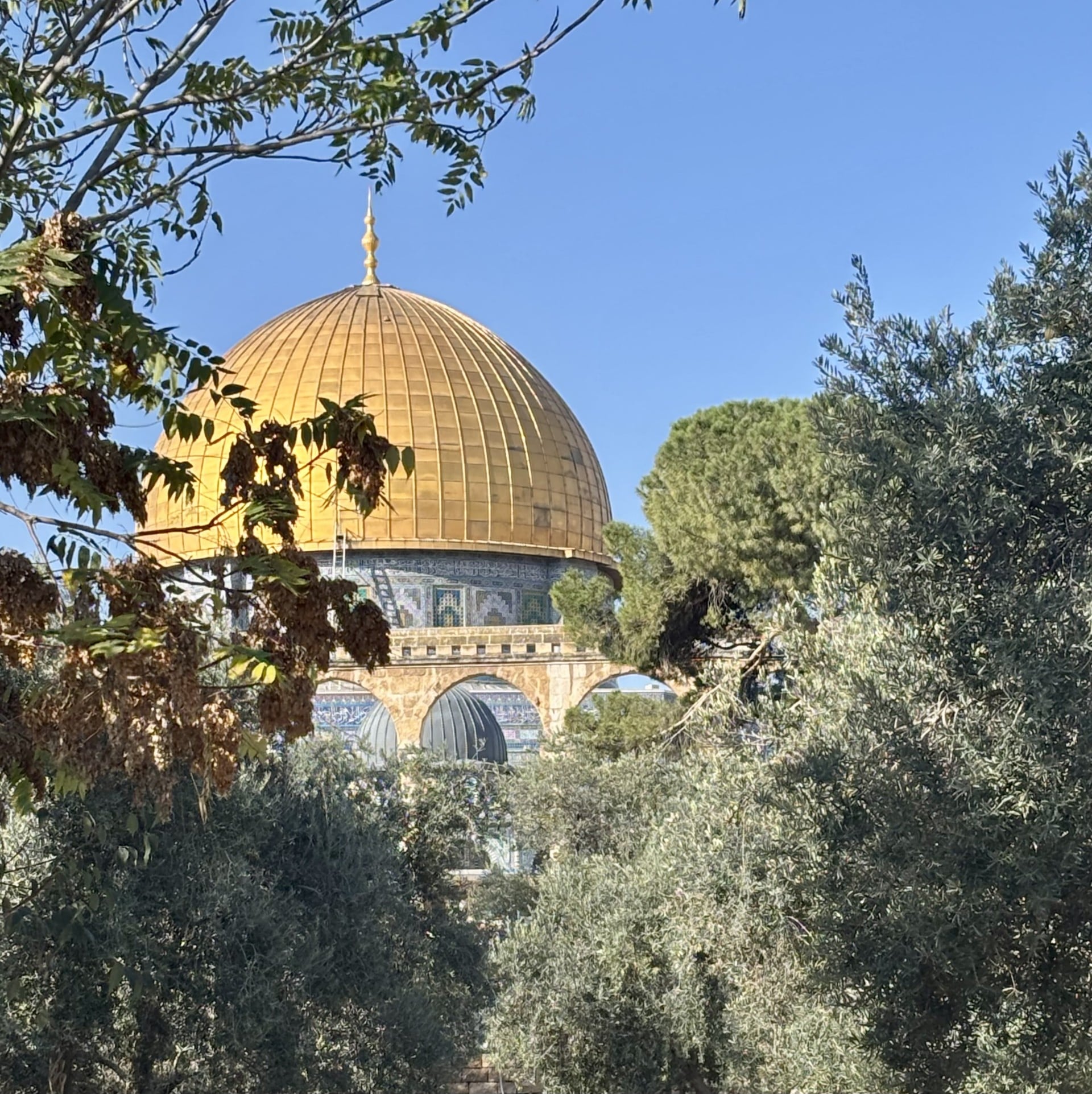
I looked over to where he was pointing, this orthodox Jewish man, with his kind, twinkling blue eyes. They were often on me, for he saw the tears in mine and presumed I was moved to tears by the sacredness of the place, rather than the intense distress I was actually feeling. I saw a part of the Beit Hamikdash, with the backdrop of the Golden Dome behind it. It makes a beautiful picture. Far less beautiful were the intensely agitated voices of the policeman and woman with us, constantly telling our guide to walk on. Under their constant gaze, I felt as though a grenade was about to be thrown on us any minute. The holiest place in our religion, apparently, and yet a ticking bomb.
What was even more unnatural was the very small number of Muslims present. A few, around and about, but we were by far the largest group.
What’s happened to them all? The guide was asked. Oh, after October the 7th, they don’t really feel safe here, he said.
Two holy sites, dedicated and sacred to the same God, but it looks like we are incapable of sharing.
Old news, isn’t it? Ishmael and Isaac and all that? Why should over five thousand and five hundred years make any difference? I mean, surely, that’s not nearly enough time to think of a way to change our education?
But funnily enough, we haven’t given up trying. Some of us, I mean.
For one week, five home room tutors and I took 67 of our year twelve students on a tour around Israel and the West Bank. We had organised and invited around six speakers per day, to talk about the conflict in the Middle East, their perspectives, and their ideas for the solutions to the conflict. Every day, we made sure the students heard at least three contesting opinions.
There was the woman who had witnessed and experienced the 7th October in Kfar Aza, who lost members of her family, friends, who described how she had had terrorists inside her own house, and yet who told us she knows many people in Aza just want quiet; they want Hamas to leave. She believes there can be peace between us.
There was the religious settler in Kiryat Arba, Hebron, who told us all about her life, since she was a child, and how their family and the Arab families used to interact, talk to each other, do business with one another. How things changed as she’d got older. She focused on her wonderful family and how much she loves living in her house and her neighbourhood. She hoped she’s a good mother, a good person. She mentioned, in passing, that her sons can’t join the army because they have been arrested in the past. She failed to mention why.
There was the Arab peace activist in Hebron, who told us, with a friend of his, how much they and all Palestinians just want peace, a quiet life, to live together with the Jews. And then there were the soldiers who were ostensibly there to protect the Arabs, not the settlers, who told the students not to believe anything he said.
There was the Jewish history teacher in Hebron who tried to convince the students he was relaying facts, using his very detailed PowerPoint presentation.
There was the young man who refused to go into the army, and told this group of very- soon-to-be soldiers just because you are born here, that does not mean you have to do things which you believe are wrong and against human values.
There was the adult from Neve Shalom who told the students: “There is another person, like you, who believes the same thing but about another reality altogether.”
On and on it went. Speaker after speaker, place after place. One lovely student (if a little on the dramatic side) said she felt as though she had been mentally tortured. Hadn’t they come on the week hoping to understand by the end of it who was right? Who to believe?
What is black? And what is white?
They found different colours, again and again.
The person who was supposed to hate all Arabs, a settler in the settlements, working for a charity where Jews and Arabs work together. The Arab Israeli who should be accepted by all his Israeli friends, just like he used to be, having to go back to his hometown after 7th October because he felt unsafe. The officer who has experienced four wars, who has fought and survived a hero, and who told the students, “If we kill all of them, then we are just like them.”
How do teenagers cope with such an education? A week of being told nothing is as it seems, there is no one right answer, there is no one right opinion, there is not even one stereotype of who this or that person is supposed to be.
And what did they have, at the end of it?
“I never thought it would be so hard.”
“Everyone is right. So, what can I do with this?”
“I came here knowing my beliefs. And then, I woke up.”
“How can I tell someone who’s never had a day out at the sea, that I am right?”
“I learned to listen.”
“It was good to be together. To listen to each other. I managed to understand each person we met.”
I feel privileged to be part of a school that gives this kind of education to our young people. I wish the whole world gave this kind of education to young people. Then us older people wouldn’t be in such dire need of that kind of education too.
And while the whole world judges us, and condemns us, and sometimes also shoots us, it is a blessing to know that at least in my little corner we are showing our teenagers, soon to be soldiers, what happens if you put a gun in the hands of someone who believes, absolutely, that what someone else teaches them is right.