


Middle East Forum Fellow/North Africa Risk Consultant
Egypt and Pakistan Are Co-Producing Weapons. Read the Fine Print.
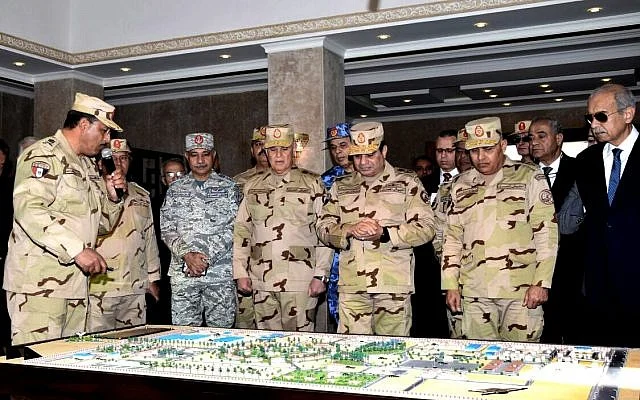
Egyptian President Abdel-Fattah el-Sissi, center, attends the inauguration of the East Suez Canal Counter-Terrorism command, in Sinai, Egypt on February 25, 2018. (MENA via AP)
Egypt’s military establishment does not make moves casually, and its deepening defense industrial partnership with Pakistan deserves more scrutiny than it has received. What looks on the surface like a routine bilateral agreement between two large Muslim-majority armies is in fact a signal of something broader: Egypt is systematically reducing its dependence on Western-controlled arms pipelines, and it is doing so by cultivating partnerships that carry embedded strategic complications the United States has yet to seriously address.
The immediate news is straightforward enough. Egypt’s Minister of War Production, Salah Jumblat, met last week with Pakistan’s ambassador to Cairo to discuss joint defense manufacturing, technology transfer, and industrial partnerships between Egyptian and Pakistani defense companies. The meeting followed a joint military exercise called “Ra’ad 2” conducted roughly a month ago, which brought together Egyptian paratroopers and Pakistani special forces on Pakistani training grounds. Egyptian President Abdel Fattah al-Sisi has now met with two successive Pakistani military chiefs in Cairo, in July and October of last year, each time with explicit emphasis on deepening security and military cooperation. This is not a relationship being assembled ad hoc. It is being constructed deliberately.
The model Egypt is pursuing mirrors what it has already done with Turkey: co-production arrangements that allow Egypt to manufacture weapons domestically, absorb foreign technical expertise, reduce procurement dependence on any single supplier, and generate export revenue. Egyptian military officials have been candid about the logic. Co-production with friendly states insulates Egypt from political pressure that could be exerted through arms sales leverage. It also signals deterrence. As one Egyptian military adviser framed it publicly, the message being sent is that the Egyptian armed forces constitute a force that cannot be taken lightly, and that Egypt partners with nuclear-armed states from a position of strategic confidence.
That framing matters. Egypt is not shy about advertising the deterrence dimension of its partnerships, including with Pakistan, which possesses nuclear weapons. Whether that nuclear dimension is intended to resonate regionally or specifically vis-a-vis certain audiences in Washington and Tel Aviv is a reasonable question, and not one Egyptian officials seem eager to answer.
The more concrete concern lies in the specific hardware reportedly under discussion. According to defense industry reporting, Egypt and Pakistan are in negotiations over joint production of JF-17 fighter aircraft and attack drones inside Egypt, alongside Egyptian interest in Pakistani programs to upgrade Mirage jets into cruise missile launch platforms. The JF-17 is not simply a Pakistani aircraft. It is a co-development with China, built with Chinese engines, Chinese avionics, and Chinese technical infrastructure. A decision by Egypt to manufacture JF-17s domestically would mean integrating Chinese aerospace technology into the Egyptian defense industrial base in a way that is qualitatively different from simply purchasing Chinese hardware. It would create enduring supply chain dependencies, technical personnel exchanges, and maintenance relationships with Chinese defense entities that could prove difficult or impossible to unwind.
This is the dimension that the United States has consistently underweighted in its approach to Egypt. Washington’s leverage over Cairo has historically been exercised through military aid and arms supply. Egypt, aware of this leverage and chafing under it, has spent the better part of a decade building an architecture designed to make that leverage irrelevant. It has held four major defense industry exhibitions since 2018 showcasing domestically manufactured tanks, drones, rocket artillery, and advanced air defense systems. It has co-production arrangements with Turkey. It has pursued deals with South Korea, France, and Russia, sometimes simultaneously. The Pakistan partnership is not an isolated development. It is the next tile in a mosaic that Egypt has been laying methodically.
For American policymakers, the instinct has been to treat each of these bilateral arrangements as separate problems to be managed individually. That approach misses the cumulative effect. Egypt is not shopping for weapons. It is building a defense industrial ecosystem specifically calibrated to eliminate the pressure points that external powers, including the United States, have historically used to influence Egyptian behavior. Once that ecosystem reaches sufficient maturity, the traditional toolkit of American influence over Cairo narrows considerably.
The invitation extended to Egypt’s war production minister to attend the IDEAS 2026 defense exhibition in Karachi this November is not a footnote. It is an indication that this relationship is moving from political consultations into institutional depth. Defense exhibitions are where supply chains get built and where long-term industrial relationships get cemented.
The United States still has time to engage Egypt on what co-production with Chinese-platform-dependent partners actually means for interoperability, for intelligence security, and for the durability of any future security cooperation. That conversation will be considerably harder to have once the manufacturing lines are running.