


Middle East Forum Fellow/North Africa Risk Consultant
Egypt’s Gaza Deployment: A Force Built to Fail
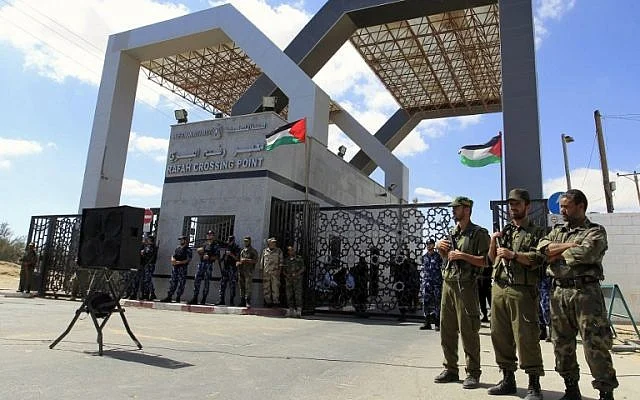
Members of Hamas' security forces standing guard in front of the Rafah border crossing with Egypt in the southern Gaza Strip, September 16, 2013. (photo credit: AFP PHOTO/SAID KHATIB)
The U.S. State Department announced this week that Egypt has formally joined the International Stabilization Force for Gaza, posting photographs of Egyptian military personnel and describing Cairo’s contribution as “critically important” to the mission’s success. On its face, this looks like meaningful progress toward the Phase 2 commitments of the Sharm el-Sheikh ceasefire agreement. In reality, Egypt’s participation reveals precisely why the force cannot accomplish what Phase 2 actually demands.
The problem is not Egypt’s involvement. The problem is Egypt’s conditions for it.
Egyptian military and diplomatic officials have been explicit that Cairo does not want the Stabilization Force to carry a “peace enforcement” mandate. In the language of their own experts, a peace enforcement role would mean “military confrontation with Palestinian resistance elements,” and that is something Cairo will not accept. Read plainly, Egypt is willing to deploy troops to monitor crossings, oversee aid flows, and watch Israel withdraw from territory it controls. Egypt is not willing to disarm Hamas. That distinction is not a footnote. It is the entire problem.
Phase 2 of the ceasefire framework was premised on a Gaza that is moving toward permanent calm, which requires, at minimum, a credible process for neutralizing the military infrastructure that produced October 7. There is no version of long-term stabilization that coexists with an armed Hamas governing an enclave on Israel’s southern border. A Stabilization Force that is structurally prohibited from confronting that reality is not a stabilization force. It is an international monitoring mission with a better name.
This is not a new failure mode in the region. The precedent is UNIFIL in southern Lebanon, a force that spent nearly two decades issuing statements while Hezbollah built a precision missile arsenal capable of striking deep into Israeli territory. UNIFIL’s mandate was robust on paper and paralyzed in practice because its contributing states, including many of the same countries now pledging troops for Gaza, defined success as the absence of direct confrontation rather than the absence of armed threat. The result was not stability. It was the management of instability in ways that suited Hezbollah’s timeline. There is every reason to believe the Gaza Stabilization Force will follow the same trajectory if its mandate is shaped by the same logic.
Egypt’s position is at least coherent from Cairo’s perspective. Egypt genuinely fears the precedent of Arab military forces taking kinetic action against Palestinian armed groups. The domestic political costs would be significant, and Cairo has spent years cultivating its image as the indispensable mediator precisely because it never places itself in direct opposition to Palestinian factions. A Hamas delegation led by Khalil al-Hayya arrived in Cairo the same day Egypt’s Stabilization Force participation was confirmed. That juxtaposition is not coincidental. Egypt wants to be on both sides of this equation, which means it cannot be fully useful on either.
The World Peace Council, the multilateral body overseeing Phase 2 under American stewardship, has also been slow to convert pledges into deployments. Since February, when five nations including Morocco and Indonesia publicly committed troops, the force has existed largely as a framework rather than a functioning entity. Egypt’s formal entry may accelerate the deployment timeline, but it does not change the underlying mandate problem. A larger force built around the wrong mission statement is not better than a smaller one.
Israel’s position in all of this is uncomfortable but clear. Jerusalem cannot endorse a force that will operate in Gaza under a mandate that leaves Hamas’s military capacity intact. Doing so would legitimize a security architecture designed to constrain Israeli freedom of action without imposing equivalent constraints on the actors who threaten Israeli civilians. The pressure from Washington to cooperate with the Stabilization Force is real, and Israel will face significant diplomatic costs if it appears to obstruct a mechanism that American officials have publicly praised. But accommodation is not the same as endorsement, and Israel should be unambiguous with its American partners about what the force’s current mandate actually accomplishes.
The fundamental question that Egyptian officials themselves have raised, whether the force is designed for peacekeeping or peace enforcement, has still not been answered by the parties who created it. That ambiguity was politically convenient during the negotiations at Sharm el-Sheikh. It is now operationally disqualifying. A force that cannot answer that question cannot protect a single Israeli community from renewed attack, cannot prevent Hamas from reconstituting behind whatever security umbrella the international community provides, and cannot deliver the durable outcome that Phase 2 promised.
Egypt joining the Gaza Stabilization Force is not a step toward that outcome. It is a demonstration that the force’s contributing states have already negotiated away the tools necessary to achieve it.