


Middle East Forum Fellow/North Africa Risk Consultant
Egypt’s Great Betrayal? Why Cairo Protects Hamas as Iran’s Empire Burns
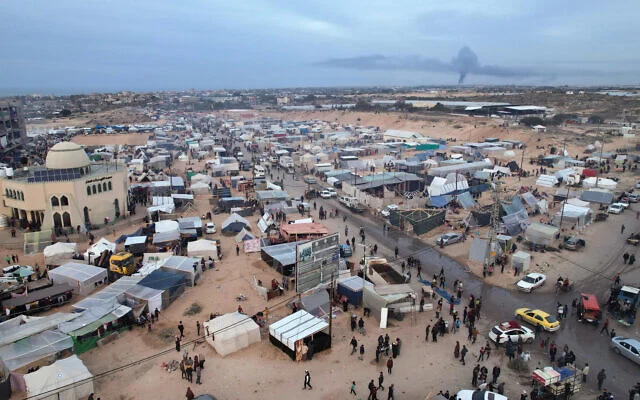
An aerial picture shows displaced Palestinians who fled Khan Yunis setting up camp in Rafah further south near the Gaza Strip's border with Egypt, on December 7, 2023 (Mahmud Hams / AFP)
As Israeli and American strikes turn Tehran’s oil depots into raging infernos and black toxic rain falls on the Iranian capital, Egypt’s leadership has locked onto a single obsession: preventing any Palestinian from leaving the war zone in Gaza.
This is not compassion. This is a deliberate strategy that keeps Hamas in business, freezes the conflict in perpetual misery, and blocks the only realistic path to breaking the cycle of terror once and for all.
The Egyptian position sounds reasonable at first glance — no “displacement,” no emptying of Gaza, no Israeli exploitation of the chaos in Iran. But look closer and the hypocrisy screams. For years Cairo has kept the Rafah border locked tighter than a vault, citing national security threats from jihadists. It has poured troops into Sinai to crush Islamist networks. It has watched Gaza rot under Hamas rule — tunnels, rockets, human shields — without ever offering ordinary Palestinians a genuine exit or alternative. Now, precisely when the Iranian axis that bankrolls Hamas is collapsing in real time, the same leadership suddenly treats any movement of civilians out of the combat zone as an existential catastrophe for Egypt.
This is strategic insanity.
The timing exposes everything. While the IRGC’s top commanders are being eliminated in Beirut hotels and Iran’s proxies run out of cash and orders, Cairo warns of Israeli “plots” to exploit the moment. Yet the real plot has always been Hamas’s: turn Gaza into a permanent launchpad for Iranian-funded war, hide behind civilians, and count on Arab capitals to protect the status quo. By insisting every Palestinian must remain trapped in the killing field, Egypt guarantees Hamas can regroup, rebuild tunnels, and prepare the next massacre. It transforms Gaza into a pressure cooker that Egypt itself fears will eventually blow toward Sinai — a self-fulfilling prophecy created by its own policy.
True security demands the opposite. Israel is methodically clearing Hamas infrastructure while offering civilians a future free of jihadist rule. Arming Gaza’s clans, empowering local governance untouched by Hamas, and allowing families who want safety to relocate temporarily or permanently is not displacement — it is liberation. It drains the human shield pool Hamas relies on. It lets ordinary Palestinians vote with their feet against terror. Egypt’s refusal to allow even that option keeps the civilian population chained to the very terrorists who have destroyed their lives.
This stance is also economically suicidal for Egypt itself. The Iran war is already spiking food prices, threatening electricity supplies, and straining supply chains. Egyptians are being told to report hoarders and prepare for rationing. Yet instead of focusing every resource on stabilizing its own population and economy, the leadership diverts diplomatic energy to phone calls with European leaders and public statements condemning Israeli actions in the West Bank. The message is unmistakable: Egypt would rather risk domestic hardship and regional chaos than allow the Palestinian issue to be resolved through decisive victory over radical Islam.
The human cost of this obsession is staggering. Hundreds of Lebanese civilians, including dozens of children, have died because Hezbollah dragged its country into Iran’s war. Saudi civilians have fallen to Iranian missiles targeting Gulf infrastructure. Yet Cairo’s loudest outrage is reserved for the mere possibility that some Gazans might escape the battlefield Israel is sanitizing of terror. This selective compassion reveals the priority: preserving the Palestinian cause as a perpetual tool of leverage rather than ending the suffering through strength.
Israel does not need Egyptian permission to finish the fight. The Jewish State is doing exactly what any nation facing existential threat must do — destroy the enemy’s capacity to attack while creating conditions for civilians to choose life over death cults. Forcing every Palestinian to stay put under Hamas shadow is neither humane nor wise. It only guarantees the next round of rockets, tunnels, and hostages.
The collapse of the Iranian regime is a historic earthquake. The entire axis that sustained Hamas and every rejectionist front is fracturing before our eyes. Egypt’s leadership now faces a binary choice. It can cling to outdated fears and anti-Israel reflexes, isolating itself further as the region realigns around victory over terror. Or it can recognize that true national security requires dropping the old rejectionist playbook and aligning with the forces that are actually winning.
The black rain over Tehran is not merely an environmental catastrophe for the mullahs. It is a loud strategic alarm for every Arab capital still trapped in yesterday’s thinking. The era of weaponizing the Palestinian issue to justify endless conflict and internal paralysis is ending. Egypt’s obsessive resistance to any form of civilian relocation is not defending national security — it is delaying the only outcome that can finally bring stability and prosperity to Gaza and the wider region.
Israel will not pause until the mission is complete. The question for Cairo is simple: will it continue shielding the terrorists of yesterday, or will it finally join the side of history that is delivering victory today?