


Middle East Forum Fellow/North Africa Risk Consultant
Egypt’s Turkey Embrace Is a Test Washington Is Failing
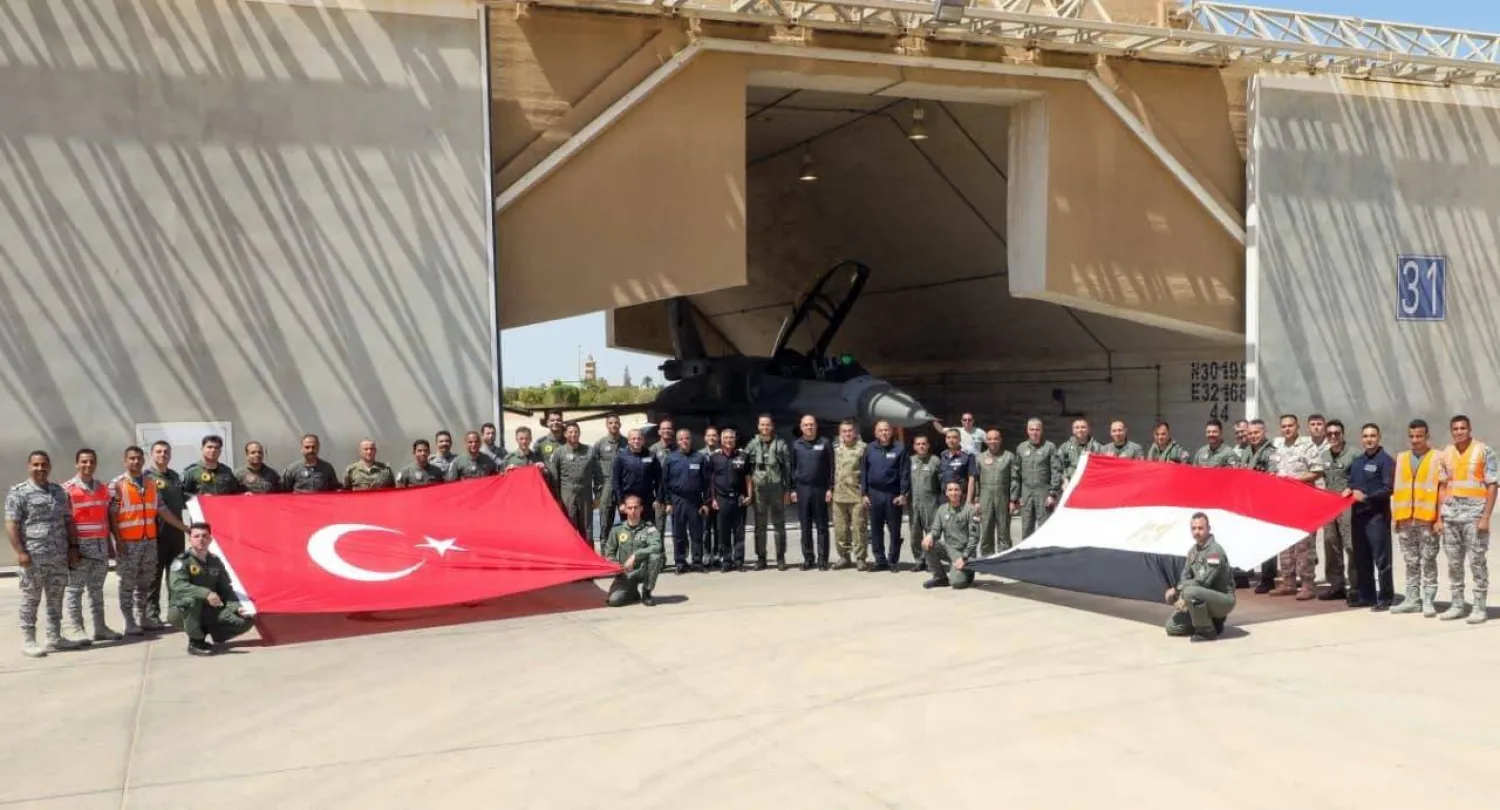
The Egyptian-Turkish joint air training on Thursday (Egyptian Military Spokesman’s official Facebook page)
Egypt’s decision to conduct simultaneous joint military exercises with Turkey and Oman this week has been greeted with the usual diplomatic boilerplate about exchanging training expertise and unifying operational concepts. In Washington, it has barely registered at all. That silence is itself the story.
The drills are not incidental. Egyptian and Turkish fighter jets are currently conducting multi-role air sorties from Egyptian airbases, building on a special forces exchange in Ankara in April and naval maneuvers in the eastern Mediterranean last September, the first of their kind in thirteen years. Simultaneously, Egyptian commando units are running joint exercises with Omani special forces under the Qal’at al-Jabal 2 framework. Cairo is not hedging opportunistically. It is constructing a deliberate multi-vector military posture designed to signal independence from any single patron, including Washington.
The Turkish dimension deserves scrutiny it is not receiving. Recep Tayyip Erdogan’s government did not merely fall out with Cairo over the Muslim Brotherhood in 2013. It spent the following decade actively working to undermine the moderate Arab security architecture that anchors Israeli and American interests across the region. Erdogan called Israel’s prime minister a terrorist, opened Turkish territory to Hamas political leadership, and positioned Ankara as the leading state voice of militant Palestinian nationalism. None of that has meaningfully changed. What has changed is Egypt’s willingness to compartmentalize, treating Erdogan’s anti-Israel posturing as someone else’s problem while absorbing Turkish investment and military interoperability.
The Oman exercise running in parallel is not coincidental decoration. Muscat is the region’s designated mediator, the one Gulf capital that maintains functional relations with Tehran, Jerusalem, and Ankara simultaneously. Egypt training with both Turkey and Oman in the same week is a message about strategic identity: Cairo refuses to be categorized. For Sisi, that ambiguity has domestic value, projecting an image of sovereign foreign policy at a moment when Egypt’s economy remains structurally dependent on IMF disbursements, Gulf bailouts, and American aid. But ambiguity as a strategy has costs that Cairo is not being asked to pay.
The United States provides Egypt with approximately 1.3 billion dollars in military assistance annually. That figure has remained largely stable for decades, functioning as a post-Camp David entitlement rather than a strategic instrument. Washington has attached human rights conditions to portions of that aid, periodically withholding tranches over specific cases, but it has never seriously deployed the military relationship as leverage over Egypt’s strategic alignment. The result is a partner that takes American weapons and American money while deepening military interoperability with a government actively hostile to American allies.
The Abraham Accords framework did not create a formal alliance, but it ratified an emerging security logic: Arab states aligned against Iranian expansionism and militant Islamism could normalize with Israel and collectively stabilize the region. Egypt was never a signatory, but it functioned as a pillar of that architecture, maintaining its peace treaty with Israel and coordinating on Gaza border security. Every incremental step Cairo takes toward Ankara erodes that architecture. Turkey’s military and political networks in Gaza, Libya, Somalia, and the Sahel represent precisely the destabilizing vectors the Accords framework was designed to contain. Egypt is now training alongside those networks rather than against them.
This expanding Cairo-Ankara axis is particularly evident in the Horn of Africa, where their coordinated military and diplomatic footprint in Somalia is actively rewriting maritime access and regional stability parameters. Yet, Washington continues to view these defense realignments through a localized lens, ignoring how they dilute Western influence on broader geopolitical fronts.
Washington should respond with conditionality that is specific, enforceable, and tied directly to the military aid relationship. Future tranches should require Egypt to certify that operational concept harmonization with Turkish forces does not extend to scenarios involving the Gaza periphery, the eastern Mediterranean, or Libya’s western theater, where Turkish and American interests remain in direct tension. Cairo should also be asked, formally, to clarify the scope of its military coordination with Ankara given Turkey’s ongoing support for networks that threaten Israeli security. That conversation has never happened because Washington has never demanded it.
Egypt is not an adversary. But it is not behaving like a partner either. Washington manufactured that ambiguity by never requiring a choice, and it will eventually have to live with the consequences.