Eight Lights for Hanukkah
Do you know all the secrets hidden in the roots of Hanukkah?
Why, really, do we say Hallel on Hanukkah?
- In our part of the world, the week of Hanukkah is the darkest week of the entire year. The days are shortest, the nights longest, and toward the end of the month the moon itself disappears. Rosh Ḥodesh Tevet is the darkest twenty-four hours of the year. Only afterward does the moon begin to wax again, and by the end of Tevet the days themselves start to lengthen.
- This is why the Talmud (Avodah Zarah 8a) speaks of eight days of fasting observed by Adam, in response to his realization that the days were growing shorter, out of deep anxiety that the world was sinking into darkness as a consequence of his sin. When Adam later saw that the days were growing longer he understood the fixed, benevolent order of creation and established eight days of celebration. Later, idolaters appropriated these days, turning them into pagan fire festivals and markers of a new year.
- Precisely at this time, the olive harvest and pressing come to an end. The olive-oil season begins at Sukkot and concludes at Hanukkah. Hence the verse, “You shall observe the festival of Sukkot for seven days, when you gather in from your threshing floor and your winepress” (Deut. 16:13)—but your oil waits for Hanukkah. This is why the Mishnah (Bikkurim 1:6) rules that first fruits may be brought until Hanukkah.
These first three “lights” have nothing to do with the Hasmoneans. They are embedded in the natural rhythms of our land and of creation itself: the light of oil rises precisely at the annual low point of light.
- The prophet Haggai describes the severe drought and the preparations for rebuilding the Second Temple in the second year of Darius. The drought ended when even “the olive tree failed to bear fruit,” and on the 24th of the month of Kislev, Haggai concluded his prophecy with the declaration that “from this day onward” (that is, from the 25th of Kislev)—the day the foundations of the Temple of the Lord were laid and construction began—“from this day I will bless” (Haggai 2:15–19).
- The Second Temple did not contain the Ark of the Covenant with the Tablets and the cherubim, which had served as the “footstool” of the heavenly Throne of Glory in the First Temple. The Holy of Holies had already been hidden away before the First Destruction and remained concealed thereafter (Maimonides, Hilkhot Beit HaBeḥirah 4:1). Thus, in the Second Temple, only the golden menorah—mikshah zahav, hammered from a single piece of gold—stood as the expression of kindling sacred light, even when the Holy of Holies held only the Foundation Stone, without the revealed Presence of God in the land.
- Two months after the founding of the Temple, as foretold by Haggai, the prophet Zechariah (from the middle of chapter 1 through the end of chapter 6) described the lights of the Second Temple through a series of visions—visions of a menorah. They begin with “red, sorrel, and white horses” roaming the earth and conclude (in chapter 6) with chariots and horses in similar colors, evoking the image of sunrise itself.On the Haftarah of Shabbat Hanukkah we read only the central vision of the menorah with the “two olive trees” from which oil is poured into it. But the full meaning cannot be grasped without reading both Haggai’s prophecies and Zechariah’s visions through the end of chapter 6 (see my article at https://www.hatanakh.com/en/articles/secret-chanuka-revealed-prophecies-chaggai-and-zekhariah).
These three lights from the dawn of the Second Temple predate the Hasmoneans by centuries and connect directly to the earlier lights: the Second Temple was founded on the 25th of Kislev, at the end of the olive pressing, at the darkest point of the year; the gold that shone in it was the menorah; and Zechariah’s prophecies were revealed in visions of a menorah.
Only with the seventh light do we arrive at the days of the Hasmoneans.
- First Maccabees (chapter 4) recounts how Judah the Maccabee and his brothers purified the Temple from pagan defilement and celebrated eight days of Hanukkah on the very same date on which the sanctuary had been desecrated three years earlier. It is shocking to discover that the Hellenizers chose to profane the Temple precisely on the day the foundations of the House of God had been laid according to the prophecies of Haggai and Zechariah—turning those days into a celebration of an idolatrous temple in Jerusalem.After three years of warfare, and following Judah’s first four battles against the Seleucid Greek armies, the Hasmoneans purified the Temple and reestablished the House of God in purity, in fulfillment of Haggai’s and Zechariah’s prophecies. A year later, they fixed the eight days of Hanukkah as a festival for all generations.
- With the destruction of the Second Temple, all the Hasmonean victories were erased. The menorah itself was carried off to Rome, immortalized in the horrific relief on the Arch of Titus—the enemy who destroyed the Temple. The Jews of Rome strictly forbade going to see that arch, until the establishment of the State of Israel.All the celebratory days recorded in Megillat Taʿanit were annulled, except for Hanukkah and Purim (Taʿanit 18–19). But why did Hanukkah remain? After all, all the Hasmonean victories were wiped away. This question lies hidden within the famous Talmudic inquiry (Shabbat 21b): “Mai Hanukkah?”—“What is Hanukkah?”
From the perspective of mourning the destruction, even Hanukkah should have been abolished; it seemed as though darkness had prevailed. Only the memory of the “miracle of the cruse of oil” preserved the days of Hanukkah—the light of oil rising at the darkest point of the year—and sustained Maʿoz Tzur Yeshuʿati through all the generations of exile.
And now—Rome has fallen. Its heirs have fallen as well. We have merited to return to the land of our ancestors through the wondrous miracle of the ingathering of exiles. We sing Maʿoz Tzur not only for ancient miracles but for the miracles of independence and renewal. The State of Israel took the image of the menorah from the Arch of Titus and restored it to Jerusalem as the emblem of the state.
Many years ago, I once greeted Rabbi Mordechai Breuer, of blessed memory, on Shabbat. With a sigh he told me that his family had taken him on a trip to Rome. I asked, “What did you see there?” He asked me in return, “Do you know what appears on the other side of the Arch of Titus, opposite the menorah?”
I replied, “I have never been there, and I do not intend to go.”
With an excitement I had never seen before, he said: “Horses! I—Mordechai Breuer of Jerusalem—stood in Rome and saw Zechariah’s visions once again!”
In Zechariah’s prophecies, the horses express God’s sovereignty over the world, and the menorah stands in the House of God in Jerusalem.
On the Arch of Titus, the horses represent Rome’s dominion over the world; the menorah is taken to Rome; the Jews are in exile.
With the return to Zion, the horses return to the Creator who governs history, and the menorah returns to Jerusalem—together with the State of Israel as a state of ingathered exiles, and with the miracles of independence and renewal.
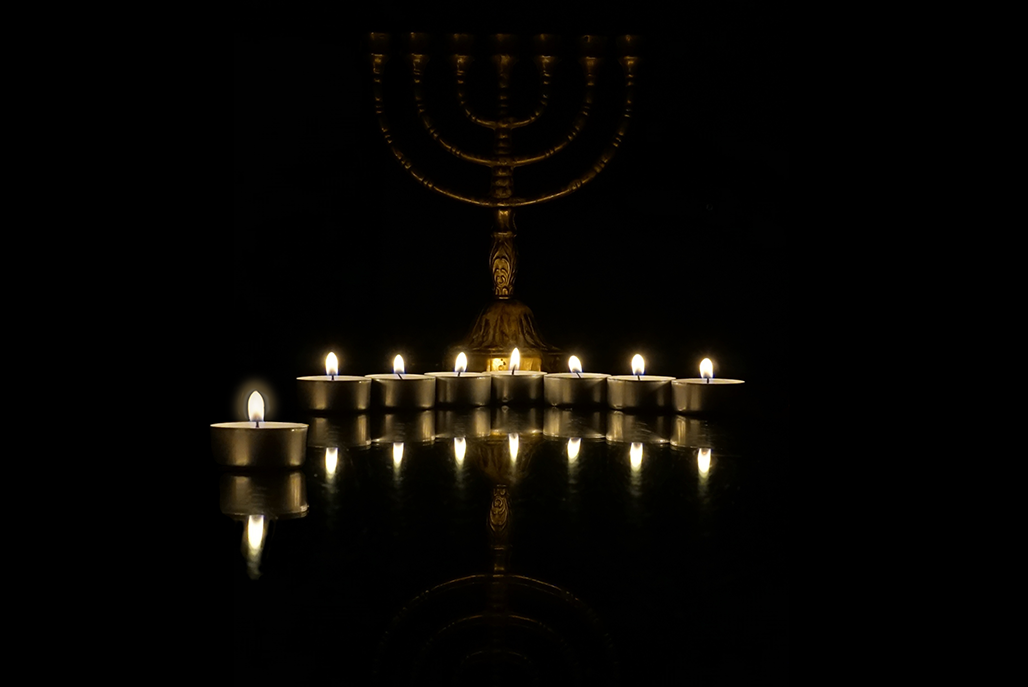
These are the eight lights of Hanukkah.