


Einat Wilf’s Solution to the Conflict Involves Conversion Therapy for Palestinians
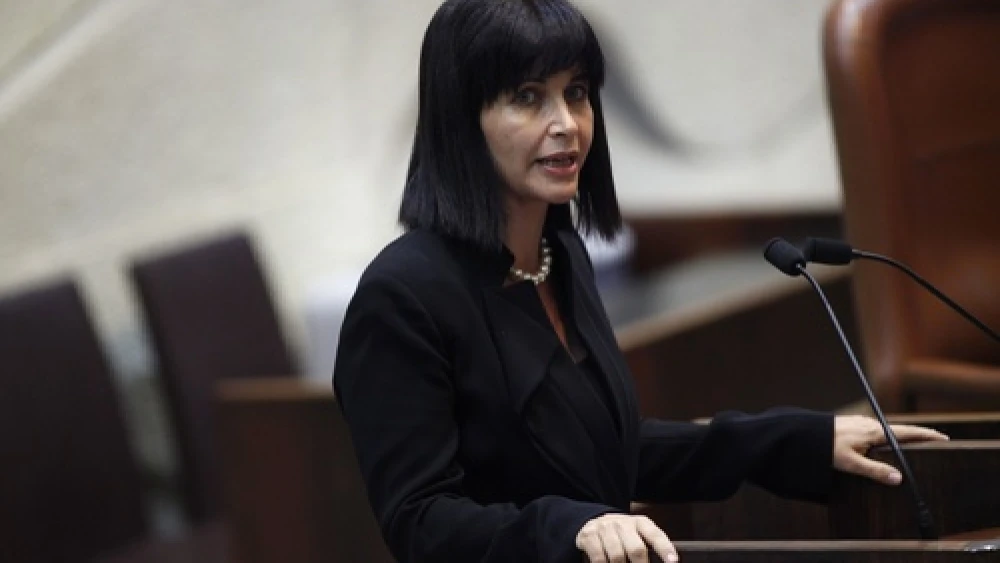
Dr. Einat Wilf has joined the list of parties and party fragments that claim to represent those undecided between the blocs and effectively maintain Netanyahu’s coalition in power. Wilf chose to join her colleagues, Yoaz Hendel and Yaron Zelekha, despite little public support.
I am writing about her, not the others, because I have a personal perspective as someone who knew and appreciated Dr. Wilf in the past and, like her, was a foreign policy advisor to the late Shimon Peres. Therefore, it is difficult for me to understand what led her worldview to extreme nationalism. There is no problem with changing positions, but I want to clarify that Dr. Wilf is currently on the far right, for anyone who might be confused by her liberal appearance.
Wilf has built a career on the argument that a permanent settlement with the Palestinians is impossible because they supposedly refuse to accept the Zionist narrative. This position is clearly anti-Zionist. She accuses the Palestinians of passivity and lack of responsibility, but that’s precisely what she preaches. She evades taking responsibility for our fate, leaving the initiative in the hands of others, and leads to the dismantling of Zionism, as the illusion of the status quo and the approach to managing the conflict lead to a bi-national state without a solid Jewish majority, and thus to the loss of the democratic national home for the Jewish people.
Wilf’s main argument, that the Palestinians will never give up on the right of return and that they are intent on flooding Israel with millions of refugees, is contrary to reality. While the evasion of an agreement and the rush to annexation, which Dr. Wilf partially shares, indeed guarantee the loss of the Jewish majority, it is precisely the Palestinian side in the various rounds of negotiations that has demonstrated an understanding and acceptance that the right of return will not be fully realized within the borders of Israel.
The vast majority of the negotiators – Israelis, Americans, and others – testify that the issue of refugees was not a barrier to the agreement and that the PLO leadership has understood since Oslo that any arrangement on the refugee issue would include their resettlement in their host countries, in third countries, and in the Palestinian state when it is established, and only Israel would decide whether to accept a limited number of refugees into its territory.
It would be better for Wilf, instead of talking and writing about Palestinians, to meet with them. Thus, she will learn that the PLO leadership is more pragmatic than she is and is ready for practical solutions – including those they proposed in the past – that align with the Jewish character – and majority – of the State of Israel.
And it is not just the leadership; according to the latest survey (August 2026) by the Palestinian Center for Policy and Survey Research, led by Dr. Khalil Shikaki, 56% of Palestinians support the two-state solution based on the 1967 borders. Although this figure is less than during periods of hope, it is still a clear majority, and this is before a government is elected in Israel that could enable the realization of the vision.
The Palestinians have not only internalized the necessary change. The entire Arab world demonstrated this with the Arab Peace Initiative of 2002 – reaffirmed in the Arab League summits – which stipulated that Israel has veto power over any arrangement regarding the refugee issue. Indeed, since that gathering over two decades ago, the Arab world has referred to the issue as the “refugee problem” and not the “right of return.”
Wilf presents herself as a liberal and supports a political solution when possible, but her conditions for that “when possible” drain any expectation of substantive content.
Wilf was a member of the Knesset for three years, serving, serving in the 18th Knesset. Initially as a member of the Labor Party and later as part of the Independence faction led by Ehud Barak, which broke away from the Labor Party in order to continue serving in Netanyahu’s government. Her term in office is mainly remembered for her call, ahead of the 15th anniversary of Rabin’s assassination, to remove Yitzhak Rabin’s picture from the wall of the Labor Party’s faction room. “It is time for our party to stop nurturing Rabin, who represents a lost opportunity for many,” she said at the time.
In the 15 years since then, she continued her ideological journey, far from the legacy of Rabin and Peres, into the embrace of extreme right-wing ideas wrapped in the false guise of “militant center-left.”
Wilf, who titled one of her books “Peace Not Now,” carries the name of peace in vain in a worldview whose essence is that “neither peace nor security will be possible as long as the Palestinian ideology built on the denial of Zionism continues to exist.” To the disregard for repeated Palestinian recognition of the State of Israel, she adds an even stranger layer: a demand for “Arab Zionism.” In other words, her solution to ending the conflict is to subject Palestinians to conversion therapy, forcing them to abandon their Palestinian identity and embrace Zionism.
Only when the Palestinians adopt Zionism is she willing to consider talking to the “Mandate Arabs, now known as Palestinians” about “coexisting alongside the State of Israel.” Thus, the demand to recognize our Zionist identity is accompanied by a denial of the Palestinian national identity. A strange basis for an arrangement and for coexistence in peace.
And until the Palestinians join the Zionist movement, from Wilf’s perspective, Israel can apply its sovereignty anywhere. “It is definitely possible to annex territories to the State of Israel,” she notes in her party’s goals, requesting that new settlements be established only in the annexed territories, fulfilling the annexation dream of the far-right in her platform and living in peace with the contradiction between the platform and her willingness to see the existence of the ‘Mandate Arabs’ alongside the State of Israel.
For the Arab citizens of Israel, Wilf leaves two options: to enlist in the IDF (which does not want them) and fight against their people, or to lose civil rights to education, health, welfare, and more. But even if they enlist in the IDF, they will not receive education in their language because, in her view, “the state will fund only state education in the Hebrew
This is the paternalistic and racist conversionist vision that Wilf offers to the Palestinians. Such a vision is suitable for the study hall of those who adhere to Jewish supremacy on the fringes of Israeli society.
What is, of course, absent from Wilf’s vision is the need to repair the state and restore it from the harsh reality into which the perception of conflict management has led us: the strategy of treating all Palestinians the same, which has weakened the Palestinians who seek a political settlement, and the funding of the believers in a solution through terror.
Instead of leading to a resolution, we are racing toward a bloody bi-national reality. Instead of helping to empower a moderate Palestinian partner who seeks peace, we paint every Palestinian in the colors of Hamas and the denial of our existence. And all of this is happening while denying the fact that since the PLO recognized Israel in 1988 and the entire Arab world in 2002, we have refused to recognize the other side’s right to a state.
Those who seek a hawkish center-left can discover many answers within the current party system. Those who want to support ideas of religious and racial supremacy are invited to vote for Wilf. Even if it fails or succeeds, the votes of those who support it will significantly contribute to Netanyahu’s attempts to cling to power.