
Founder | Children’s Book Author | Empowering Women and Girls & Supporter of Global Peace Initiatives | Mom | Yema
Featured Post
A Yom Kippur prayer found me in my mother’s kitchen
From Granada to Morocco to Montreal, El Nora Alila has traveled through centuries of Jewish exile. This year, it helped me come back home
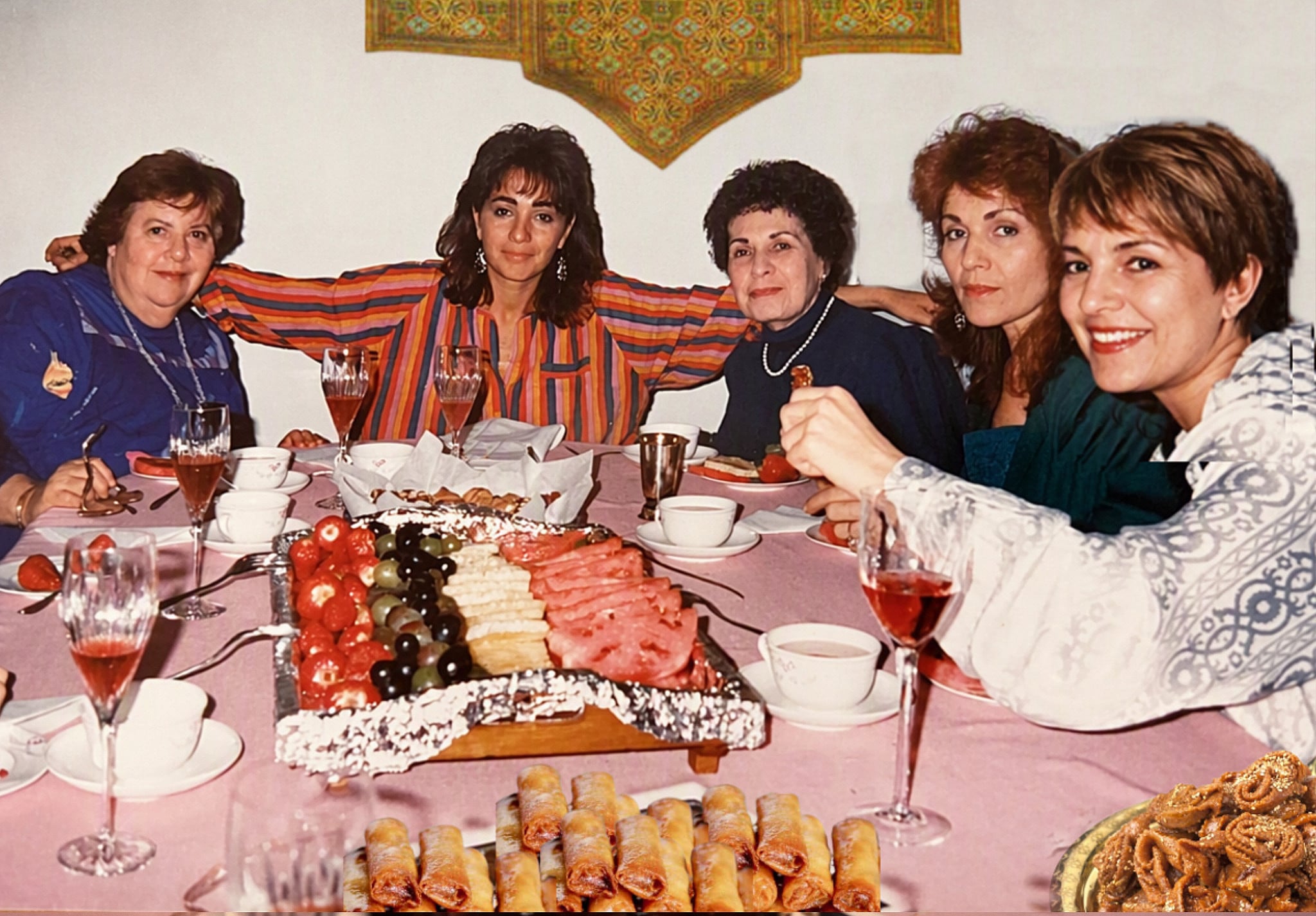
The author with family and friends at Yom Kippur break-fast meal (1987)
This story begins with a woman standing in her kitchen at eleven at night making almond cigars dipped in honey, dressed in a simple caftan, and behaving as though there were no other possible way to welcome the Jewish New Year, and later, to break the Yom Kippur fast.
It’s September, a few days before Yom Kippur, and El Nora Alila, part of the Sephardic and Mizrahi rite, won’t be sung this year at the Chabad synagogue I attend in San Diego. It’s not a piyyut, a Hebrew prayer-poem, that I think about during the year. It used to surface once a year, many years ago, at a Sephardic synagogue, in the hour when the gates of Yom Kippur are closing, and then it would disappear again for 12 months.
But I have just come back from Montreal, where I spent August with my 89-year-old mother, who recently suffered a stroke, and somewhere between the hospital corridors, her kitchen table, and the upcoming holidays, the melody rose up in me on its own. It pulled me straight back to childhood, the way nostalgia does, uninvited, for a version of the past that only exists once you’re far enough from it.
It arrived the way certain things do when you’re home and suddenly surrounded by smells and images: mint tea steeping on the stove, my mother’s caftans folded in a drawer, our family photos out on the table, the men in tasseled fezzes and djellabahs, the women with painted, iconic faces and pointed babouches beneath silver-threaded caftans. The memory of sticky, golden cigars and shabakia served at break-fast gatherings, shared with the same close circle every year. But it isn’t only celebrations that pull people together like that. Tragedy and illness do the same. When my mother got sick, the same people showed up with food, with visits, with phone calls, with prayers.
I grew up between Israel and Montreal, in Sephardi synagogues where this song was sung with a kind of joy that never quite matched its subject matter: God’s judgment, the closing gates, the last hour to plead your case before heaven locks its doors for another year. And yet everyone sang it like a celebration. As a kid, I never questioned that contradiction. Sitting beside my mother last month, I understood it in my body before I understood it in my head.
So I went looking for the song’s origins. What I found surprised me, not just the history, but how much of my own moment was already folded inside it.
Turns out there’s a man behind the poem, and not a happy story. Moses ibn Ezra was born in Granada, Spain, around 1055, into a Jewish world entwined with Arabic poetry and philosophy, and earned the nickname Ha-Sallaḥ, writer of penitential prayers. Then the Almoravids took Granada, the Jewish quarter was destroyed, and he fled and never went home, spending his life writing about longing and impermanence, which, if you’ve ever left a place you loved without choosing to, is a feeling I understand now in a way I didn’t before. He died after 1138, still displaced. Granada barely remembers him. Another poet from the city has a statue; he has almost nothing. A man who asked all his life to be seen by God, invisible where he came from.
Except he isn’t, not entirely. El Nora Alila opens Ne’ila, the last service of Yom Kippur, and Ne’ila means closing, the image of the gates of heaven swinging shut as the sun goes down. In the version I know, there are eight stanzas, each circling back to that phrase, like someone knocking on a door they know is about to lock. Tucked into the opening letters of the poem is his name and a blessing: Moshe Chazak Tam, Moses, may he be strong and whole. Read down instead of across, and there he is. He hid his name inside the prayer, and centuries later, people still sing it without knowing it’s there.
There’s a mystical layer too, something about this hour reaching the deepest, most singular part of the soul, the part the rest of the year keeps sealed. Maybe that’s why tradition asks you to sing here instead of pray. The version I know best, Meir Banai’s from 2007, acoustic guitar and a dum-tak-tak rhythm built for dancing, takes a poem about dread and gives it a pulse. Urgency and joy, both at once.
I don’t know exactly why this piyyut came back to me now, decades later, in my mother’s kitchen instead of a synagogue. But exile and return might be the same motion, seen from different distances. Ibn Ezra never got back to Granada, my ancestors never got back to Spain or Portugal, my parents left Morocco and never went back either, and I got on a plane and came home to Montreal, the easiest version of that same journey my family has made for hundreds of years. Something in me had also been away, and this August, without meaning to, I found my way back.
My mother is recovering, slowly. This year I’m going to ask the rabbi whether we can sing El Nora Alila too, when the gates of Ne’ila close, her name folded into my own private acrostic, my grandparents and parents standing there with him. Ibn Ezra wrote himself into a Hebrew prayer-poem so he could never be erased. I understand that impulse now: the wish to leave something of yourself lodged inside the people who love you, so that even after the gates lock, some part of you is still getting in.
Tizku LeShanim Rabot.
Related Topics
Related Posts