

El-Sayed Won. My Concerns Didn’t Disappear.
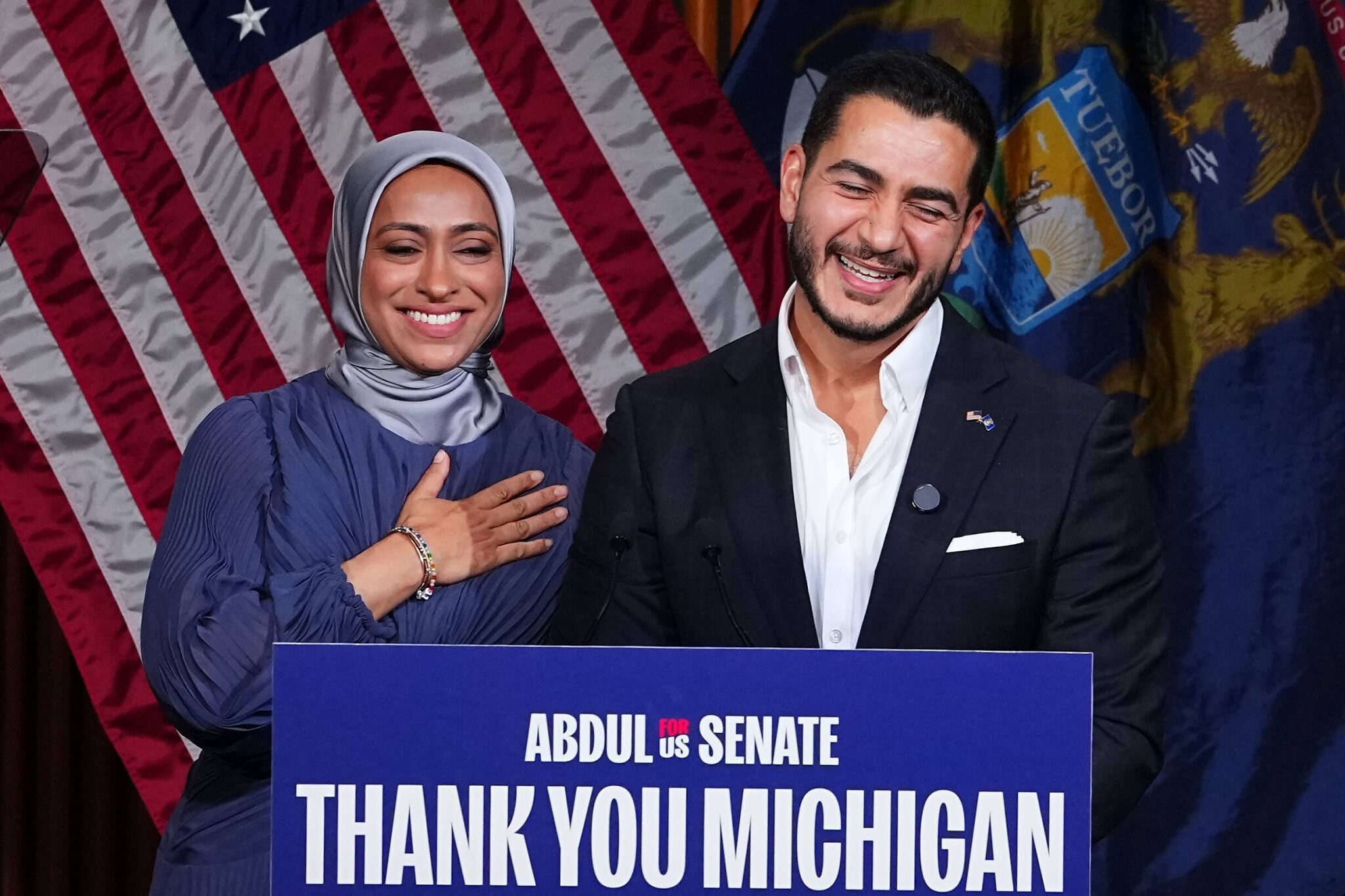
Abdul El-Sayed has won his Senate race. The concerns I expressed about his judgment remain relevant as he prepares to take office. His words, choices and use of that office will matter to Michiganders, to the country and to Jewish Americans concerned about our safety.
A childhood classmate challenged me: Why had I not reacted with the same alarm to Trump’s appointment of Dr. Mehmet Oz? What, specifically, had El-Sayed said or done to warrant my criticism? He requested examples, dates and documentation, adding: “Mere statements mean nothing!”
Fair enough. We should examine the record. Below is an edited version of my reply, with my friend’s name omitted.
Dear Friend,
I judge people by their words, actions and policies. Years ago I promoted YOU: The Owner’s Manual, coauthored by Dr. Oz and my friend Dr. Michael Roizen, with whom my husband, Alan, worked closely as an anesthesiologist at Cleveland Clinic. That connection predates this political discussion.
You asked why I didn’t oppose Dr. Oz when Trump appointed him. What antisemitic statement or slur by Dr. Oz are you referring to? What statement denies Israel’s right to exist? I’m not aware of one. Being Muslim does not make someone a threat, and sharing a religion does not make two people’s views equivalent. My objection to El-Sayed concerns his own public statements and choices.
I find Trump’s personality and rhetoric offensive and believe he has contributed to deep divisions in our country. At the same time, I appreciate actions during his administration that benefited Israel, including moving the U.S. Embassy to Jerusalem in 2018 and helping broker the Abraham Accords in 2020.
I am not a party-line voter. I evaluate candidates by their conduct, moral consistency and policies, including how those policies affect Jewish safety and Israel’s security. No politician is my hero or role model.
Four concerns about judgment
Several examples explain my concerns about El-Sayed’s judgment. First, in the October 8 debate, when repeatedly asked whether Israel or Iran posed the greater threat to America, he declined to identify one and said, “both of them have proven dangerous in their own way.” As an American patriot, I find that framing outrageous given the two countries’ very different records toward the United States.
Supporting Israel does not require agreeing with every Israeli government decision. But refusing to distinguish this ally from a regime with Iran’s record of targeting Americans is a profound failure of judgment. I find El-Sayed’s framing an antisemitic double standard, and I find it disturbing as both an American and a Jew.
Second, there is the grocery-store messaging. The supermarket advertisement depicting a couple unable to afford groceries because they must reserve money for killing Palestinians was produced by Rebellion PAC. El-Sayed’s campaign disavowed affiliation with it. That disavowal does not erase the advertisement or answer for his own statements.
In an October 15 interview, El-Sayed himself connected higher grocery and gasoline costs to a war he argued Israel had pushed America into. He has also characterized Israel’s conduct in Gaza as genocide—a characterization I reject. Those are his own positions, separate from the outside PAC’s advertisement.
I find this messaging inflammatory and irresponsible. The word “genocide” carries enormous historical and moral weight. Linking that accusation to Americans’ difficulty paying for groceries can direct people’s financial frustration toward Israel and, in an already dangerous climate, feed hostility toward Jews. A public figure should understand the consequences of putting such a message before an audience.
Third, El-Sayed’s decision to campaign with Hasan Piker raises serious questions for me about his judgment and whom he chooses to elevate. Piker had said, “America deserved 9/11.” Piker subsequently walked that statement back, El-Sayed explicitly rejected it, and El-Sayed later said he had no plans to campaign with Piker again. Those facts do not resolve my objection to the original decision to campaign together.
The fact that Piker said those words at all is deeply disturbing to me. The statement was already public and had reached an audience. Words that justify the mass murder of Americans can influence listeners and make such hatred seem acceptable. In my view, walking it back afterward is too little, too late. He should never have said it in the first place. Public figures are responsible for the messages they put into the world, and candidates are responsible for their judgment in choosing whom to elevate.
Fourth, consider his response to the March 12 attack on Temple Israel in West Bloomfield, Michigan. An armed man rammed a truck into the synagogue, which houses a preschool with 140 children, and exchanged gunfire with security. The FBI classified it as a Hezbollah-inspired terrorist attack targeting the Jewish community. A security guard was injured; the children escaped physical harm.
El-Sayed condemned the attack, but in his March 13 statement also said, “hurt people hurt people,” discussing the attacker’s relatives killed in an Israeli airstrike. He also referred to “the war that created this in the first place.” The Israeli military identified the attacker’s brother, Ibrahim Muhammad Ghazali, as a Hezbollah commander killed in Lebanon. Hezbollah is a U.S.-designated terrorist organization.
I find that framing outrageous and sickening. Grief does not excuse attempting to murder Jewish children in their classrooms and synagogue. The innocent children killed in Lebanon deserve compassion; their deaths cannot justify targeting preschoolers in Michigan. Nor should a Hezbollah commander’s death be treated as morally equivalent to an attack on Jewish children. Understanding an attacker’s motives must never blur his responsibility for choosing terrorism.
A reassuring manner does not settle these concerns. I look for consistency between a candidate’s public assurances, policies, language and campaign choices. I want leaders whose records give me confidence. Repeatedly troubling statements and associations make that confidence harder to earn. These are questions about judgment and responsibility that matter to everyone in Michigan, whatever their religion.
A subsequent clarification or disavowal does not ensure that everyone who encountered the original message sees or accepts the correction. The words are already out. Their potential influence does not disappear. Public figures should exercise responsibility before speaking, rather than expect an explanation afterward to undo the damage.
Why the Iran–Israel distinction matters
Consider Iran’s record: 52 Americans were held hostage for 444 days; Iran-backed Hezbollah killed 241 American service members in the 1983 Beirut barracks bombing; and the U.S. government has attributed at least 603 American military deaths in Iraq to Iran’s activities. These are American citizens and service members whose lives and families were devastated.
Iran has also directed assassination plots against American citizens on American soil, including journalist Masih Alinejad. Hostage-taking, deadly attacks on our military and attempted murder of Americans are concrete threats to our national security.
A nuclear-armed Iran would pose a danger far beyond Israel. It could trigger a regional nuclear arms race, multiplying the risk of catastrophic war. I can object to Trump’s rhetoric while supporting strikes intended to prevent Iran from acquiring nuclear weapons. Confronting that threat before it becomes nuclear is about protecting Americans, too—and preventing a far more devastating conflict later.
My concern goes beyond antisemitism. I see the Iranian regime’s hostility and violent Islamist extremism as threats to America and Western democratic values—to freedom of speech, religious liberty and our right to live without coercion or terror. Defending those freedoms is a responsibility we share as Americans.
What the U.S.–Israel partnership means for Americans
For me, Israel is America’s strongest ally in the Middle East because this partnership contributes to American security, technological strength and economic interests.
Israel is a designated major non-NATO ally. Our relationship includes defense agreements, joint exercises, strategic planning, weapons development and intelligence cooperation. A 2026 Senate Intelligence Committee bill credited timely U.S.–Israel intelligence sharing with protecting American personnel and property and providing a strategic advantage.
Israeli-developed technology directly supports American forces. Trophy active-protection systemssupplied for U.S. Army Abrams tanks help defend vehicles and crews. The Marine Corps’ Medium Range Intercept Capability incorporates Tamir interceptors and key components of Israel’s Iron Dome system to defend American forces against aerial threats.
The countries also cooperate on Arrow, David’s Sling and Iron Dome development or production. Cybersecurity collaboration among the Department of Homeland Security, Israel’s National Cyber Directorate and the BIRD Foundation supports solutions to strengthen both countries’ resilience.
The Office of the U.S. Trade Representative reports approximately $54.2 billion in bilateral goods and services trade in 2025. Joint innovation extends to healthcare, pharmaceuticals, agriculture and food technology. Energy research supports commercialization and energy security; a joint IDE Water Technologies–Northwestern University project addresses wastewater reuse and PFAS separation.
Israel was America’s first free-trade-agreement partner, beginning in 1985. The BIRD Foundation reports that more than 1,200 supported American–Israeli collaborations have generated over $10 billion in direct and indirect revenues. These are companies developing products and bringing them to market together.
These collaborations benefit American service members, businesses and communities. Criticism of an Israeli government does not erase the value of that partnership or make Israel’s relationship with America equivalent to Iran’s.
Foreign aid and consistent standards
The same need for context applies to foreign aid and grocery bills. Egypt’s longstanding U.S. military-aid level is approximately $1.3 billion annually. Congress maintained approximately $1.65 billion in combined assistance for Jordan for fiscal year 2025. Israel’s regular annual military and missile-defense assistance is $3.8 billion, with additional assistance appropriated separately in some years. These are different funding categories, but Israel is far from the only recipient of substantial American support.
El-Sayed has said he opposes funding other foreign militaries too, including Egypt’s. His broader position does not justify the outside PAC’s advertisement singling out Israel through Americans’ grocery bills. Why aren’t Egypt and Jordan the subjects of that same message? War can affect fuel, transportation and food prices. That does not justify reducing complicated economic pressures to an inflammatory message about Israel taking food off Americans’ tables.
Why October 7 remains central
My objection to inflammatory language about Israel is inseparable from October 7 and the suffering that followed. Hamas-led attackers killed approximately 1,200 people, including more than 40 Americans, and abducted hundreds. They deliberately attacked civilian communities and a music festival. Children, parents and grandparents were murdered, injured and taken hostage.
Children witnessed their families being murdered. A UN investigation documented three siblings who saw their parents killed; the three-year-old was abducted, while the other children hid in a wardrobe for 14 hours. These were deliberate acts of terror against families.
The suffering continued in captivity. Israel’s Health Ministry reported beatings, starvation, burns, restraints, humiliation and sexual abuse, including abuse of minors, based on accounts from released hostages and care teams. UN investigators separately documented severe food deprivation, isolation, physical abuse and threats against hostages.
The UN’s special representative on sexual violencefound clear and convincing information that some hostages suffered rape, sexualized torture and other cruel and degrading treatment. Her team also found reasonable grounds to believe rape and gang rape occurred during the attacks.
Consider Hersh Goldberg-Polin, the young Israeli American whose lower arm was blown off during the attack. He was abducted while grievously injured, held captive and later murdered. His suffering and his family’s loss should never become a political talking point.
The perpetrators recorded parts of their crimes. Associated Press journalists viewed footage that included attackers’ body-camera material and videos militants posted online. Human Rights Watch concluded that killing civilians and taking hostages were central aims of the planned attack.
Public celebrations, including crowds cheering as victims were brought into Gaza, compounded the horror. By October 8, people were already celebrating the attacks at rallies in America.
Footage showed Shani Louk’s body being displayed in a pickup truck. Associated Press reporting also described street celebrations and the distribution of sweets in Lebanon. I find those scenes morally horrifying. Anyone who participated in kidnapping or abusing victims bears responsibility for their own actions.
I regard October 7 as a genocidal assault aimed at destroying Jewish communities through mass murder and terror. I will not accept language that obscures these crimes or minimizes the threat posed by their perpetrators. That is why I scrutinize candidates’ words, judgment and associations.
Public influence and the wider threat
You urged me to “relax,” reminding me that he is “only one person” and that America protects freedom of religion. I cherish that freedom for everyone. But one public official can influence policy, shape opinion and lend legitimacy to harmful ideas.
The FBI has warned that ISIS and al-Qaeda inspire and encourage attacks inside America, including through online propaganda. The ISIS-inspired New Orleans attack in January 2025 killed 14 people. Violent radicalization is a real national-security concern.
El-Sayed must be judged on his own record. Respecting Muslims’ religious freedom and confronting violent Islamist extremism are consistent responsibilities. My concern is protecting Jewish lives and the constitutional freedoms of every American.
The evidence behind my concern for Jewish safety
Jews constitute roughly 2% of America’s population, yet anti-Jewish incidents accounted for approximately 14% of reported hate-crime incidents in 2025, according to ADL’s analysis of FBI data: about seven times our population share.
ADL’s separate 2025 audit recorded a record 203 physical-assault incidents, including 32 involving deadly weapons. Three people were murdered in antisemitic attacks that year. These are different reporting systems and their figures should not be added together.
The danger predates October 7. Eleven worshippers were murdered at Pittsburgh’s Tree of Life synagogue in 2018. More recently, Israeli Embassy employees Sarah Milgrim and Yaron Lischinskywere murdered outside Washington’s Capital Jewish Museum in May 2025. The following month, people walking in Boulder, Colorado, to advocate for hostages were attacked with Molotov cocktails. Karen Diamond subsequently died from her injuries.
The disproportionate targeting extends beyond America. Jews comprise approximately 1% of Canada’s population, yet 920 of its 4,882 reported hate crimes in 2024 targeted Jews, approximately 19%. Tel Aviv University’s worldwide reportrecorded 20 people killed in four antisemitic attacks outside Israel in 2025, the highest annual death toll in more than three decades.
Britain recorded 135 antisemitic assault incidents in the first half of 2026, an 82% increase over the same period in 2025. France recorded 126 incidents of antisemitic physical violence in 2025, up from 106 in 2024. These reports use different measures, but each documents serious hostility toward Jewish communities.
There is nothing irrational about recognizing this threat and making Jewish safety a priority. Would you have faulted a Jew in Europe in 1939 for making survival an overriding political concern? History teaches how dangerous it is to assume acceptance and security are guaranteed.
We cannot overlook hatred because confronting it is uncomfortable, assume fitting in will protect us, or hope people expressing hatred do not mean it. American freedom and security require vigilance. If we don’t stand up for ourselves, who will?
The values behind my vigilance
I apply the same scrutiny across religions and political parties. My objections extend to particular rhetoric and positions of Tucker Carlson, Chuck Schumer, Bernie Sanders and Neturei Karta that I find repugnant. Carlson is Christian. Schumer and Sanders are Jewish. Neturei Karta identifies as Orthodox Jewish. El-Sayed is Muslim. My standard concerns their words and conduct. These are different people and groups with different records; the common standard is whether the particular words or actions I criticize undermine Jewish safety or spread hostility toward Jews and Israel.
Neturei Karta is a tiny, fringe ultra-Orthodox anti-Zionist sect. It does not represent Orthodox Judaism as a whole; mainstream ultra-Orthodox communities have repudiated its extremist positions. Its rejection of Israel’s legitimacy and its leaders’ associations with Iran, Hamas and Hezbollah are repugnant to me.
Being Jewish gives Schumer or Sanders no exemption from criticism, just as being Christian gives Carlson none. An Orthodox Jewish identity does not make Neturei Karta’s positions acceptable. The same standard applies to El-Sayed. Religious identity alone makes no one guilty and gives no one a free pass.
I hope Republicans and Democrats work together for our country. I will welcome responsible leadership and challenge harmful conduct, regardless of party. Reassurance has to be earned through conduct.
I’m grateful for the freedoms and opportunities I’ve enjoyed as an American and for the sacrifices of my father’s generation defending them. I’m an American patriot, a Zionist and a proud Jewess.
By Zionist, I mean supporting the Jewish people’s right to national self-determination in Israel, their ancestral homeland, and Israel’s continued existence as a Jewish state. I stand proudly with our people, mindful of generations denied the freedom to live openly and practice their faith.
I raised my children to see the image of God in every person: Muslim, Jew or Christian; gay or straight; whatever their race or background. I taught them to respect everyone’s dignity and freedom to live and practice their religion without harming others.
They were among the first teen volunteers with Friendship Circle of Cleveland, building friendships with children with disabilities. My daughter was also active in Bridges at NYU, bringing Muslim and Jewish students together for dialogue and understanding. These are values our family has practiced.
I close this conversation with goodwill, wishing you and your family the best.
Vigilance and hope
I remain vigilant, but I refuse to surrender hope. As Dennis Prager said: “It’s not over, my friend. The American spirit lives in hundreds of millions of Americans. That’s another reason not to despair.”
Hope is also a deeply Jewish value. Rabbi Jonathan Sacks wrote: “To be a Jew is to be an agent of hope.” For me, that means facing danger honestly while refusing to surrender our responsibility to act, protect others and help build a better future.
I believe we will prevail because that spirit endures in Americans willing to defend their neighbors, stand against hatred and protect the freedoms generations sacrificed to secure. Those who seek to intimidate us will not crush our spirit or our way of life.
Defending America, Western democratic values and the dignity of others is what it means to be American and a decent human being.