Writing on Jewish life, relationships, trauma, and resilience
Elie Wiesel, October 7, and the Burden of Memory
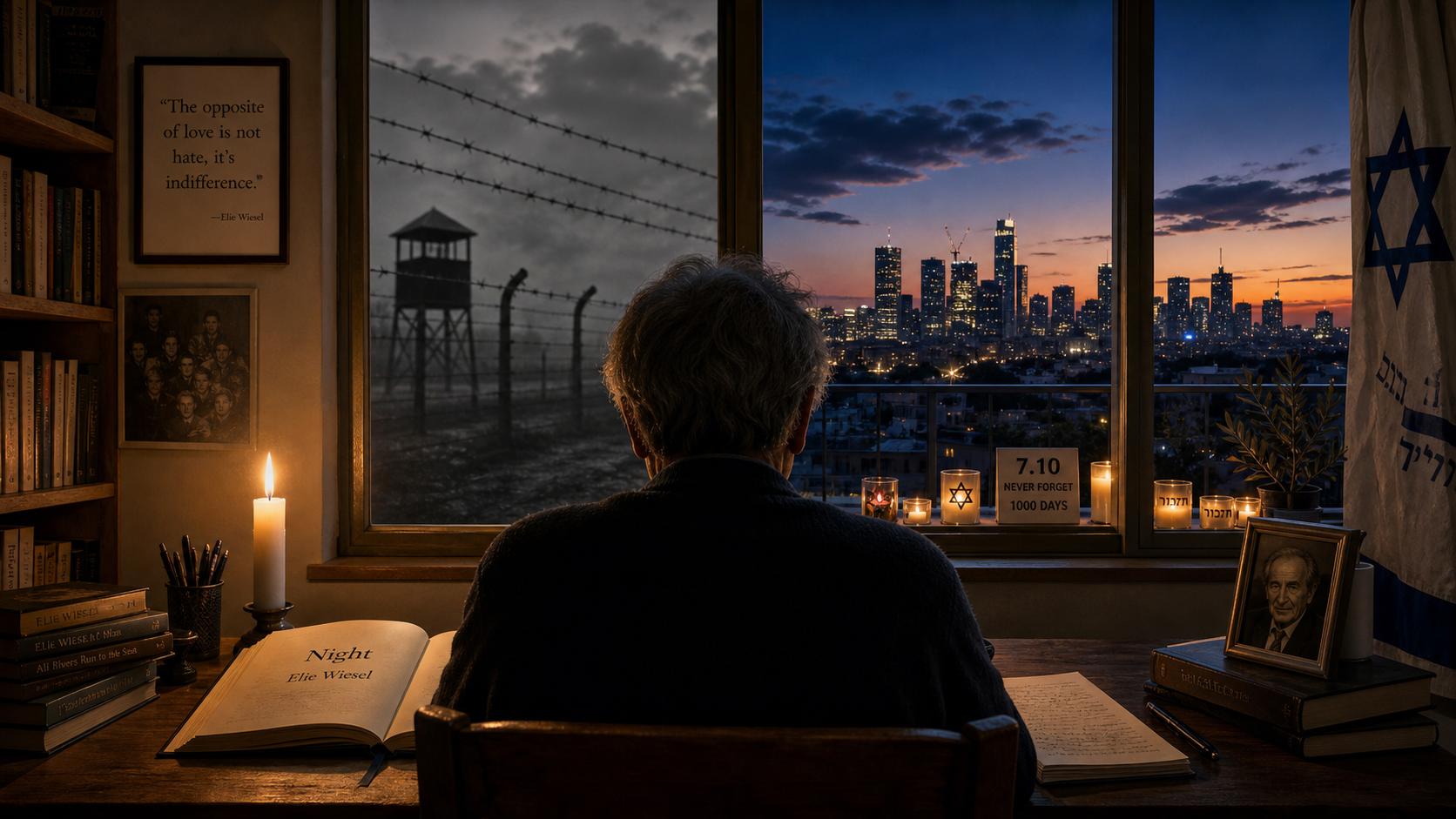
Illustrative. AI image created by the author.
For more than half a century, I have asked the same questions over which Elie Wiesel struggled and shared his wound.
Not as a survivor. I carry no personal memory of the camps, no father lost to a death march, no childhood incinerated in the fires of Auschwitz. I come to these questions as a Jew raised in the long shadow of the Shoah, and as someone who has spent decades sitting with traumatized families — watching silence metastasize into distance, watching unspoken grief destroy the people who contain it.
I also come to them as a person of wounded faith myself. I should say what I mean by that, because it matters to everything that follows. I have never stopped believing in God. But there have been seasons — after certain losses, after certain betrayals I witnessed in families I was supposed to be helping — when belief felt less like comfort and more like an argument I couldn’t stop having. I kept showing up to the argument. That, I eventually understood, was the faith. Wiesel taught me the vocabulary for it long before I knew I would need it.
When I first read Night as a young adult, something shifted in me that has never shifted back. The book did not explain the Holocaust; it refused to. Wiesel wrote not as someone confident that language could master catastrophe, but as someone tormented by the fear that language might diminish it. That terror felt honest to me in a way most attempts at meaning-making did not. It confirmed something I had already intuited from years of sitting with people in pain: the most dangerous thing you can do with suffering is resolve it too quickly.
Today, on the tenth anniversary of his death, I find myself holding Wiesel’s questions differently than I did a year ago. October 7 is the reason. So is a slower reckoning — with the Wiesel his archives reveal, a man considerably more complicated than the one the world chose to see.
The Wiesel the World Knew
The Wiesel most of us encountered wore dark suits and carried a grief that seemed bottomless. He was the Nobel laureate of quiet dignity, the author of the famous formulation that the opposite of love is not hate but indifference. He made it possible for the world to absorb the Holocaust without being entirely destroyed by it. That was a gift.
But the archival record tells a harder story — one scholars have been assembling for decades, even if much of the reading public has never absorbed it. Dr. Yoel Rappel, who spent years organizing Wiesel’s archive of nearly a million documents at Boston University, brought to light an earlier, rawer Hebrew version of Night that had sat buried for decades. In those pages, Wiesel did not mourn God. He indicted Him. He accused Jewish leaders in Palestine, London, and New York of knowing what was coming and staying silent. He described Hungarian neighbors watching the deportations with visible happiness. He confessed to a desire for revenge that he would spend a lifetime suppressing in public.
The scholar Naomi Seidman argued — nearly thirty years ago now, in work that scandalized some and persuaded others — that Wiesel’s suppression of that rage was, in effect, his ticket into the literature of non-Jewish Europe. The published Night, shaped in part by the French Catholic writer François Mauriac, allowed readers to enter the Holocaust without confronting every edge of the survivor’s fury.
Knowing this does not diminish Wiesel for me. It deepens him. The man who put God on trial and dreamed of revenge was not a different person from the one who spoke of memory as sacred obligation. He was the same person, carrying both truths at once, quietly enough that the world could look away from the fury. That is a more honest portrait of what it means to survive catastrophe than the saintly icon the world preferred — and I recognize the portrait. In my work with families shattered by trauma, I have sat with people who love and rage in the same breath, who hold faith and fury without resolution, who cannot afford the luxury of choosing one over the other. Wiesel did that for seventy years. He just did it where fewer people were watching.
The Wound and the Work
Wiesel described his faith as wounded. He wrote that nothing could justify Auschwitz — not even God’s own explanation, which he said he would reject. And yet he remained attached to God, to Torah, to Jewish memory, to the Jewish people. He could not divorce himself from any of it.
That paradox is not weakness. In my experience, it is the most honest theological position available to a Jew of his generation — perhaps of ours. The alternatives are to abandon faith entirely, which is its own form of surrender to the murderers, or to paper over the wound with easy answers, which is a different kind of surrender.
His exchange with the Lubavitcher Rebbe has stayed with me for years. When Wiesel asked how one can believe after the Holocaust, the Rebbe answered: how can one not believe? Wiesel replied that if this was an answer, he rejected it. If it was another question, he accepted it.
That distinction — between an answer and a question — is one I have spent my career trying to teach. In relationship education, we know that premature resolution is often more damaging than sustained uncertainty. The wound that is covered too quickly doesn’t heal. It hides. Wiesel understood this theologically decades before I understood it professionally.
Silence, Sin, and October 7
In a midrash Wiesel returned to repeatedly, Pharaoh consults three advisers before acting against the Hebrews. Balaam urges cruelty. Jethro protests and flees. Job, who inwardly opposes the plan, says nothing. The rabbis interpret Job’s later suffering as punishment for that silence. From this, Wiesel drew the lesson he stated most plainly in his final years: silence in the face of evil always helps the oppressors.
I have thought about that teaching every day since October 7.
Not only about the silence of the world — the institutions, governments, and communities that looked away, or looked elsewhere, or fashioned the murders into a political argument before the bodies were identified. But about a closer silence: the silence within the Jewish world itself. The questions about failures of protection and leadership that have been muffled by grief, by solidarity, by the exhausting demands of a thousand days of war.
Wiesel was too honest to flatten all silence into guilt. He knew the difference between the silence of the bystander and the silence of the victim. From his own decade of muteness after the camps, he understood that silence has layers — that it can be shock, testimony, even survival. The shock of the wounded is not the complicity of the powerful.
The moral task is not to shame the wounded into speech. It is to ensure that the silence of the wounded is not exploited by the powerful.
The works recovered from his archive — the Hebrew Night, the cantata Ani Maamin, the play The Madness of God, the poem The Tale of a Niggun — are not footnotes to his legacy. They are its subterranean core. They show a man who never made his peace with God, who never stopped demanding accountability from the living and the dead alike. That Wiesel — the one who buried his rage in archives rather than extinguish it — is the one I find most necessary now. Not because this moment requires rage, but because he modeled something harder: you can carry the full weight of what happened, including the parts that indict people you love and institutions you depend on, without being destroyed by it. You can hold the question without pretending to have the answer.
Choosing the Living
Wiesel returned often to the biblical command to choose life. He noted that the Hebrew word chayyim can also be read as “the living.” For survivors, he said, the choice was never abstract. It meant choosing the living, again and again, in defiance of despair.
He also said: because I remember, I despair. Because I remember, I have the duty to reject despair.
I have carried that formulation for years into rooms with families who have lost so much that despair feels not only rational but loyal — as if grieving less would betray the dead. The hardest thing to teach is what Wiesel embodied: that remembering and choosing life are not opposites. They are the same act, performed with fear and trembling, over and over, without the comfort of resolution.
I would like to end this essay the way tributes usually end — with the wound acknowledged and the obligation affirmed, everything held in dignified balance. Wiesel himself might not let me. The truth is that ten years after his death and a thousand days into this war, I do not know how to hold everything he asked us to hold. Some mornings the memory and the choosing of life sit together in me. Other mornings they fight, and despair has the upper hand for a while.
I keep showing up to the argument.
Perhaps that is the tribute. Not resolution, but attendance. He never stopped asking. Neither, apparently, do we.
Related Topics
Related Posts