

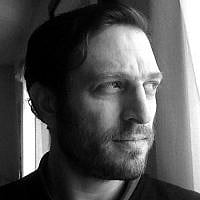
Emmanuel Faye Interview | Alexandre Gilbert #329
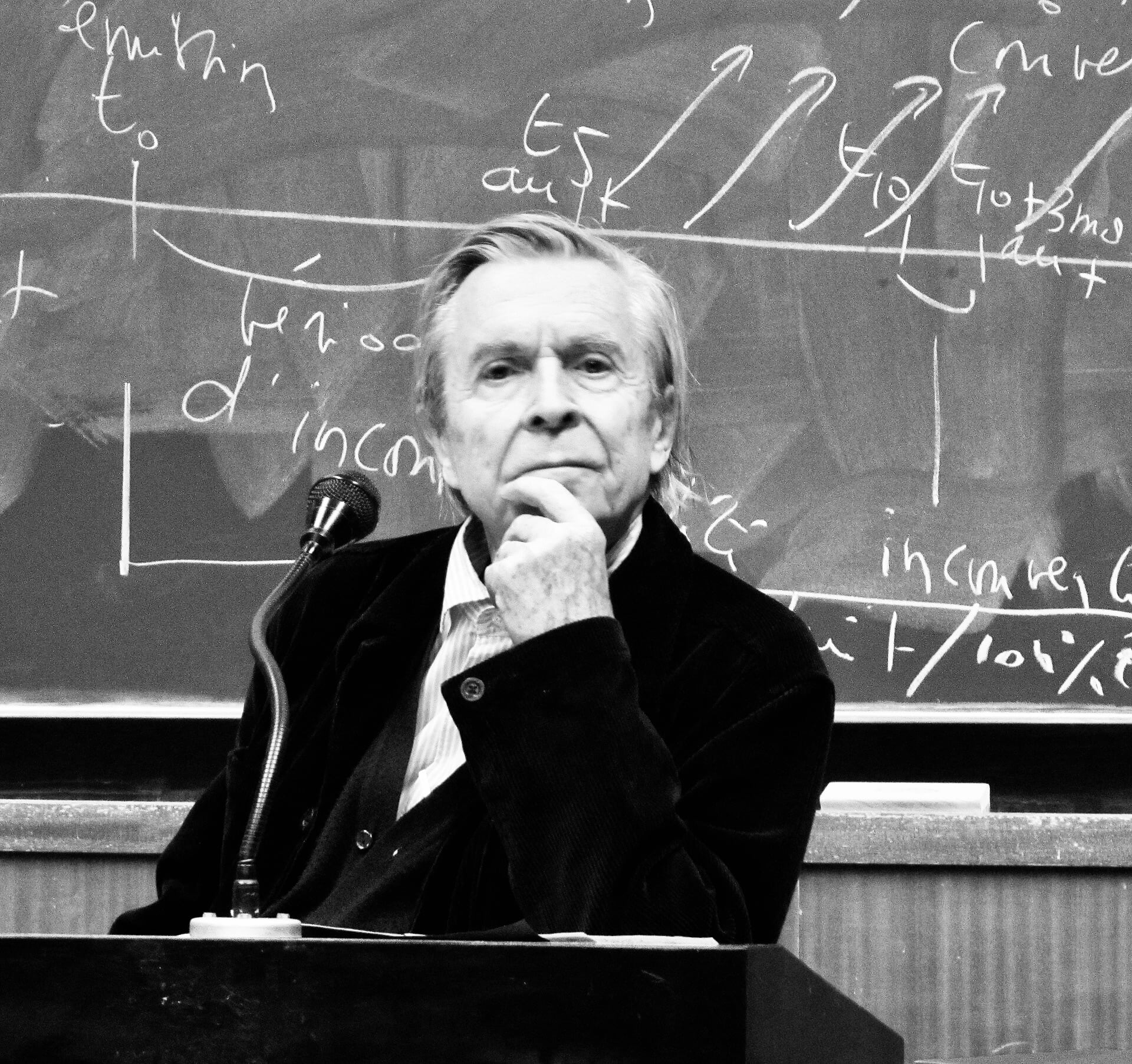
In 2025, a year before the passing of the philosopher and writer Jean-Pierre Faye, his son, Emmanuel was interviewed by Vincent Cespedes. Faye, was known for his work on political language and totalitarianism, engaged in major debates on Martin Heidegger’s legacy and co-founded the Collège international de philosophie with Jacques Derrida, later diverging from him intellectually. Excerpts.
So there was this presence of Heidegger, but never as an explicit object. Heidegger was behind everything, but he never took a text by Heidegger to teach us directly. We could have analyzed it, said what we thought—no. Heidegger was the presupposition, and one had to learn how to think—that is, in the end, to think in a Heideggerian way. As for me, I resisted as best I could. To resist, since we were taking a course on Nietzsche—in which we were reading a text by Nietzsche that I enjoyed even though I wasn’t a Nietzschean, The Philosopher’s Book in a bilingual edition—I turned to Klossowski’s book on Nietzsche, Nietzsche and the Vicious Circle, which works on Nietzsche’s valetudinary states, somewhat in the manner of Lou Andreas-Salomé, who had been Nietzsche’s fantasized woman. So I opposed to Heidegger’s Nietzsche the Nietzsche of Klossowski. And very cleverly, Jacerme, instead of opposing me and saying, “No, no, forget Klossowski, you must read Heidegger,” said: “Ah, you are interested in that? Do a presentation on it.” And he let me give a six-hour presentation—three times two hours. I think of my poor classmates: he practically gave me an entire week. I spoke for six hours about Klossowski’s book, which is quite peculiar, because Klossowski’s truth is that Nietzsche revolves around madness as around his axis.
As you can imagine, after six hours on this subject, I thought: ‘I’m going to crack; I’m going to go mad.’ I was therefore led to turn back towards Heidegger’s courses on Nietzsche, which I found heavy and scholastic — I did not have a feel for his prose — and I told myself that I still had to get into it. I began to speak about it a little, and my grades went from 14 to 18 with Jacerme, because I would write two lines on Heidegger’s truth — I laugh about it now!
At one point, I turned to my father, who, in 1961, had published some of Heidegger’s controversial political writings, including his profession of faith to Adolf Hitler in November 1933. What struck me at the time, as I was moving towards Heidegger almost in spite of myself, was that it was impossible to talk about these texts with Jacerme. The very idea was unthinkable. It was not even possible. One could not. It was very strange — a kind of omertà that gripped you so tightly that nothing could be said. There was an absolute denial; a kind of diffuse negationism that made discussion impossible.
In the evenings, my father, Jean-Pierre Faye, and I would talk about it. I would probably try to ‘kill the father’ by defending Heidegger and taking the opposing view, as a Freudian might say. I had allowed myself to believe that Heidegger’s actions in 1933–34 were indefensible, but afterwards he moved beyond the metaphysics of the will and technology to embrace the ‘letting-be’, becoming a kind of German Lao Tzu of the Black Forest. I believed in that myth for a time. We discussed it freely and, although he disagreed, he was not scandalised that I did not follow his critique of Heidegger to the letter.
Later, I thought it was strange that I could discuss things freely with my father, but not with my teacher. So I began to think that there was something wrong with Heidegger. There is no debate, no Socratic element and no place for discussion or an agora. If you disagree, it’s because you haven’t learned how to think.
Vincent Cespedes: You also met, through your father, philosophers who were critical of Heidegger.
Emmanuel Faye: Yes, there was also an interesting episode. At the time, I was writing what we would now call a Master’s thesis on Heidegger and language. I had poet friends and we were working on Celan. I was interested in a non-objectifying relationship with language. At one point, I believed that Heidegger helped us to better understand the poetic act. Now I have completely abandoned that view. To me, his work is a kind of sacralised destruction of poetry, a dehumanisation and devitalisation. In my view, Heidegger is at least as disastrous for poetry as he is for philosophy — but that is another question.
At the time, I believed in it. Then, in the winter of 1977–78, Gilles Deleuze, an old university friend of my father, came for lunch. Before we sat down to eat, I was sitting on the sofa in my father’s office, which also served as a living and dining room. Deleuze leaned towards me, rubbing his hands with a slightly ironic air, and asked what I was doing. I told him that I was writing a thesis on Heidegger and language. He laughed and said: ‘Ah, the Nazi druid.’ It was a bit harsh on druids, but a fair point.
There were several such moments. Marcuse also came to lunch—he had been a Heideggerian, but had since moved away from it. He even gave my father a short interview, which is still unpublished, in which he explained his critique of Heidegger. So there were a few milestones.
However, it was the Spiegel interview, published after Heidegger’s death in 1976, that made me abandon that mirage, that Heideggerian bog. I admit that I did not read it in German at first, but in a French translation published by Mercure de France later on. I believe the famous phrase ‘Only a god can save us’, from Hölderlin, was misunderstood because no one realised that, for Heidegger, that god was himself.
There are two striking passages. First, he claims that National Socialism was moving towards a satisfactory relationship between man and technology. If this entire critique is intended to rehabilitate Nazism as a means of escaping technology, then the entire myth of a Heidegger who broke with the philosophy of the will in 1936 collapses. Then there is another passage in which he expresses doubt that democracy is the solution for Europe. Today, this might appeal to some, but in 1978 it did not.
At that moment, it was as if a stained-glass window had shattered. I thought, ‘This is impossible — he has come out, he has tricked us, he has waited until after his death to avoid accountability.’ I closed the book, feeling so shocked and disgusted that I stopped reading German philosophers for twenty years, somewhat excessively, à la Jankelevitch. I turned towards humanism and humanity, working on Latin authors and becoming a specialist in Renaissance philosophy.
See also: