Eternal Revelation, Finite Hands
On the Danger of Making Human Interpretation Untouchable
Judaism begins with a refusal.
In a world saturated with idols — carved gods, divine kings, cosmic hierarchies that made power feel inevitable — the Torah introduces a radical claim: the ultimate cannot be seen, touched, or controlled. God has no image. No physical form. No object that can be pointed to and declared, “Here — this is it.”
That refusal is not a theological footnote. It is the foundation of Jewish civilization. By denying the legitimacy of idol worship, Judaism denies something even more dangerous: the human impulse to take what we can grasp and declare it absolute. The Torah’s revolution is not only against statues, but against certainty masquerading as holiness.
And yet, that same impulse does not disappear simply because idols do. It evolves. It finds new, more respectable expressions — sometimes inside religious life itself.
Judaism rests on a distinction that is both its strength and its burden: what comes from God is eternal; what comes from human beings is not.
The question is whether we still know how to live with that distinction.
Jewish life is not lived in abstraction. We do not encounter revelation directly. We encounter it through texts, interpretations, laws, customs, rituals, and institutions — through forms created by human hands to carry something they cannot fully hold.
These forms are not mistakes. They are necessities. A tradition without vessels cannot survive. But a tradition that forgets the difference between the vessel and what it carries risks turning faith into a subtler form of idolatry.
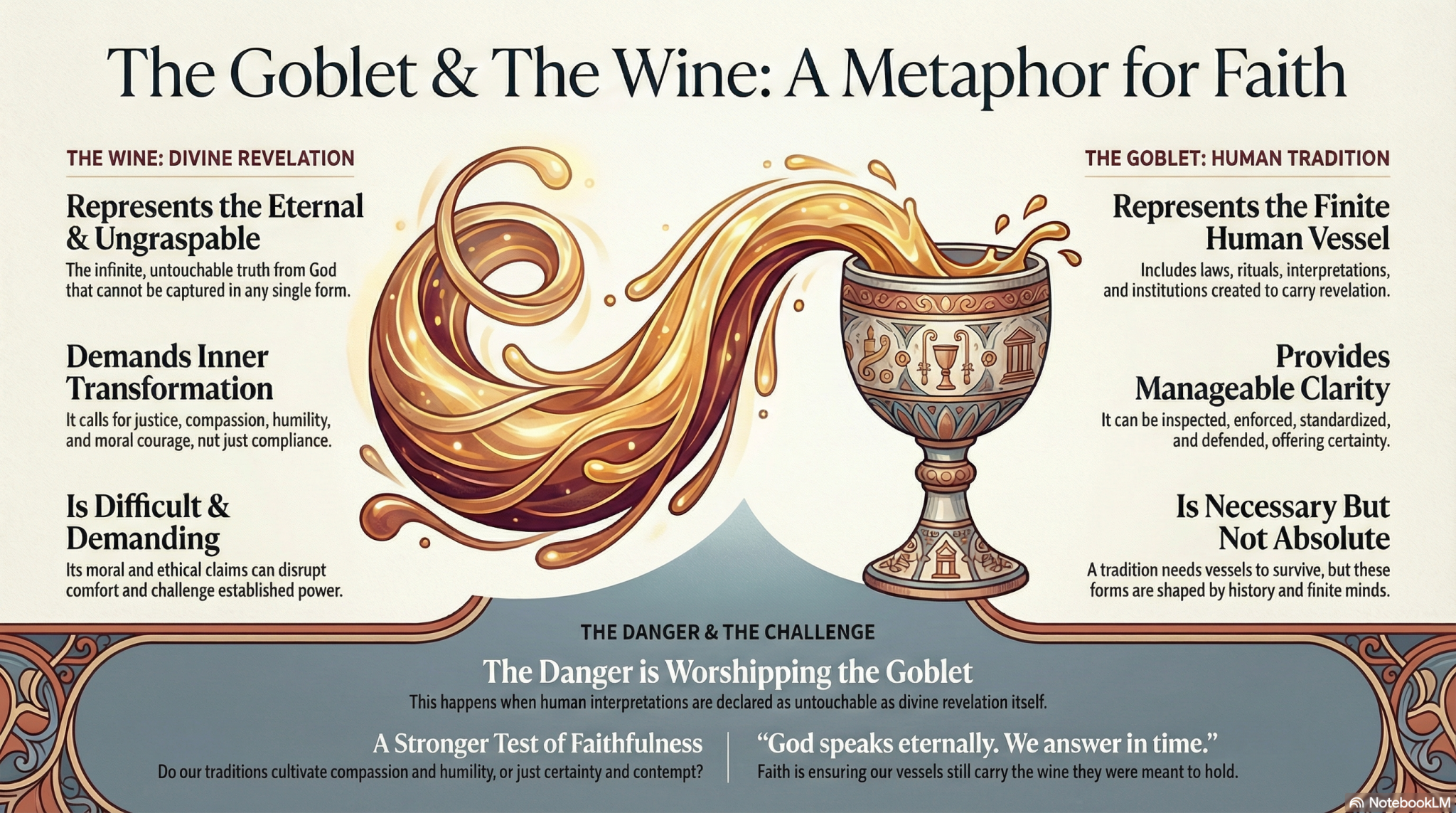
The danger is not that we make goblets.
The danger is that we begin to worship them.
Eternal revelation, finite hearing
Revelation may be eternal, but our hearing is not.
We encounter Torah through language and culture, through history and fear, through communal needs and moral horizons that shift over time. We reason with finite minds. We legislate under pressure. We apply ancient commitments to new realities with imperfect tools.
The Torah itself seems to assume this. It does not close the system. It does not hand us an exhaustive manual for every future case. It leaves space — the very space where interpretation, argument, judgment, and responsibility live. That space is not a flaw. It is the condition of covenant.
But empty space is frightening. It demands courage. It demands accountability. It demands that human beings remain morally present rather than sheltered by certainty.
And so Jewish history shows a recurring temptation: to fill that space by declaring our interpretations untouchable.
When humility becomes closure
There is a move that feels like humility but functions like closure.
We take human interpretations — disciplined, serious, binding interpretations — and we speak about them as if they occupy the same plane as revelation itself. What began as covenantal extension is framed as eternal decree.
This move does important work. It stabilizes obligation. It protects continuity. It guards against fragmentation. A people scattered across centuries and continents cannot survive without authoritative structures.
But it also changes the nature of faith. Once a practice or ruling is framed as “what God commanded,” questioning it no longer feels like responsibility. It feels like rebellion. The distinction between divine demand and human response collapses.
For many observant Jews, that collapse is decisive. The conversation ends not because the questions are weak, but because they now feel illegitimate.
The goblet has become sacred in itself.
Why the goblet is so seductive
The wine of Judaism is demanding. It asks for transformation, not just compliance. It demands restraint of power, integrity in private life, justice that disrupts comfort, compassion that complicates law. It insists that holiness be carried into places ritual cannot easily reach.
The goblet, by contrast, is manageable. It can be inspected, enforced, standardized, and defended. It offers clarity in a world of moral ambiguity. It can serve as proof of loyalty when inward transformation is harder to see.
Over time, communities can begin to protect the vessel more fiercely than the purpose it was meant to serve. Ritual correctness can replace moral attentiveness. Boundary maintenance can eclipse covenantal courage. The system becomes oriented toward preserving itself rather than refining the people who live within it.
This is not a Jewish failure. It is a human one. Every tradition that claims access to the eternal faces the same temptation: to guard what can be guarded, and quietly neglect what cannot.
Guardianship without confusion
Judaism cannot survive without guardianship. Law, ritual, and tradition are acts of care. Without them, Torah dissolves into personal sentiment.
But Judaism also cannot survive without extension — the ongoing, serious application of Torah’s eternal demands to changing human realities. Extension is not betrayal. It is fidelity in motion.
The danger arises when guardianship is pursued by freezing extension — when preserving form becomes more important than preserving meaning, and certainty becomes more valued than truthfulness.
A tradition can be meticulously observed and still drift from its animating spirit if it loses the ability to ask whether its vessels still carry the wine they were meant to hold.
A stronger test of faithfulness
The question is not whether our practices are ancient, authoritative, or communal. The question is simpler and more demanding:
What are they doing to us?
Do they cultivate humility or entitlement?
Do they deepen compassion or sharpen contempt?
Do they restrain power or justify it?
Do they make us more careful with other human beings — or merely more certain of ourselves?
If such questions feel forbidden because our inherited forms have been declared untouchable, then we have quietly replaced one kind of idolatry with another. Not the worship of images, but the worship of human certainty sanctified by tradition.
The courage to leave the distinction intact
God’s eternity does not depend on our pretending that our interpretations are eternal.
Revelation can be infinite even if our understanding is partial. Covenant can be binding even if our applications bear the marks of history. In fact, acknowledging our finitude may be a deeper form of reverence than denying it.
Judaism began by insisting that the ultimate cannot be captured. It would be a profound irony — and a familiar human one — if we responded by capturing it anyway, not in stone, but in the comforting certainty of our own constructions.
We need goblets. We cannot live without them.
But we must never forget what they are for.
If the Torah’s God is truly ungraspable, then the most faithful posture is not to render every inherited form unquestionable. It is to preserve the harder, holier distinction at Judaism’s heart:
God speaks eternally.
We answer in time.
And our faith is measured not by how fiercely we defend our vessels, but by how honestly we ensure they still carry the wine.