The views expressed herein are solely mine.
Europe’s Bluff Will Collapse Without America
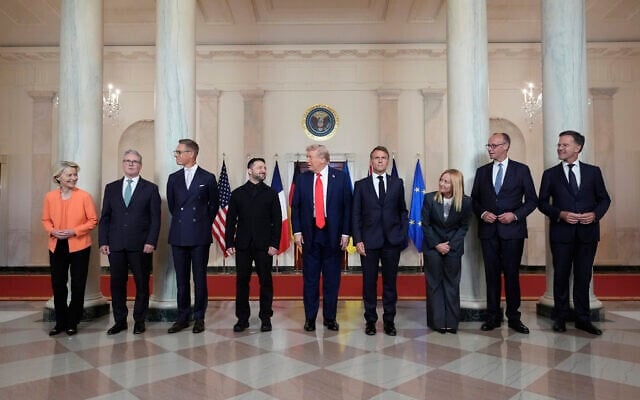
European Commission President Ursula von der Leyen, from left, British Prime Minister Keir Starmer, Finland President Alexander Stubb, Ukrainian President Volodymyr Zelenskyy, US President Donald Trump, France's President Emmanuel Macron, Italy's Prime Minister Giorgia Meloni, Germany's Chancellor Friedrich Merz and NATO Secretary General Mark Rutte stand before a group photo in the Grand Foyer of the White House on Monday, August 18, 2025, in Washington, DC. (AP Photo/Alex Brandon)
Europe’s outrage over Greenland is not about principles—it is about panic. When the United States treats the Arctic as a strategic theater—shipping lanes, rare earths, missile defense—European elites answer with sanctimony because they lack leverage. This moral theater is how a dependent power pretends to be sovereign. Push this far enough and the result is not “transatlantic debate,” but a rupture that hollows out NATO itself.
Let’s name the hypocrisy plainly. NATO exists because America pays, deploys, and decides. Roughly 2/3 of total NATO defense spending comes from the United States. In 2025, the U.S. accounted for ~68–70% of allied military outlays while many European members still failed to meet the 2% of GDP benchmark they pledged a decade ago in Cardiff.
On the other hand, America also provides the backbone capabilities Europe lacks: strategic airlift, ISR (intelligence, surveillance, reconnaissance), missile defense, space assets, cyber integration, nuclear deterrence, and the command-and-control architecture that actually makes forces fight as one. Europe talks values; Washington supplies logistics, satellites, munitions stockpiles, and blood.
In parallel, Europe’s favorite answer is “strategic autonomy.” Translation: we will criticize Washington today and hope it rescues us tomorrow.
Thus, the fantasy of a standalone “European army” collapses on contact with reality. Defense is not a logo—it is production lines, readiness rates, ammo reserves, political will, and citizens that legitimately want to defend their sovereignty. Nevertheless, Europe’s societies are deeply anti-war, politically fragmented, and the left-wing mainstream there is hyper allergic to border-related issues. Therefore, an army built on that culture would be a press convoy in uniform.
On top of that, and while they ignore reality, the bill will come due when Donald Trump is gone and deterrence weakens.
In that scenario, unmistakably, Mr. Putin will not appeal to conquest speeches; he will just wait for a window to suffocate and neutralize what he wants. Those windows are bullying and attacking Estonia, Latvia, and Lithuania—the Baltic hinge where Article 5 becomes real or meaningless. Arrived to that point, defending the Baltics will require speed, mass, and control of escalation. Europe lacks all three without America.
What would Europe do in that scenario? Issue statements. Call emergency summits. Debate sanctions timetables. Worry about “provocation.” Come on, we all know they would hesitate—because hesitation is their strategic culture. And while Europe hesitates, deterrence dies. And after deterrence dies, and their securitization challenges deepen, they will lose.
Then comes the predictable pivot. The same capitals that lectured Washington will rush back to the Oval Office. The same leaders who sneered at U.S. power will beg for U.S. protection. This is the endless cycle: dependency dressed as virtue. Europe condemns the hand that shields it, then grabs that hand when the shield lifts.
Hence, Greenland is not the cause—it is the mirror. It reflects a continent that wants security without sacrifice, authority without force, and peace without preparedness.
Today, NATO survives not because Europe is ready, but because America keeps choosing to carry it. If the alliance fractures, it will be because Europe mistook moral posturing for defense—and learned, too late, that hypocrisy is not a strategy. It is geostrategic suicide.
Related Topics
Related Posts