CFO | Empower Society for Good I Author
Every Jew Counts. Every Jew Has a Role to Play.
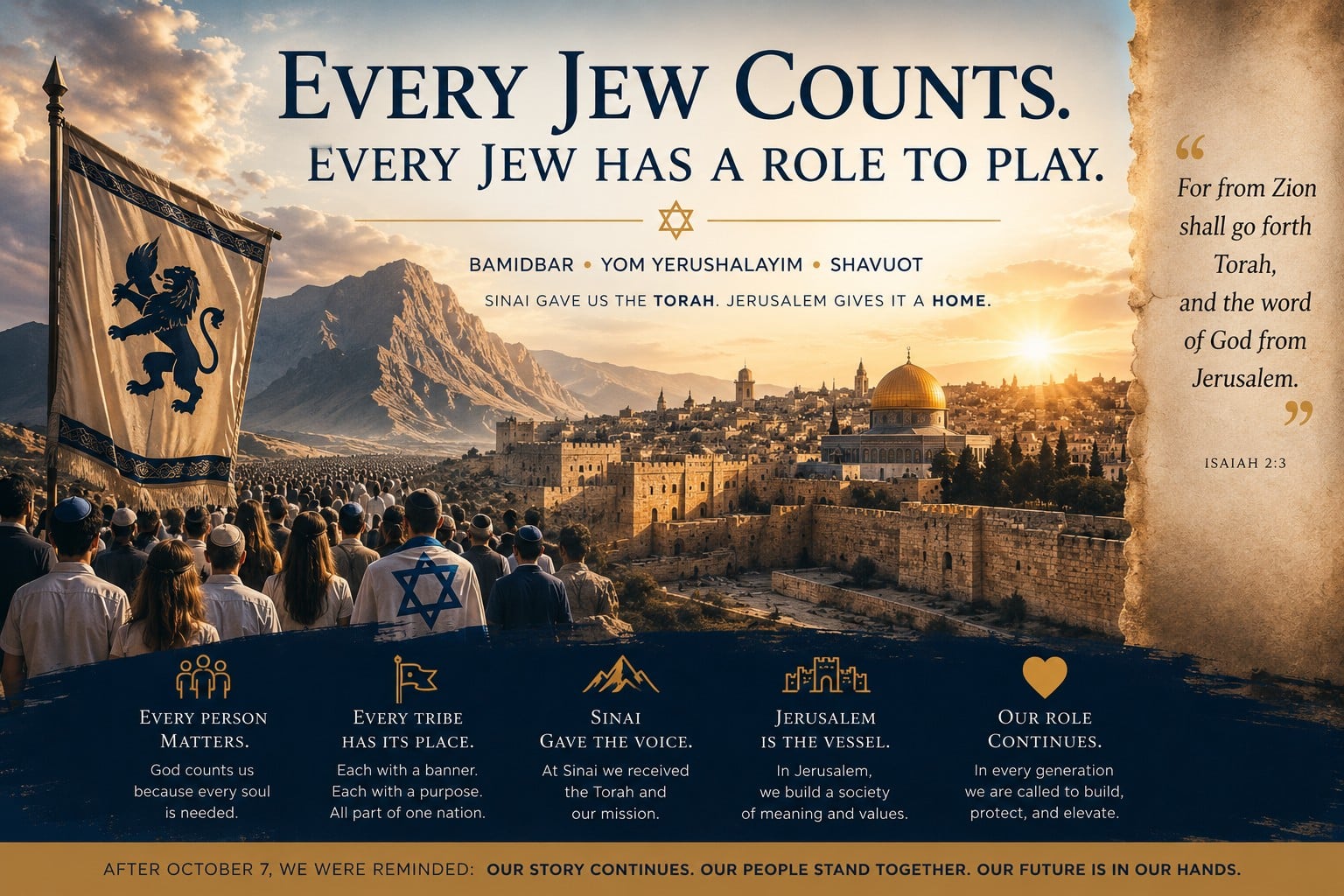
“The Israelites did accordingly; just as God had commanded Moses, so they camped by their standards, and so they marched, each according to their clan and according to their ancestral house.” — Numbers 2:34
As we enter the Book of Bamidbar, we are not merely beginning another section of the Torah.
We are entering the desert wanderings once again.
Not only the desert wanderings of Sinai thousands of years ago, but the wandering journey of the Jewish soul through history.
The timing feels difficult to ignore.
We move from Yom Yerushalayim toward Shavuot while still carrying the grief, confusion, courage, anger, unity, and awakening that followed October 7.
Jerusalem.
Sinai.
Desert wanderings.
These are not only places or events in Jewish history.
They are stages of Jewish consciousness.
Sinai is revelation.
Jerusalem is responsibility.
And the desert wanderings are everything in between.
The long and difficult journey between inspiration and maturity.
Between freedom and responsibility.
Between survival and redemption.
Perhaps that is where many Israelis and Jews throughout the world find themselves today:
between miracle and uncertainty,
between strength and vulnerability,
between survival and deeper purpose.
For many years, the story of modern Israel often felt almost impossible.
A scattered people returned home.
Hebrew returned to daily life.
The land flourished again.
Jerusalem was reunited.
Exiles returned from every corner of the world.
A tiny country surrounded by enemies became strong, innovative, and resilient.
Many quietly believed that Jewish history itself was changing.
That perhaps after centuries of exile, persecution, pogroms, and the Holocaust, the Jewish people had finally entered a different chapter.
But Bamidbar reminds us of something painful:
redemption is never simple.
The generation that left Egypt witnessed miracles beyond imagination.
They saw the sea split.
They stood at Sinai.
They heard the voice of God.
And yet only days later fear, exhaustion, complaints, division, and uncertainty entered the camp.
The Ishbitzer Rebbe, called Bamidbar “the book of mistakes.”
Not because the people are bad.
But because redemption itself is messy.
The desert wanderings strip things away.
Illusions.
Certainty.
Sometimes even hope.
And perhaps October 7 stripped many things away as well.
For many Israelis, it did not only break a sense of security.
It shattered assumptions we did not realize we were carrying.
Perhaps many of us believed that Jewish sovereignty, military strength, technology, intelligence systems, and success had finally pushed the deepest fears of Jewish history behind us.
And then suddenly history felt frighteningly close again.
Things that should never have happened did happen.
The shock was not only military.
It was existential.
How could such vulnerability exist after everything Israel had built?
How could Jews once again feel exposed, hunted, unsafe in their own land?
Part of the pain after October 7 was not only the brutality itself, but the confusion that followed afterward.
Even as new reports and testimonies continue emerging about the atrocities, including the sexual violence committed during the attacks, parts of the world still struggle to confront what happened with moral clarity.
Accusations and counter-accusations quickly filled the public space.
Truth itself often seemed pulled into ideological battles.
Perhaps this too is part of the desert wanderings of our time:
not only fear and trauma,
but the struggle to hold onto moral clarity in a world increasingly fractured by politics, narratives, anger, and tribalism.
Bamidbar reminds us how easily human beings lose direction even after moments of revelation.
How quickly fear, ideology, and confusion can cloud judgment.
And how difficult it can be to remain anchored to truth, dignity, and humanity in the middle of emotional upheaval.
Bamidbar understands this emotional world deeply.
The Torah never presents redemption as a straight line.
Even after Sinai there is confusion.
Even after miracles there is fear.
Even Moshe, Aaron, Miriam, and the generation of Exodus struggle in the desert wanderings.
The Torah removes the fantasy of perfection.
And perhaps that is one of its deepest kindnesses.
Because Jewish history was never built on perfection.
It was built on covenant.
On continuing the journey even after failure, disappointment, fear, and heartbreak.
Yet alongside the pain of October 7, something else emerged.
People showed up for one another.
Soldiers left their homes without hesitation.
Families opened their doors.
Volunteers cooked, drove, donated, prayed, listened, comforted, buried, and rebuilt.
Jews across the world suddenly felt connected again.
Some fought with weapons.
Some fought with words.
Some fought with kindness.
Some fought simply by refusing to disappear.
And perhaps that is one of the deepest truths of Bamidbar:
Every Jew counts.
Every Jew has a role to play.
The Torah opens Bamidbar with counting.
Not counting wealth.
Not counting power.
Not counting land.
Counting people.
Every tribe had its banner.
Every family had its place.
Every soul mattered.
The census in Bamidbar is not administrative.
It is existential.
God counts the people because every soul is needed for the journey ahead.
And perhaps after October 7, we understand this more deeply than before.
For many years, modern Jewish life often drifted toward comfort and individualism.
Jewish identity could sometimes feel cultural, optional, even secondary.
But October 7 reminded many Jews that history did not end.
The covenant did not disappear.
The Jewish people are still carrying something ancient, burdensome, fragile, and deeply necessary through history.
And this brings us to the quiet connection between Yom Yerushalayim and Shavuot.
Shavuot is the moment of revelation at Sinai.
It is where the Jewish people received Torah, mission, and responsibility.
But Sinai was never meant to remain in the desert.
The Torah was meant to travel through the desert wanderings and eventually reach Jerusalem.
Sinai gives the voice.
Jerusalem becomes the vessel.
Jerusalem is where spirituality enters national life.
Where holiness encounters politics, power, responsibility, and human imperfection.
Without Torah, Jerusalem risks becoming only stone, nationalism, survival, and power.
Without Jerusalem, Torah risks remaining detached spirituality, unable to shape society itself.
The Jewish dream was never merely to survive history.
It was to bring holiness, morality, compassion, memory, and responsibility into history.
Perhaps this is why Yom Yerushalayim always arrives so close to Shavuot.
First comes Jerusalem.
Then comes Torah.
First the return to the city.
Then the question:
What kind of society will we build within it?
And perhaps this is also part of the deeper struggle of modern Israel.
To understand that Israel is not merely another country like every other country.
It is a people returning to history.
A nation carrying memory, trauma, faith, disagreement, survival, and moral responsibility all at once.
Israel has borders, armies, elections, arguments, fears, divisions, and failures like every other nation.
And yet it also carries thousands of years of longing, prayer, exile, covenant, and hope.
Perhaps this is why Israel occupies such a disproportionate place in the moral imagination of the world.
Not only because of politics.
But because, consciously or unconsciously, people sense that the story unfolding in Israel touches larger questions about identity, morality, power, faith, survival, and human destiny itself.
And perhaps there is another layer to the desert wanderings that feels deeply connected to the story of modern Israel itself.
For centuries, the Land of Israel was neglected, barren, underdeveloped, and largely unwanted.
Travelers who visited described swamps, malaria, emptiness, rocky hills, and desolation. Mark Twain famously wrote of a land that appeared “desolate” and “unlovely.”
It was a backwater of empires.
Few powers truly invested in it.
Few believed anything meaningful could emerge from it again.
And then the Jewish people returned.
The deserts began to bloom.
The Hebrew language returned to life.
Agriculture flourished.
Cities were built.
Universities, hospitals, farms, and industries emerged from sand and scarcity.
What had been neglected for centuries slowly became economically vibrant again.
And with that growth came migration as well.
As Jewish pioneers developed agriculture, infrastructure, commerce, and employment opportunities during the late Ottoman and British Mandate periods, Arab migration into the land also increased from surrounding regions seeking economic opportunity and stability.
The land that many had ignored suddenly became desirable again.
The desert bloomed.
Perhaps that itself carries something deeply symbolic.
The Jewish story has often been about bringing life where others saw emptiness.
Hope where others saw despair.
Renewal where history appeared exhausted.
And yet, as Israel flourished, the hostility toward it also intensified.
The more the land bloomed, the more people wanted to uproot it.
Why?
Perhaps because the existence of Israel challenges many assumptions about history itself.
A scattered people returned.
An ancient language revived.
An exiled nation survived.
A desert bloomed again.
Israel is not only a political story.
For many people, consciously or unconsciously, it touches deeper questions:
about faith,
identity,
memory,
morality,
and whether history contains meaning at all.
The Book of Bamidbar begins with order.
The tribes are counted.
Each family stands beneath its banner.
Every person has a place around the Mishkan.
At first glance, everything appears stable and organized.
But as the journey unfolds, the Torah slowly reveals the fragile inner world of a people carrying redemption.
Fear enters.
Complaints emerge.
Leadership becomes strained.
Tribes divide.
Faith weakens.
The spies panic.
Korach rebels.
Moshe himself becomes exhausted.
And perhaps this is precisely why Bamidbar feels so painfully relevant today.
Over the coming weeks, as we journey through the parshiot of Bamidbar, we will encounter:
the fear of uncertainty,
the exhaustion of leadership,
the danger of internal division,
the struggle between idealism and reality,
the challenge of power,
and the search for holiness in a fractured world.
The desert wanderings were never only geographical.
They were emotional.
Spiritual.
National.
And perhaps modern Israel is still navigating its own desert wanderings —
between trauma and redemption,
between strength and humility,
between power and morality,
between fear and faith.
The wilderness generation was not evil.
It was human.
And perhaps that is the deeper message of Bamidbar.
The covenant survives not because people are perfect.
But because even through fear, failure, confusion, and wandering, the journey continues.
Perhaps that is the real preparation for Shavuot this year.
Not the fantasy of perfection.
But the willingness to continue walking together through the desert wanderings.
Still searching.
Still struggling.
Still carrying one another.
And still hearing, beneath all the noise of history, the quiet reminder that every soul matters and every Jew still belongs within the story.
Related Topics