Everyone Has a Plan for Gaza
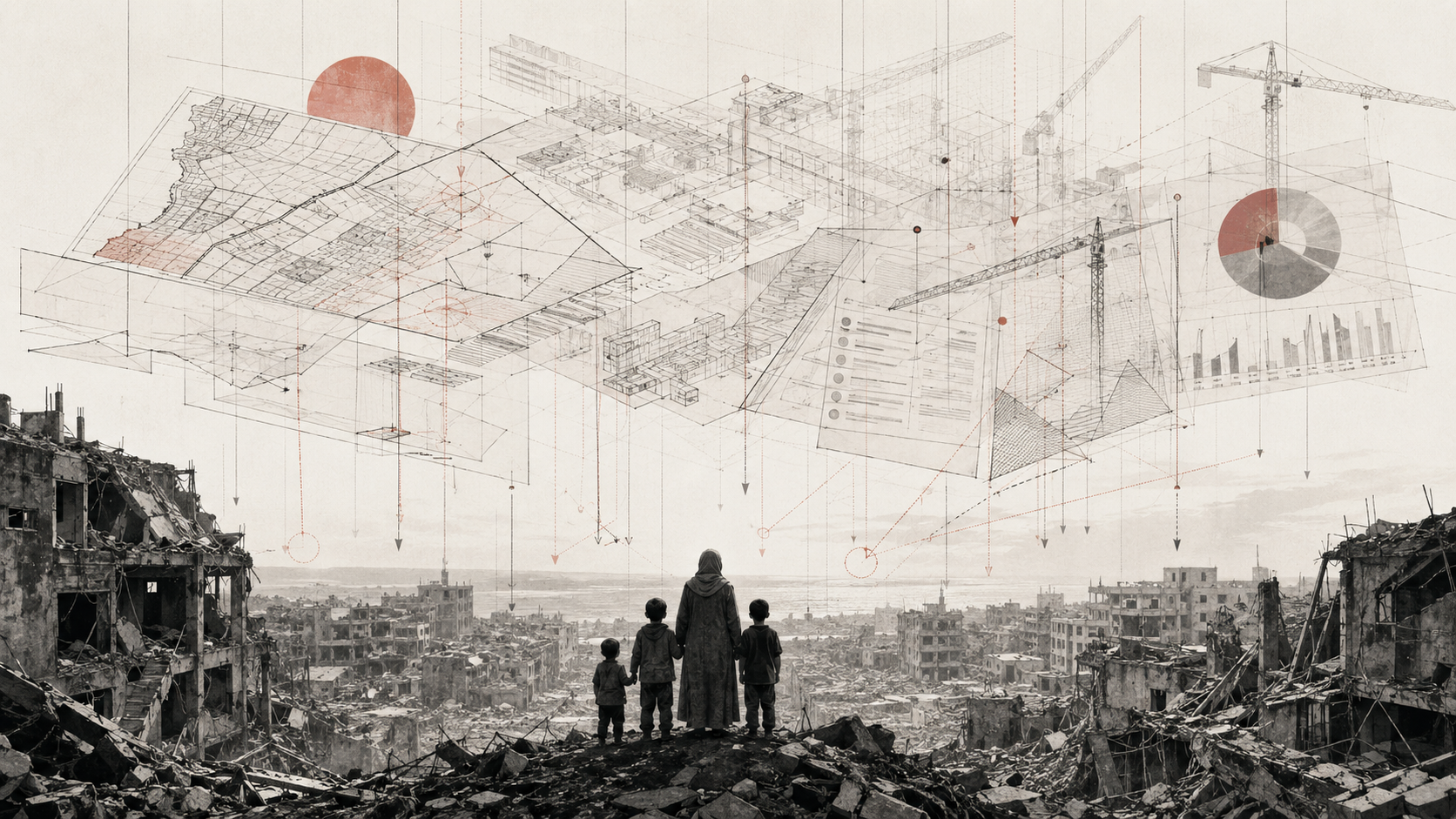
A conceptual image on destruction, reconstruction, and the external administration of meaning.
Text and concept: Yochanan Schimmelpfennig
Image: OpenAI image generation, based on the author’s concept
Copyright: Yochanan Schimmelpfennig, 2026
Everyone Has a Plan for Gaza
Governments have plans. Donors have plans. Security officials have conditions. Technocrats have committees. International agencies have damage assessments. Consultants have reconstruction schemes. Activists have slogans. Diplomats have frameworks. Commentators have moral certainties.
The people of Gaza are still waiting for something more basic: authorship.
This is the problem almost nobody wants to name. Gaza is not only being destroyed, counted, mourned, defended, condemned, securitized, and promised reconstruction. It is also being translated into languages that are not its own. It becomes a humanitarian file, a security problem, a donor project, a diplomatic test, a moral symbol, a battlefield, a future investment zone, a trauma image, a proof of someone else’s argument.
That is why the coming reconstruction of Gaza may become the clearest example of a deeper Palestinian condition: not simply occupation, not simply suffering, not simply war, but the external administration of meaning.
Reconstruction sounds innocent. Who could be against rebuilding homes, hospitals, roads, water systems, schools, electricity networks? But reconstruction without authorship is not reconstruction. It is the continuation of capture by other means.
If the people of Gaza become beneficiaries, data points, security risks, displaced clients, future workers, or symbolic inhabitants of someone else’s master plan, then the future itself has been taken from them before it has begun. The bulldozer and the architectural rendering belong to different moments, but both can participate in the same theft if the people of the place are denied authority over what the place is to become.
This is not an anti-Israel argument. It is not an argument against Israeli security, nor against the reality of Israeli fear. Hamas’s violence, armed control, and refusal to disarm cannot be wished away by slogans. No serious discussion of Gaza’s future can pretend that weapons, authority, and control are secondary matters. They are central.
Nor can any serious discussion ignore that a powerful current within Palestinian political discourse has not merely opposed Israeli policy, occupation, settlement expansion, military rule, or inequality, but has denied Israel’s right to exist as a Jewish state at all. That refusal is real. It cannot be dissolved into humanitarian language, softened into a misunderstanding, or hidden behind Western activist sentimentality. Israeli fear shaped by that refusal cannot simply be dismissed as paranoia.
But that fact cannot be allowed to do the opposite work. The existence of Palestinian discourses that deny Israel’s legitimacy does not transform every Palestinian life, memory, wound, citizenship status, refugee history, or demand for dignity into an annihilationist program. To recognize the reality of anti-Israel refusal is necessary. To use it as a master key for interpreting all Palestinian reality is another act of capture.
That is the double trap.
One discourse turns Palestinians into pure threat. Another turns them into pure victims. One needs Palestine as an invented enemy. Another needs Palestine as a sacred wound. One erases. The other sanctifies. Both avoid the same difficult thing: Palestinian reality as it is — heterogeneous, wounded, politically fragmented, morally serious, internally conflicted, and not reducible to anyone’s preferred grammar.
This is what I mean by an assigned side.
Palestine is not simply one side in a conflict. A side is not just a population that suffers, resists, remembers, buries its dead, or makes claims. A side is a form capable of establishing the conditions under which it becomes publicly intelligible. Palestine is too often made intelligible by others before it can appear as itself.
Its visibility is not absent. It is administered.
Gaza becomes catastrophe, threat, resistance, ruin, or humanitarian file. The West Bank becomes map, zone, settlement problem, legal case, or administrative laboratory. Jerusalem becomes holiness, flashpoint, myth, or diplomatic danger. The refugee becomes wound. The diaspora becomes conscience. The Palestinian Authority becomes either embryo of statehood or proof of failure. The Palestinian citizen of Israel becomes test, exception, accusation, or classificatory discomfort.
Modern power no longer needs to make a minority invisible. It is often enough to make it hypervisible as someone else’s problem.
This is why the usual vocabulary often fails. This text does not begin with genocide, colonialism, apartheid, or settler colonialism. Not because those words are irrelevant, and not because the realities they try to name can be dismissed in advance. It avoids beginning there because, in today’s moral economy, such words often function less as instruments of analysis than as passwords of belonging. They identify the speaker before they illuminate the object.
The question here is prior: what happens to a reality when it can enter public speech only after being translated into a vocabulary that already knows what it needs that reality to mean?
This is also why cheap activism is not harmless. Much of the Western left and academic performance culture loves the abstract Palestinian: pure victim, pure resistance, perfect evidence against the West, Israel, imperialism, capitalism, or liberal hypocrisy. Such a Palestinian is convenient because he does not interrupt the spectacle. He has no classes, no elites, no factions, no fear of Hamas, no anger at corruption, no exhaustion with his own leaders, no private desire for normality.
He is perfect because he says nothing the placard has not already prepared for him.
The real Palestinian may not fit any of these decorations. He may be a resident of Gaza, a Palestinian citizen of Israel, a refugee in Lebanon, a worker in the Israeli economy, a critic of Hamas, an opponent of Israeli domination, someone exhausted by the Palestinian Authority, someone who wants a state, someone who wants civil rights, someone who wants return, or someone who simply wants to survive until tomorrow.
When such reality appears in place of the symbol, cheap activism loses its certainty. That is why it so often refuses to admit it.
The opposite gesture is no better. If cheap activism turns Palestine into a sacred wound, triumphalist denial turns it into a fabricated enemy. A JNS essay by Avi Abelow, “The Myth of the Palestinian Cause,” is useful because it performs this inverse ritual clearly. Palestine becomes not a difficult political reality, but an artificial hostility, a myth, a weapon against Jewish sovereignty.
This is not analysis. It is counter-ritual.
The activist says: Palestine is pure suffering. The triumphalist says: Palestine is pure invention. One sanctifies. The other erases. Both refuse Palestinian reality when it ceases to be useful.
The most difficult question, however, is not only what others do to Palestine. It is whether Palestine can become more than what others need it to be.
This is not merely a question of diplomatic recognition. Recognition can also capture. Defense can also appropriate. Mourning can also consume. Reconstruction can also dispossess.
The harder question is whether Palestine can generate a political form not organized only around reaction: reaction to Israel, reaction to the West, reaction to the Arab world, reaction to humanitarian language, reaction to anti-colonial mythology, reaction to religious mobilization, reaction to the security categories of its opponent, or reaction to the activist need for moral confirmation.
Palestine has reality, memory, suffering, symbolic intensity, and an immense capacity to endure. But endurance is not yet transformation. Suffering gives a claim; it does not automatically give form. Death gives urgency; it does not automatically give authorship. Ruin gives the necessity of rebuilding; it does not automatically give the authorship of the rebuilt world.
This is the point cheap activism cannot bear, because it needs Palestine as a wound. A wound does not have to answer for its future. A wound accuses. But political form must do more than accuse. It must be able not only to say what was done to it, but also to create a way of life that is not merely the effect of what was done to it.
Palestine can become more than an assigned side only if it refuses all three reductions: being used by others as a sacred wound, being erased by others as an invented enemy, and being organized from within around the refusal of Israel as its only political grammar.
The most absurd violence of modernity is this: one can really die and still not be recognized as the author of the meaning of one’s own death. The body will be counted, shown, mourned, disputed, used, defended, inserted into a report or an indictment. But the meaning of that death will be fixed elsewhere: in a television studio, a ministry, a newsroom, a humanitarian organization, an expert office, an academic panel, an activist campaign, a wartime security narrative, or a reconstruction board.
So the question is not: who is on the side of Palestine?
That question is too cheap.
The real question is: who can speak about Palestine without immediately transforming it into a function of his own discourse? Who can defend without appropriating? Who can rebuild without possessing? Who can recognize without administering meaning?
One does not have to be against Israel, against Zionism, against Palestinians, against the West, or against activism in order to understand this. One has to be against intellectual laziness that immediately turns reality into a ready-made distribution of roles.
The future begins where the wound refuses to remain the only grammar of existence.
Only then could Palestine cease to be a place about which everyone speaks, and become a form that establishes the conditions of its own speech.
Yochanan Schimmelpfennig