


Stephen J Stern PhD
Everyone Hates the Enlightenment—Except When They Need It
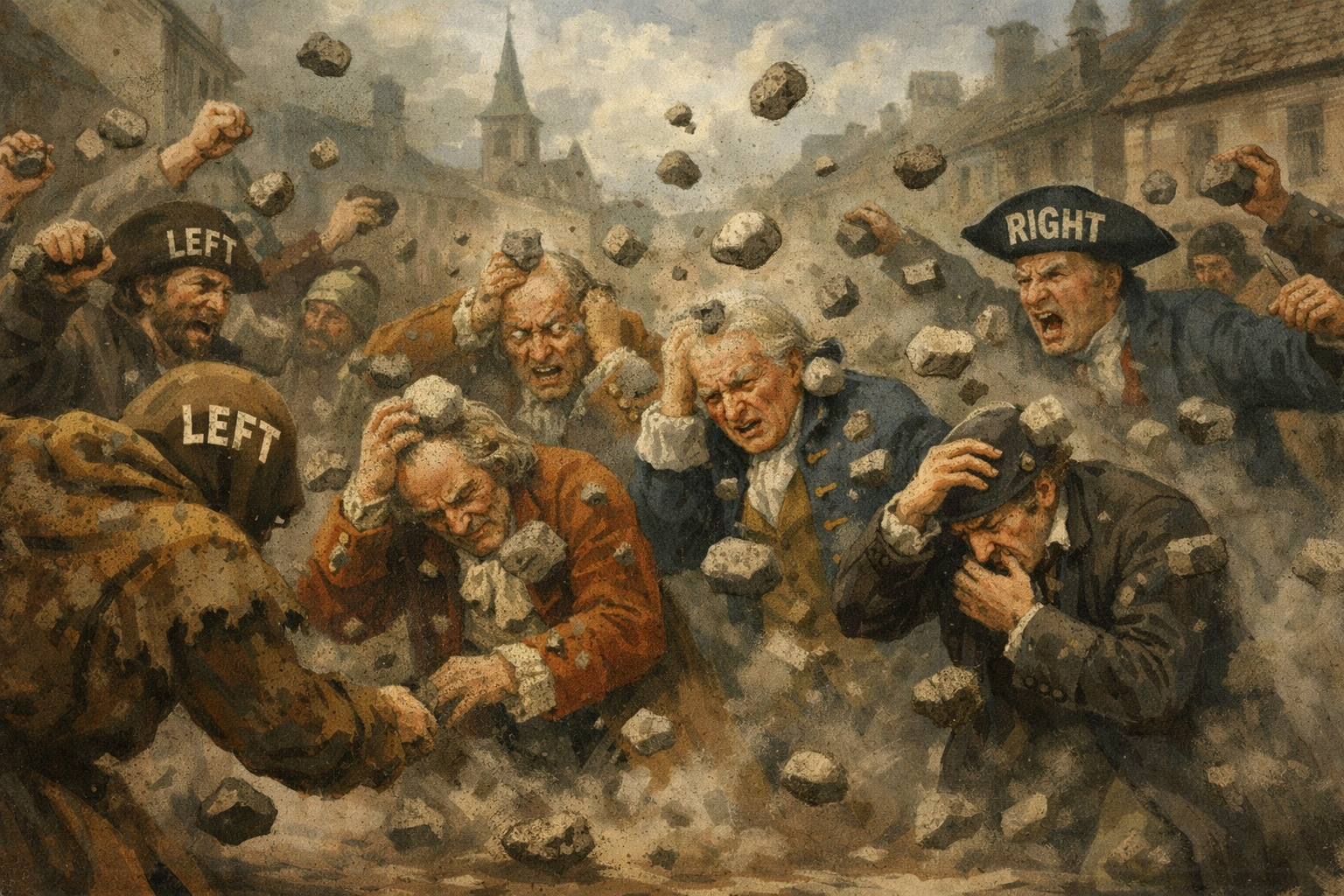
Image by Stephen Stern
The Left’s Convenient Amnesia
The academic left did not critique the Enlightenment. It declared it morally tainted and beyond repair. That declaration has become ritualized. It is repeated often enough to feel settled. It is neither rigorous nor historically honest. The Enlightenment had limits, immoral ones. Everyone knows that. But treating those limits as moral collapse is an evasion, allowing critics to keep the moral inheritance while refusing responsibility for it. Enlightenment thinkers wrote toward a future they would never see. Not one lived in the world they were arguing into existence. Is that fact ignored because it ruins present postures of superiority?
The standard academic move is reduction. Enlightenment thought is flattened into 18th century British Philosophers John Locke and Adam Smith plus property and empire, then dismissed as morally bankrupt. You see this reasoning from many disciplined disciples of 20th century French philosopher/psychologist Michel Foucault, turning reason into a mask for power, or in post-structuralist readings that make moral aspiration impossible. Power explains everything. Moral progress explains nothing, in turn disappearing individual development, disagreement, and moral learning over time.

Locke, Hume, Smith, and the Evolution of Thought
John Locke is treated as the original sin. Property. Possession. Empire. End of story. But Locke is also where bodily autonomy entered political philosophy, refusing to leave to this day. The claim that my body is my labor and thus the product of my labor is not a side note. It is the beginning of bodily autonomy, self-ownership as a moral category. That idea has not stayed frozen. It mutates, expands, and is argued over to this day. Enlightenment thought does not end with Locke. It begins there.
18th century Scottish Historian and Philosopher David Hume explicitly rejects the fantasy that reason governs human life. Hume’s close friend, Adam Smith, founder of capitalism, builds an account of moral psychology grounded in sympathy, foundational to his economic philosophy, rather than mere calculation. This is not Enlightenment hubris. It is Enlightenment self-correction. Yet today Smith is often reduced to a proto-economist, or, along with Hume, a racist moralist (he horrifically was), while their psychological insights about emotion, moral perception, and human agency are often claimed as modern innovations.
Three Germans: Kant, Hegel, and Marx

Then came three Germans. Immanuel Kant, the eighteenth-century German ethicist, endlessly cited. Kant is blamed for metaphysical abstraction, universalism, and rigidity by scholars, including myself in these pages, who quietly rely on his insistence that persons are ends rather than means. Theorist Judith Butler repeatedly challenges the construction of the human subject, yet their work depends on Kantian moral residue. The attack proceeds while the scaffolding remains.
19th century GW Hegel follows, worried that Kant is too subject-centered and alienated from the other. Hegel begins with the other, aspiring to overcome Kantian alienation with (history as a progressive dialectic realizing) God’s love, which he identifies as Spirit. Marx takes Hegel’s systemic march of history as progress but changes the ingredients. It is not love that will overcome alienation, but the proletariat. Class conflict.
Like the British, these German thinkers concerned themselves with human welfare. Think of them all around a table in a never-ending, disagreeable discussion. Western philosophy is a giant discussion motored by disagreement. The goal is the wisdom of understanding, not just being right.
By the time you reach the mid-nineteenth-century English philosopher John Stuart Mill, the Enlightenment discussion has absorbed its own critiques. Mill is explicit about power, conformity, coercion, and the tyranny of the majority. He defends individuality as a moral good necessary for collective flourishing.* Many critics repeat his warnings while ignoring him, reflecting that Mill complicates the story of Enlightenment arrogance.
French Style vs. British Substance

The French Enlightenment (with like minded hate and bigotry) today is treated more gently, largely because it reads better. Voltaire sparkles. Rousseau emotes. Salons feel radical. Meanwhile, the British thinkers who did much of the conceptual work plagiarized by the French are treated as dull, bourgeois suspects. When aesthetic preference, not argument, fuels what is rewarded, we kill off debate and discussion, aspirational cornerstones of the Enlightenment and democracy.
Another common habit is anachronistic moral shaming. Figures like Locke, Voltaire, and Kant are measured against contemporary vocabularies of race, gender, and sexuality, then dismissed as hypocrites. Hypocrisy existed. Locke wrote South Carolina’s eighteenth-century constitution equating Black persons with property. Evil work. No one can deny it. Kant had no regard for Jewry, framing it as haunting civilization, although he admired his Jewish friend, philosopher Moses Mendelssohn. 18th century French philosophers shared similar bigotries, spending more time blasting Judaism than the English, with whom they were at war. They ironically didn’t know Jews, few lived in their France. However, should we also ignore their moral language used to name that hypocrisy? Do we want totalizing condemnation to replace complex explanation, judgment, understanding, moral performance, and historical thought?
Then there is selective inheritance. Concepts like autonomy, consent, equality, and bodily integrity saturate contemporary political and ethical theory. They appear constantly in the work of left thinkers. But the moment their philosophical origins are named, those origins are often disowned. Locke is too compromised. Hume is racist. Smith is a colonialist. Kant is too rigid. Hegel results in Prussian militarism. Marx is completely right or completely wrong, rarely acknowledging that Marx does not exist without Hegel, the self-elected Christian philosopher who defies Christian theology. Mill is too liberal. Much of these charges are true. Nevertheless, the inheritance is kept. The ancestors are denounced while attempting to launder Enlightenment complexity into critical purity.
The Right’s Open Hostility
And here is where the right comes on stage. The same Enlightenment that the academic left dismisses is the one the modern right hates even more openly. Thomas Hobbes is embraced by MAGA, but his pessimistic vision of human nature is often twisted into an argument against democracy. Conservative thinker Edmund Burke rightly denounced the French Revolution while unfortunately supporting the “natural hierarchies” the thinkers mentioned above philosophized against. Burke’s hierarchical template is invoked by the right when egalitarian claims of the Enlightenment appear.
In contemporary politics, the right attacks the Enlightenment as elitist, utopian, or corrosive of traditional authority. Think of Pat Buchanan warning against universal human rights, or critics of liberal democracy who reduce Locke’s labor theory to a license for economic liberalism only insofar as it preserves existing hierarchies. Where the left obscures the lineage, the right weaponizes it as a threat.
Distrust of ordinary moral agency unites both sides, but for different reasons. From Foucault through Althusser to contemporary structuralists, the left treats individuals as effects rather than agents. Ethics migrates into systems and abstractions. Likewise, from Burke through contemporary right-wing critics like American philosopher Yoram Hazony, individuals are treated as incapable of rational self-governance and in need of hierarchy, authority, or divine sanction. The Enlightenment is accused of naïveté in trusting people. What replaces that trust, on both sides, is paternalism.

Plato Returns
Plato quietly returns to both traditions. Not as a writer of dialogue seeking wisdom, but as a model of governance by those who claim superior insight. History is unambiguous. Plato’s most devoted students did not become emancipators. They became tyrants. The Enlightenment’s alleged crime was faith in ordinary moral agency. The modern left refuses it in principle while exploiting its gains. The modern intellectual right refuses it openly, preferring order over myopic equality. Both misunderstand its evolution. Both claim its moral fruits.
The Enlightenment evolved. It argued with itself. It corrected itself. It expanded its moral horizon unevenly and incompletely, as all human traditions do. The left freezes it at its earliest moment, condemns it for not being what it later made possible, and lives comfortably inside its moral world. The right attacks it, pretends it is a threat, and occasionally borrows its tools when convenient. That is not critique. It is bad faith.
The United States’ founding document reflects the Enlightenment’s trust in moral agency, even as its authors betrayed it. “We hold these truths to be self-evident, that all men are created equal, that they are endowed by their Creator with certain unalienable Rights, that among these are Life, Liberty and the pursuit of Happiness. That to secure these rights, Governments are instituted among Men, deriving their just powers from the consent of the governed.”

The Enlightenment Legacy
Those words were later taken up by people excluded from them, such as Frederick Douglass, Sojourner Truth, Harriet Tubman, and Martin Luther King Jr., and turned against their authors’ hypocrisy. That is not accidental. It is the Enlightenment’s legacy.
If we abandon that legacy while enjoying its fruits, we are left with hollow arguments, convenient amnesia, and no moral courage to face the future.
*Mill’s co-author and wife, philosopher Harriet Taylor Mill, wasn’t publicly acknowledged for co-developing their philosophy. Mill always engaged her as an equal, while society and his publishers did not.