Executive Director - Understanding Israel Foundation
Everyone’s Self-Identity Counts – Except the Jews
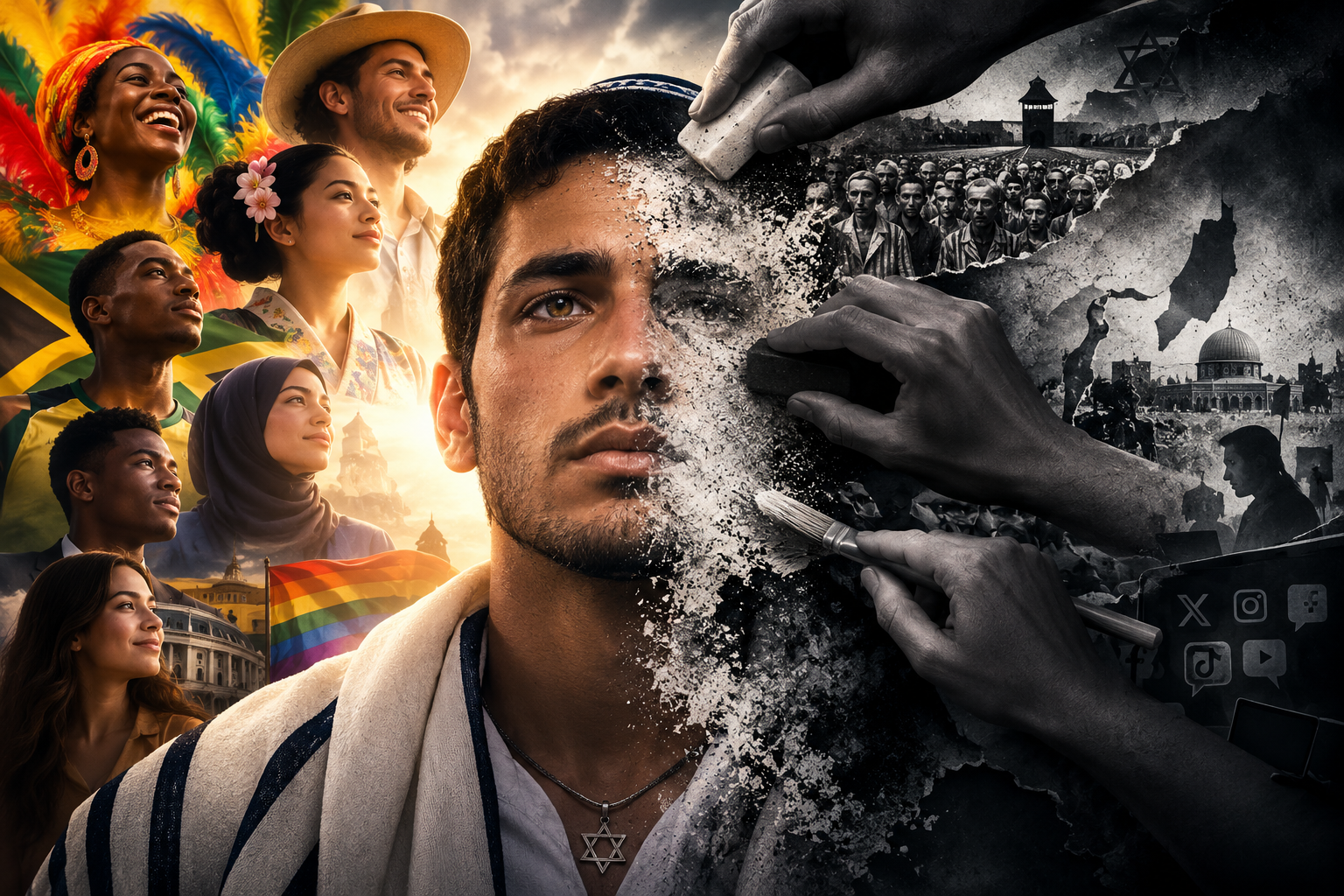
Everyone's Identity Matters - Except the Jews
How important is your identity to you? What happens if someone tries to take your identity away from you – not just insult your identity, but claim it never belonged to you at all? How would you respond or react?
For many of us today, our national identities are sacrosanct and something we are fiercely proud of. In Trinidad and Tobago, this is perhaps even more relevant. The inter-Caribbean rivalries between the small states that make up the West Indies make the differentiated national identities of each island a point of personal pride. In the Caribbean, we are also painfully aware that the outsized cultural reach of Jamaica can overshadow many of the other islands.
I decided to test my research questions by conducting a mini-experiment. I took to my Facebook and Threads accounts and provocatively posted the following:
“Ok, here’s what I’ve uncovered:
The people who live in Trinidad and Tobago today are actually Jamaicans.
There’s no such thing as ‘Trinidadian’ or ‘Trini culture’; it’s just an extension of Jamaica and Jamaican culture. Soca and calypso are derived and descended from Jamaican music; Carnival originated in Jamaica; doubles is a Jamaican invention; the steel pan came out of Kingstown.
Do you agree?”
I then followed up the next day with:
“Controversial hot take (but actually true):
‘Trinidadians’ have been claiming that there was something called the ‘Black Power Movement’ in the 1970s in ‘Trinidad’ which was a movement to ensure the rights of people of color. Evidence clearly shows: 1. THIS NEVER HAPPENED; 2. IT WAS JAMAICAN, NOT TRINIDADIAN. Any people who died during these events were JAMAICAN, NOT Trini.
I’m going to keep exposing the lies of ‘Trinis’.”
On my locked Facebook account — populated by my friends and people I know — I was met with a mixture of incredulity and typical Trinidadian humor. One commenter said, “Not true. Where did you hear that from?”; another patiently tried to explain the history of Carnival, particularly its definite roots in Trinidadian culture; another joked, “I knew it! Thanks for Divali, Jamaica!”; and a Jamaican doctor friend, no doubt delighted that I had finally gone over to their side, simply commented, “Absolutely 100.”
On Threads, where my reach was much less controlled, I received replies from Trinidadians I do not know, and these were considerably less polite. “No ones taking your rage bait, go to sleep bro”; “Every day people come on the Internet with foolishness”; and, simply: “Stop with your f*ing BS.”
Why Identity Matters
In “An Integrative Theory of Intergroup Conflict” (1979), Henri Tajfel and John C. Turner developed what became known as Social Identity Theory: individuals do not possess only a personal identity, but also deeply embedded social identities connected to their membership in groups — nationality, ethnicity, religion, political affiliation and other communities. Humans naturally categorize the world into “in-groups” — the groups to which we belong — and “out-groups,” or those to which we do not.
Jan E. Stets and Peter J. Burke later developed these ideas further in “Identity Theory and Social Identity Theory” (2000), arguing that identities create an interface between the individual and the social structures around them. By adopting an identity, individuals incorporate socially defined meanings into their own self-concepts. Those identities influence how they act, who they trust and how they understand their place in society.
Identities, therefore, are integral to how we make sense of the world, how we internalize ourselves within the wider groups to which we belong, and because of that, our identities are tied to an inherent sense of value, belonging and security.
So what happens when someone challenges that identity? What happens when someone tells you that your history is a lie? Or that the culture you celebrate is not yours? What happens when they tell you your ancestors did not build what you believe they built? Or that your people are not actually the people you believe yourselves to be?
My little experiment demonstrated that even a relatively trivial attempt to challenge/erase/ rewrite/misrepresent/misattribute any aspect of Trinidadian identity — particularly its cultural expressions and sacred history — resulted in understandable discomfort, anger, incredulity, jest and, in some cases, outright hostility.
For my Trinidadian friends, followers and others, this was only a social-media post.
For the Jewish people, this has been the lived experience.
The Jewish Question of Identity
As an emerging Holocaust scholar and the head of the only pro-Israel advocacy think tank in the Caribbean, the issue of antisemitism forces its way into almost every conversation, initiative and thought I have to contend with. First, we must understand that the Holocaust did not emerge from nowhere; it grew out of centuries of antisemitism – centuries in which Jews were not merely hated, but repeatedly redefined by others, denied the right to determine who they were, portrayed as fundamentally alien and accused of being responsible for the problems of the societies in which they lived. Much of the contemporary discourse surrounding Israel and Jews forces us to confront remarkably similar attempts to redefine Jewish identity.
“Israel is a colonialist entity!”; “Jews are Khazarian converts!”; “Israeli culture is nothing but an appropriation of Arab culture!”
These arguments are not all identical, and criticism of Israel is not inherently antisemitic. But when the argument ceases to be about what Jews or Israelis do and becomes an argument about who Jews and Israelis are permitted to be, we have to stop for a moment and try to understand what’s at play here. Why are Jews or Israelis no longer permitted to self-identify, and why is there no outrage that Jews or Israelis are being denied their self-identification? In a world which endlessly discusses Raven-Symone’s luxury of self-identification as “not African-American,” why are Jewish self-identification ignored, ridiculed and not defended?
The International Holocaust Remembrance Alliance’s working definition of antisemitism identifies, among its examples, denying the Jewish people their right to self-determination. The Nexus Document goes even further in articulating the principle that it is antisemitic to deny Jews the right to define themselves as a people. This moves the conversation beyond the simplistic idea that antisemitism is merely “hatred of Jews.” Yes, hatred is certainly one manifestation of antisemitism, but we must start to expand this into understanding that the denial of Jewish self-definition is becoming an increasingly new frontline of antisemitism.
The antisemite does not always say, “I hate Jews”, as we are seeing on social media, the antisemite is not necessarily going as far (yet) as the Nazis to deny Jews life and breath, but they are denying Jews the right to self-define, and we are therefore hearing: “You are not really Jews”; “You are not really a people”; Your history is fabricated”; “Your culture and your food is stolen”; “Your connection to your ancestral homeland is illegitimate”; “You do not have the right to define yourselves.” And – God, I hope I am wrong – ultimately: “You should not exist.”
This is why I have come to the conclusion that assault on Jewish self-identity is one of the recurring mechanisms through which antisemitism operates. The objective is not always immediately physical extermination; sometimes it wants to force Jewish assimilation, or Jewish religious persecution, or denial of Jewish historical experiences, or the co-option of Jewish identity by others, or the insistence that Jews are something other than what Jews themselves say they are.
It Starts With Hate
This is where I believe we often misunderstand antisemitism. The antisemite does not necessarily begin with evidence and arrive at hatred; often, the hatred comes first and the reasons come afterward. The accusation therefore becomes the moral justification for the hatred.
Pharaoh’s paranoia led him to believe the Hebrews were becoming so numerous (they weren’t) that they posed a threat to Egypt; he responded by ordering the killing of Hebrew boys. Antiochus IV Epiphanes regarded Jewish religious practice as barbaric (it wasn’t) and attempted to suppress Jewish religious and cultural life. Hitler blamed Germany’s problems on Jews, constructing fantastical conspiracies in which Jews supposedly controlled politics, finance, culture and the world itself (they didn’t), and his solution, ultimately, was to murder every Jew the Nazi regime could reach.
In all of these examples, the ideology created the hatred, and the ideology then manufactured the facts necessary to justify it, and in each case, there was an element of erasure.
Kill the Jewish boys.
Suppress Jewish religious practice.
Force Jews into another cultural identity.
Erase Jewish history.
Erase Jewish peoplehood.
And, eventually, erase the Jews themselves.
The Holocaust represented the most extreme manifestation of this erasure logic: if Jewish existence itself was the problem, then eliminating Jewish existence became the “solution.”
The Co-Option of Jewish Identity
This is also why I believe some modern forms of antisemitism deserve greater attention. My first social-media post which sought to misappropriate the origins of Trinidadian culture and attribute them to Jamaicans provides an interesting parallel to the ways Jewish identity can be co-opted, rewritten or appropriated.
Consider, for example, the Black Hebrew Israelite movement. Certain Black Hebrew Israelite groups seek to redefine Jewish identity as exclusively or essentially a racial identity and to claim Jewish identity for themselves while denying the Jewish identity of Jews who do not fit their racial or theological framework. This is not an argument about whether black people can be Jewish. Of course they can, and they are. What this becomes is an argument about who gets to define Jewishness. And that redefinition is being accompanied by hostility toward Jews, conspiracy theories and claims that existing Jewish communities are impostors. I’m sure you can see the irony here. For centuries, antisemites told Jews what they were, and now, some people who claim the Jewish identity themselves are telling Jews that they are not Jews.
The Khazarian conspiracy theory operates in a similar way. The claim that Ashkenazi Jews are essentially descendants of medieval Khazars who converted to Judaism is not supported by the historical and genetic evidence as commonly presented by proponents of the theory. More importantly, even if individual Jewish communities had complex histories of conversion and migration – as Jewish communities obviously do – that would not invalidate Jewish identity because a Jewish convert is a Jew; because a Jew descended from Jewish converts is a Jew; because a Jew whose ancestors lived in Europe is a Jew; because a Jew whose ancestors lived in Ethiopia is a Jew; because a Jew whose ancestors lived in Yemen is a Jew.
Because a Jew does not have to pass a racial purity test to be a Jew, because Judaism doesn’t define Jews in this way.
Yet the Khazarian conspiracy is frequently deployed as a means of delegitimizing the Jewish diaspora, denying Jewish peoplehood and undermining Jewish claims to self-determination in Israel. Again, the issue becomes: who gets to decide who Jews are?
Messianic “Judaism” presents another complicated and problematic example. Most Christians who support Israel and the Jewish people do so from a place of genuine friendship and solidarity, and I have personally encountered enormous generosity from Christian communities toward Jews and Israel, but Messianic “Judaism” presents something entirely different and wholly problematic. In this movement, elements of Jewish religious practice, liturgy and cultural expression are incorporated into a fundamentally Christian theological framework, while adherents sometimes call themselves “completed Jews” or otherwise claim a Jewish identity despite Judaism itself rejecting the theology and these identities as Jewish. For centuries, Christians told Jews that Judaism was wrong and Christianity had replaced it; now, in some forms of Messianic “Judaism” (which is Christianity cosplaying Judaism), Christianity seeks to co-opt Jewish identity while retaining Christian theology, an inversion that is at once dangerous and scary in terms of the outright lies and misappropriation of support that Messianic “Judaism” is taking from legitimate Jews and the State of Israel. One Christian pastor in Trinidad told me, “I support Israel, of course, and the Jews, but only the real Jews who are Messianic and have accepted Jesus.” I was floored, to say the least; but this is the real-time example of how the dangerous lies of Messianic “Judaism” are eroding, misdirecting and misleading support for Jews and channeling it to Christians!
Consider another absurd example; on October 1, 2023, at a massive pro-Israel rally in Trinidad and Tobago, an evangelical woman brought a Messianic man onto the stage and apologized on behalf of the Christian Church to the Jewish people for centuries of Christian persecution: a Christian apologizing to a Christian about Christian persecution of Jews. Can you imagine the uproar if a white British man from the United Kingdom apologizes to a white man from Nigeria for the slave trade? You see the absurdity of this? As long as Messianic “Judaism” continues to coopt a Jewish identity, it will be shunned by actual Jews. And if history teaches us anything, those who purport to like Jews and be gracious to Jews in attempts to convert Jews (because this remains the real aim of this Christian Messianic “Jewish” movement – to pretend to be Jews, to infiltrate Jews, and ultimately convert Jews out of Judaism to this version of Christianity with hollow trappings of Jewish culture), when shunned by Jews turn into genocidal antisemites, as quickly as green with envy turns into black with hate.
Again, this is not an argument against Christians. It is an argument for allowing Jews to define Judaism and the understanding that Christian support for Israel should not require Jews to become Christians. It is a request that Christian love for Jews should not require Christians to become Jews. And it is an appeal that Christians stop entertaining the folly of Messianic “Judaism” and allow Jewish identity to be presented by Jews; not Christians playing dress-up as Jews. This miseducation is leading to dangerous interfaith miscommunication and misdirected support. It needs to stop. It is another denial of Jewish self-identity.
Erasing History
My second social-media post sought to deny the realities of a painful chapter in Trinidad and Tobago’s civil-rights history, which received less attention than the first post but it still raised eyebrows. For the average Trinidadian, of course the Black Power Movement happened in Trinidad and Tobago in the 1970s. Of course it was a Trinidadian event. Of course the people who participated, suffered and died were part of Trinidad and Tobago’s history. But here I was erasing that uniquely Trinidadian experience and transferring all of its realities to Jamaica.
And that is why Holocaust denial is not simply a dispute about historical facts, but is rather an assault on Jewish memory, the Jewish experience and an erasure of Jewish history. It is an attempt to tell Jews that something which happened to their people did not happen, and applies to other attempts to deny or distort Jewish historical experience, including the persecution and murder of Jews throughout history and the atrocities committed against Jews on October 7, 2023. When someone tells a people that their history is fabricated, exaggerated, irrelevant or somehow undeserving of recognition, they are challenging the people’s right to remember themselves.
Identity Erasure Before Physical Erasure
Ultimately, this is what my little experiment was about. I wanted to allow a people who, fortunately, have not had to endure the particular history of Jewish persecution to experience – however slightly – what it feels like when someone tells you that your identity is not yours.
I took things that Trinidadians hold dear and reassigned them to someone else: denying their history and denying their cultural ownership. I told them that the people they understood themselves to be were not actually those people and scoffed at them.
And they reacted. Of course they reacted. You know why?
Because identity matters.
The Trinidadian identity matters to Trinidadians.
But by that same grace, then one should understand: the Jewish identity matters to Jews.
The conversation about antisemitism needs to evolve. The average Trinidadian, Frenchman, Buddhist or Messianic “Jew” needs to understanding that antisemitism is not always expressed on the grand scale of the Holocaust, but that it exists in microaggressions, conspiracy theories, historical denial, cultural appropriation.
It exists in telling Jews that they are not really Jews. It exists in denying Jewish peoplehood. It exists in denying Jews the right to define themselves. It exists in denying Jewish self-determination.
And these seemingly smaller acts matter because they help create an environment in which the larger acts become conceivable. The Holocaust did not begin with gas chambers: it began with ideas about Jews. Ideas about who Jews were. Ideas about what Jews supposedly controlled. Ideas about whether Jews belonged. Ideas about whether Jews were really part of the societies in which they lived. Ideas that Jewish existence itself constituted a problem. before a people can be physically erased, there is often an attempt to erase the legitimacy of their existence.
A Mini-Thesis
The study of antisemitism is ongoing. Scholars, religious leaders, governments and genuinely good people continue to wrestle with how to understand an irrational hatred that has survived centuries, changed ideological clothing and repeatedly reinvented itself. I am not suggesting that I have solved the problem with a Facebook and Threads experiment. I am suggesting that perhaps one way to understand antisemitism is to understand the importance of Jewish self-definition and continuity.
The Jew says: “This is who I am.” The antisemite responds: “No. I will tell you who you are.”
The Jew says: “This is my history.” The antisemite responds: “No. Your history is fabricated, exaggerated or irrelevant.”
The Jew says: “This is my culture.” The antisemite responds: “No. Your culture is stolen.”
The Jew says: “This is my people.” The antisemite responds: “No. There is no Jewish people.”
The Jew says: “This is my homeland.” The antisemite responds: “No. You have no right to it.”
And ultimately, when the Jew says: “I am a Jew”, the most extreme antisemite says: “You should not exist.”
When the common denominator is becoming the systematic denial and erasure of Jewish self-definition, Jewish peoplehood, Jewish history, Jewish culture, Jewish continuity or Jewish collective existence, we need to take notice. Antisemitism is evolving before our very eyes and we cannot allow this sign to pass us by because it is coming from every direction: from the Black Hebrew Israelite who erases Jewish history; from the Khazarian conspiracist who erases Jewish definitions of who is a Jew; from the Messianic “Jew” who erases Jewish identity and replaces it with a Christian cosplaying in a tallit; from the woke crowd erasing Jewish culinary traditions; from the anti-Zionist erasing Jewish connections to the land of Israel. We need to be clear: antisemitism is obsessed with the Jew; it is obsessed with defining the Jew, explaining the Jew, controlling the Jew, delegitimizing the Jew, and finally, eliminating the Jew. What it never does it listen to the Jew or allows to Jew to self-define as the Jew.
Related Topics
Related Posts