


Everything & Nothing: Ayin As The Cosmic Web
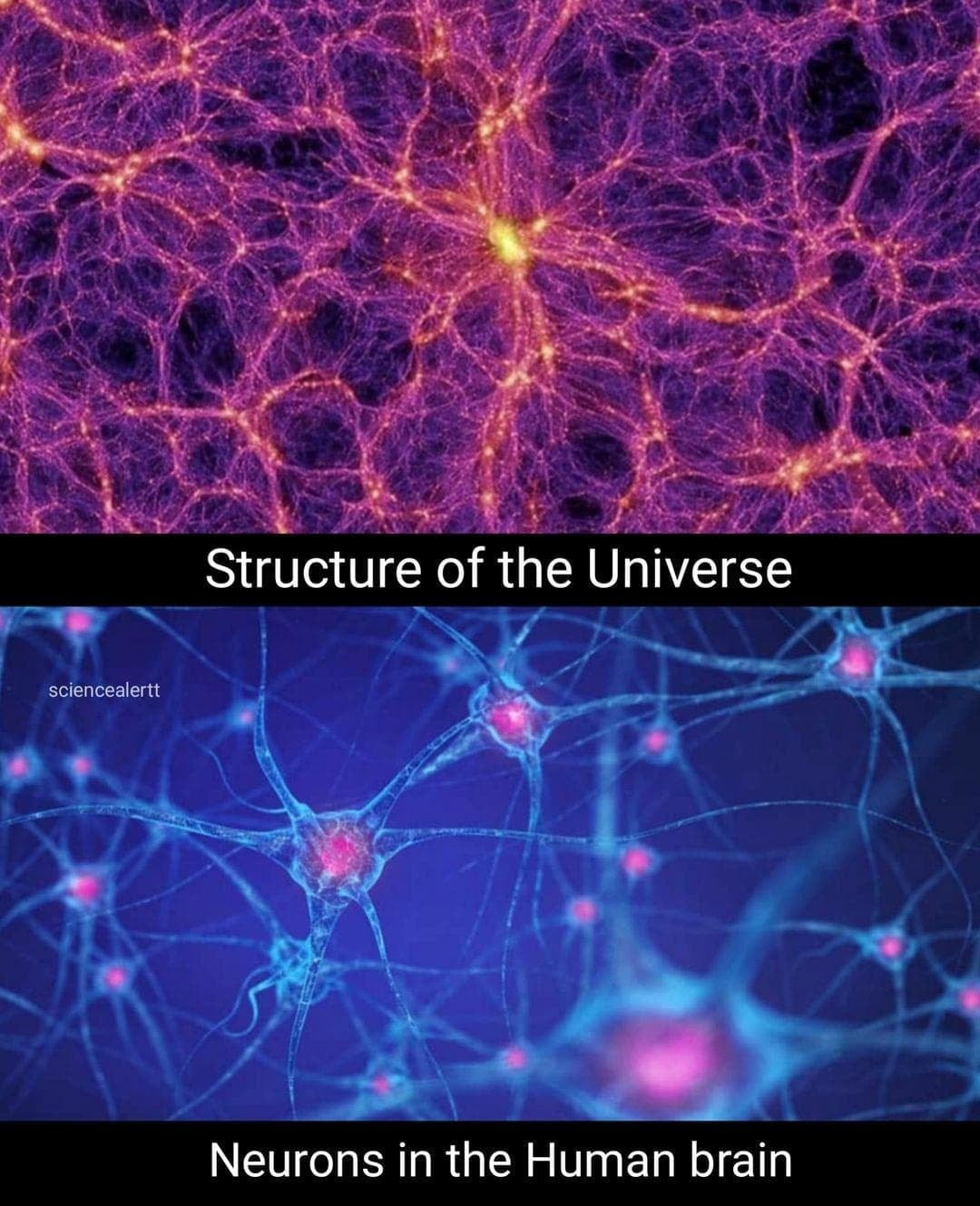
The Cosmic Web
To me, these images fairly scream, “Let us create man in our image, after our likeness” (Bereishis 1:26-28).
The top illustration of the above meme shows a particular sector of a cosmic map of the large-scale structure of the universe, including vast dark matter filaments, inferred computationally from the gravitational influence of that dark matter on other objects in the universe, like galaxies. It images these filaments of dark matter, perhaps for the first time (see: Astrophysical Journal, May 26, 2021).
Note, especially, the vast emptiness betwixt and between the dark matter structure.
The filament structure of the universe is strikingly congruent, in a topological sense, to the axon-neuronic structure of the brain, and begs the question of whether the heavenly dark matter is a scaffold for the divine “intelligence” (for want of a better word) that humankind may experience as G-d’s Chochmah (Wisdom)?
The similitude between the large-scale structure of the universe and the axon-neuronic structure of the human brain has led me to wonder if the dark matter of the universe is a sort of neural network in which information can be stored and processed on an unimaginable scale. Is the universe “conscious”? Is the large-scale structure of the universe (Macrocosm) and of the small-scale structure of the human mind (microcosm) what we mean when we say “shamayim (heaven)”? Is the sum total of the informational content of these structures in the universe a scaffold upon which G-d’s Chokhmah alights?1
Perhaps so. Let us look for answers in our Torah and inquire of our Sages.
The letter Ayin – spelled Ayin, Yud, Nun – means “nothingness” – no-“thing”-ness – in Kabbalah, metaphorically similar to dark matter.
Ayin is often used as a code-word for the Atzmut (the Ein Sof, G-d’s “Essence;” see Sefer Yetzirah, R. Aryeh Kaplan version, 1:2).
Why is the Atzmut called by the letter Ayin, meaning “nothingness”? Because “[i]f one asks, ‘What is it?’ The answer is “Ayin (nothing)”, meaning ‘No one can understand anything about It.’ It is negated of every conception. No one can know anything about It – except the belief that it exists. Its existence cannot be grasped by anyone but It.” (R. Yosef Gikatilla, Sha’arei Orah (Warsaw 1883) 44a-b; Daniel Matt, The Essential Kabbalah, 67).
So we say what [G-d] is not, but not what [He] is . . . [He is] higher than what we call being” (Plotinus, Enneads, 5.3:14; Cf. RaMBaM, Moreh Nevuchim). G-d is the cause of being in all things (Psuedo-Dionysious, The Divine Names 1:1; Moreh Nevuchim, the whole first half of the sefer). Consequently, “Ayin is more existent than all the being of the world. But because it is simple, and every simple thing is complex compared to its simplicity, it is called Ayin” (R. David Ben-Avraham Ha-Lavan, Masoret Ha-Berit, Gershom Scholem (ed.), Qovets Al-Yad, n. s. 1 (1936) 31; Moreh Nevuchim).
All we can know of the Atzmut is His “Back,” that is, His Manifestations and His Actions (Sefer Shemot, Parshat Yitro, where Moshe requests of G-d, “Show me Your Glory!” and Hashem replies, “No one may see My Face and live, but i will hide you in [the R/rock] and pass behind you, and you shall see My Back.”). Even then, we can perceive G-d’s Manifestations and Actions only from our own limited points of view, and certainly not from His own Point of View (RaMBaM, Moreh Nevuchim).
Only Ayin (no-“thing”-ness, G-d’s Manifestations and Actions, not His Essence) may be apprehended by the human mind (ibid). Anochi- the Egyptian word meaning, “I am,” with which the Decalogue begins – the “real” nature or essence of G-d – is so deeply concealed in layer upon layer of darkness that it cannot be apprehended by intellect alone. (Gittin 56b). Anochi may be apprehended only to the extent that it is experienced in the deepest recesses of one’s heart of hearts as a divine gift, and even then, it is given in that same “still small voice,” that Elijah heard, which is so difficult for us to hear (Mei HaShiloach, ibid; Sefer Yetzirah, R. Aryeh Kaplan version, see footnote 2).
What does this tell us about our own human identities as B’nei Adam? It tells us that the structure of our brain (see bottom illustration in the meme below) is similar in structure to the pattern made by everything we know about the Manifestations and Actions of G-d in His universe, which is akin to the cosmic web of dark matter. And that divinely created “structure” is replicated as a pattern in the neural structure of the human brain3. This same recurrent pattern can be said to be a shadow thrown by the “image and likeness of Hashem”, a shadow which “moves” depending upon the behavior of humankind, the arousal from below (citation to be provided). For it has also been written, “Hashem shall be the shadow on your right hand” (citation to be provided), not the other way around, a Nothing which signifies the manifest Presence of Everything.
It is as the great Kabbalist, R. Moshe DeLeon wrote, “[n]o one knows anything about the human soul; she stands in the status of nothingness, as it is written, ‘The superiority of man over beast is Ayin (Ecclesiastes 9:13). By means of this soul, the human being . . . attains the glory of Ayin.” (R. Moshe DeLeon, Sheqel HaQodesh, A. W. Greenup (ed.), (London 1911), 23-24; Daniel Matt, The Essential Kabbalah, 67). For “[w]here one finds G-d, there one finds His humility” (citation to be provided. This refers to the Tzimtzum, wherein G-d voluntarily constricted His own Presence to “make room” for the creation of beings who perceive themselves to be separate and independent from Him.)
The key to unlocking the potentialities of the human soul is therefore bittul, becoming “nothing” in one’s own eyes and nullified before G-d. This was the attribute of the Patriarchs, who were G-d’s Merkava (Chariot). The Patriarchs so lacked any sense of independent identity that it was as if Hashem was acting through them directly, without interference from their respective individual egos. As Avrohom Avinu said, “I am but dust and ashes,” and as Moshe Rabbeinu inquired, “What is man that you should take notice of him?”
Becoming bittul is a very, very high madreiga. How does one achieve it? R. Dov Ber advises, “Think of yourself as Ayin and forget yourself totally. Then you can transcend time, rising to the world of thought, where all is equal: life and death, ocean and dry land. Such is not the case if you are attached to the material nature of the world. If you think of yourself as something, then G-d cannot clothe Himself in you, for G-d is infinite. No vessel can contain G-d, unless you think of yourself as Ayin.” (R. Dov Ber, Maggid Devarav le-Yaaqov, 49, 91, & 134.)
This is because “Ayin is the root of all things, and ‘when one brings anything to its root, one can transform it. ‘First [each thing] must arrive at the level of Ayin; only then can it become something else. Ayin ‘strips off one form and puts on another.’ ‘Transformation is possible only through Ayin.'” (R. Dov Ber, Maggid Devarav le-Yaaqov, Rivkah Schatz-Uffenheimer (ed.), (Jerusalem 1976), 209.)
“This is the foundation of the entire Torah: that yesh (the apparent “somethingness” of this world), be annihilated into Ayin. The purpose of the creation of the worlds from Ayin [Nothingness] to yesh [somethingness] was that they be transformed from yesh [somethingness] to Ayin [Nothingness]” (R. Schneur Zalman of Liadi, Torah Ohr, (Vilna 1899), Noach 11a; Va-Yetse 22b).
For “[t]he essence of serving G-d and all the mitzvot are to attain the state of humility, namely, to understand that all of your physical and mental powers and your essential being depend upon the divine elements within. You are simply a channel for the divine qualities. You attain this humility through contemplation of G-d’s vastness, through realizing that ‘there is no place empty of G-d.’ Then you come to a state of Ayin . . . you have no independent self and are contained, as it were, in the Creator . . . This is the meaning of the verse, ‘Moses hid his face, for he was in awe’ (Exodus 3:6). Through his experience of awe, Moses attained the hiding of his face, that is, he perceived no independent self. Everything is part of divinity.” (Issachar Ber of Zlotshov, Mevasser Tsedeq (Berditchov 1817) 9a and b; Daniel Matt, The Essential Kabbalah, 72.)
This is why any recitation of the holy Shema which does not include even the least member of Klal Yisroel in the word “echad” is defective (Mei HaShiloach, Sefer Bereishis, full citation to be provided). For the collective soul of Yisroel is the Shekhinah.
FOOTNOTES:
[1] It is written, for “the inner power is called Ayin because thought cannot grasp it. Concerning this, Job said, “Wisdom: where is it to be found? Wisdom comes into being from Ayin” (Job 28:12; Asher Ben-David, cited by Efraim Gottleib, Ha Kabbalah Ha Kitvei Ha Rabbeinu Bachya (Jerusalem 1970), 84.
[2]”The heart also provides life-force to the brain and nervous system. When the heart stops pumping, the nervous system cannot function, and the Mind no longer provides influence over the body. The heart therefore serves as a causal link between Mind and body. It is for this reason that the Sefer Yetzirah calls the heart “king over the soul” [SY 6:3] and describes the mystical experience as the running of the heart.” (See also, SY 1:6 & 6:3 for a general description of the mystical experience itself.)
[3]”Each of the 32 paths of Wisdom delineate and define a particular aspect of creation. . . . Note that the word for “G-d” here is Elokhim. This is because man’s form parallels the structure of the delineating forces that define creation. The Kabbalists note that the 32 paths of wisdom have their parallel in the human nervous system. Thirty-one of these paths parallel the thirty-one nerves that emanate from the spinal cord. The thirty-second or highest path corresponds to the entire complex of the cranial nerves, which are twelve in number. . . . Like the nerves, each of the 32 paths is a two-way street. First, it is a channel through which the Mind exerts control over creation. Second, it is also a path through which man can reach the Mind.” (Sefer Yetzirah, R. Aryeh Kaplan version, 1:1, pp. 9-9.)
(Many thanks to my physicist husband, Joseph Hy Abeles, PhD).