
Explaining Russia’s Seriously Weird Antisemitism
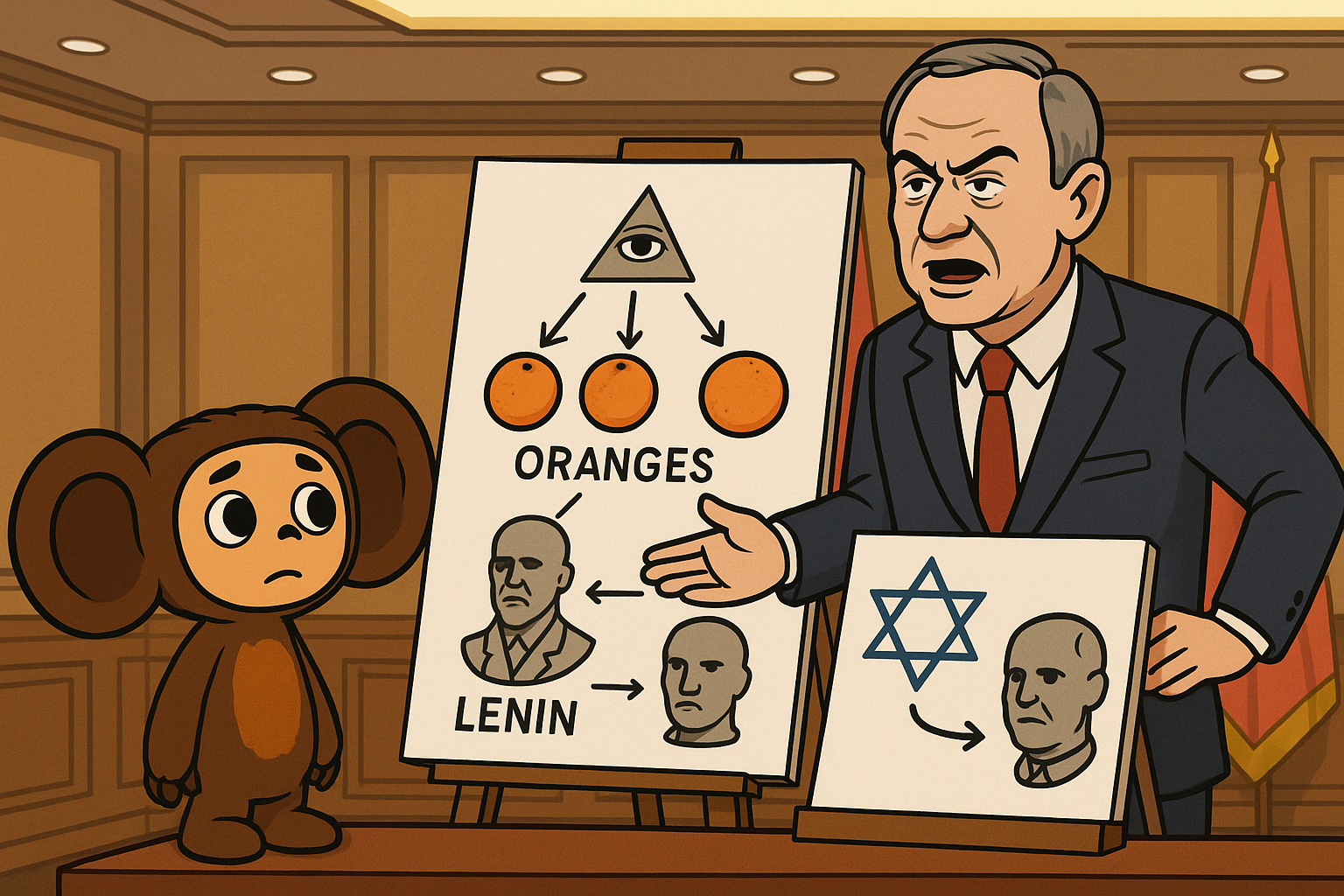
Cheburashka, oranges, Lenin, and the Mausoleum.
What do you think these have in common?
Well, if you haven’t guessed it by now, here’s your answer: they’re all related to Jews. Predictably, not in a good way.
I’ve already covered Russia’s Borat-like claim this summer that Jews are—at least partially—responsible for spreading measles in the country. Since then, plenty of new material has appeared because, if there’s one thing you can trust Russia with, it’s its ability to surprise you with the sheer degree of mental inadequacy.
Take Andrei Makarov, the Head of the Russian State Duma’s Budget and Finance Committee. In a bizarre twist, Makarov recently claimed publicly that Cheburashka—the classic Soviet cartoon character of unknown species—is Jewish.
“Do you remember where the Soviet Union imported oranges from? Only one country did. From Israel. Cheburashka is Jewish, and he arrived from Israel in a crate of oranges,” Makarov stated matter-of-factly.
In fact, no—we don’t remember that. Even some Russian MPs tried to push back, noting that the USSR also imported citrus fruit from Morocco and Spain. But Makarov was unmoved, insisting that Cheburashka is not “Spanish.”
For someone unfamiliar with the Russian mindset, this charade may look, to put it mildly, bizarre. But I, as a Ukrainian, know quite well what went through Makarov’s mind when he said it.
Nonsense at first glance, it is an elevated form of hatred, boredom, and self-perceived superiority that manifests randomly—and sarcastically—in objects that have little to no actual connection to the target of hatred. It’s a type of energy, if you will, and energy always needs an outlet. In Makarov’s case, the victim was Cheburashka. But rest assured: it can be anyone, at any time, with a touch of fantasy that will exceed even your boldest Pallywood expectations.
Still, Makarov’s self-indulgent antics look bleak compared to The Good Neighbors, a recent production by director Mariya Yefremova that she has dubbed a “romantic comedy.”
I can’t say what makes it a Russian Bridget Jones, but what I can tell you after watching several snippets is that it is an anthology of amalgamated xenophobia, self-delusional grandeur, and hatred for everyone except the “true Russian,” who is by default a mythical ancient Slav. While I’ve been familiar with the Russian system of “values” since my early teens, admittedly, the bit where a mother explains to her son Lenin’s “Jewish roots” and what that entails took even a seasoned person by surprise.
In a casual tone, the woman tells her son that the Mausoleum is a “zhydoBolshevik” project (“zhyd” is a slur for a Jew in Russian) and a machine for “suppressing the will of the Russian people.” She also drops a bombshell: Lenin’s corpse is a teraphim. And teraphim “were made from the dried heads of infants whom the Jews allegedly killed during secret religious ceremonies.”
You would think that might be enough. The answer is no.
When The Good Neighbors was taken off Rutube (Russia’s knockoff YouTube) for unclear—yet entirely understandable—reasons, Yefremova wrote an article: “Why Did Jews Get Scared by the Russian Movie The Good Neighbors?”
“The movie shows the Russian image and the Russian people in a dignified manner, so it immediately reached all the Israeli sons, and their sidelocks stood on end,” her article reads. Just as you’d expect.
Yefremova’s source of hatred isn’t hard to figure out. In her own movie’s snippet where she appears alongside her on-screen boyfriend, she—a woman in her late 40s—wears pigtails and speaks with a voice of a 13-year-old virgin who “wants to make pies out of cherries and apricots.” The whole scene smacks of the common attitude among single Russian women who often pretend they’re still little girls about to meet the Ivan of their life and perform ancient Slav pagan rituals together. And who’s responsible for their current unhappiness? Naturally, not the real Russian man she wants to make the pies for. Only the “zhyd.”
This all brings me back to a monologue from the Russian comedy TV series Ostorozhno, Modern-2, perhaps one of the greatest satirical shows ever made. In one episode, the main character—Vasily Zadov, a low-ranking officer who oscillates between embezzling the remnants of the Russian army and sucking up to his commanders—is refused an apartment because his brother repatriated to Israel.
This prompts the upset Zadov to declare: “You might think I hate my brother because he is a Jew. No, he’s a Russian—just like me.”
When you think about it, this satirical nonsense pales in comparison to Russia’s real modus operandi.