
An Aging Jewish Feminist
Facing the Unknown: Parshat Beshalach
Before I address the personal, I want to pause and notice how poignant it is that this Shabbat of Parashat Beshalach—also known as Shabbat Shirah, because of the Song of the Sea and the haftarah with Deborah’s song—falls in the same week that the body of the last remaining hostage, Ran Gvili, was released from Gaza. Song and silence, redemption and loss, hope and grief all collide this week. And yet, perhaps precisely because of that, we are being invited to begin thinking about the future—and about peacemaking.
Against this larger backdrop, my own life feels small, but it too is in motion. Since I wrote last week about my big move, I have contacted a mover, bought a bed, and started going through my clothing—helped along by good friends who are gently pushing me and encouraging me forward. I even spoke to the local rabbi in Tivon where I am moving, and arranged to read from the Megillah on Purim. And still, alongside these concrete steps, I find myself escaping into Netflix and into books of all kinds, from novels to self-help. I have always been an eclectic reader, and perhaps now more than ever.
This tension between movement and hesitation is not new. If we turn to this week’s parashah, we see that God understood His people remarkably well, because He did not take them out of Egypt by the shortest route. Why not? Because if they were too close, they might return.
“Now when Pharaoh let the people go, God did not lead them by way of the land of the Philistines, although it was nearer; for God said, ‘The people may have a change of heart when they see war, and return to Egypt.’ So God led the people round about, by way of the wilderness at the Sea of Reeds.”
Reading this, I cannot help but hear an echo of my own situation. By choosing to move to a retirement home up North and to leave the South, I too am deliberately breaking with the familiar. I hope I will not have a “change of heart,” but the Torah reminds me that fear and second thoughts are deeply human—especially when one chooses the unknown, even willingly.
Last week I mentioned, almost in passing, that many Israelites did not leave Egypt at all. That passing comment deserves more attention. Although the Torah does not say this explicitly, the verse describing the Israelites’ departure generated extensive commentary. Let us begin with the verse itself:
“Now the Israelites went up armed—וַחֲמֻשִׁים—out of the land of Egypt” (Exodus 13:18).
וַיַּסֵּ֨ב אֱלֹקִ֧ים ׀ אֶת־הָעָ֛ם דֶּ֥רֶךְ הַמִּדְבָּ֖ר יַם־ס֑וּף וַחֲמֻשִׁ֛ים עָל֥וּ בְנֵי־יִשְׂרָאֵ֖ל מֵאֶ֥רֶץ מִצְרָֽיִם׃
Because the word chamushim (“armed”) can also be read, without vowels, as chamishim (“fifty”), the sages took this ambiguity seriously and drew far-reaching conclusions.
- Rabbenu Bachya suggests that only one in fifty—or even one in five hundred—actually left Egypt.
- Toldot Yitzchak reads the phrase “with a strong hand and an outstretched arm” as referring not to the Egyptians, but to the Israelites themselves. They did not want to leave, and God had to take them out against their will, using force and persuasion. Those who did leave were not stubborn; they left because, in the end, they understood that they had no choice.
- The Kli Yakar goes even further, arguing that even those who wanted to leave still had to be taken out by God with a strong hand— against their will, against what was better for them.
- Shemot Rabbah 14:13 adds a social dimension: some Jews had Egyptian patrons, wealth, and honor, and therefore did not want to leave.
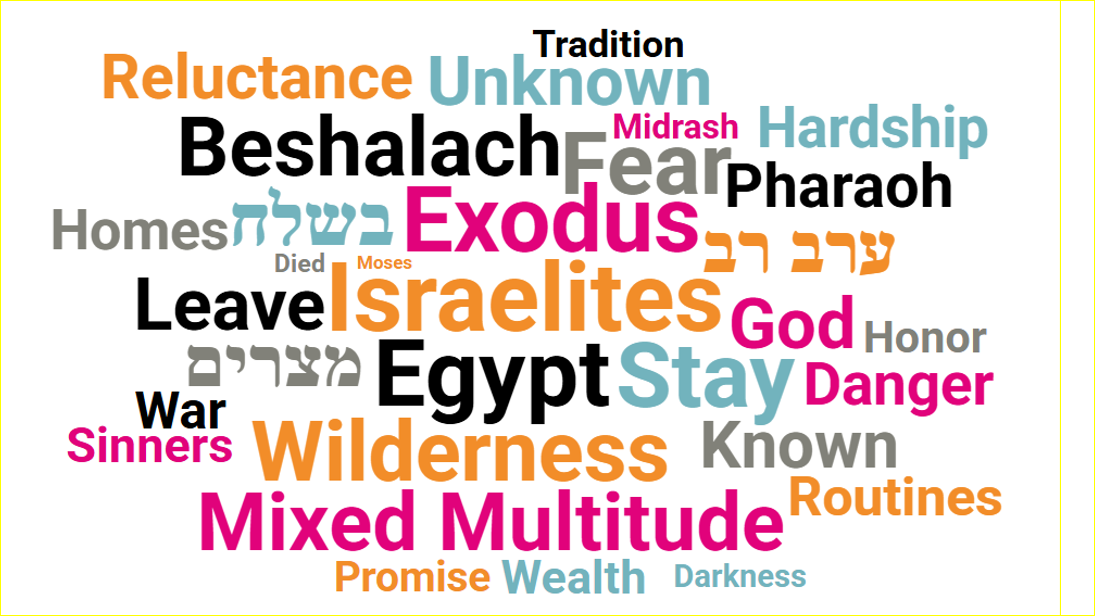
All three commentators converge on a painful truth: many Israelites did not want to go, and many did not go. Despite the Torah’s mention of a “mixed multitude” (erev rav) leaving Egypt, rabbinic tradition insists on a counter-narrative—that most Israelites stayed behind and did not answer Moses’ call.
We will never know exactly what happened, but our sages are clear about one thing: leaving is terrifying, and staying—even in an unhealthy or oppressive place—often feels safer.
Why enter the wilderness? Why trade known hardship for unknown danger? Why abandon homes, routines, neighbors—even flawed ones—for a promise from a God whose power has just been displayed so violently?
When I think about my own move, I feel a deep kinship with those who hesitated. Why should an 82½-year-old woman leave the home she has lived in most of her life? Why move north, where she knows no one? Why give up control, space, memory, and autonomy?
And yet, this very week, we are being nudged—collectively and personally—to look ahead. As I noted at the beginning, there is a growing sense that we cannot remain bound to the last two and a half years forever. On Monday, many people symbolically removed the yellow pins they had worn to show solidarity with the hostages and their families. It was not an act of forgetting, but a quiet acknowledgment of transition.
Perhaps now is the time to begin rebuilding, to do ḥeshbon nefesh—a deep moral and spiritual accounting—and to ask ourselves what it means to move forward without knowing exactly where the path will lead. As I prepare to leave, I find myself holding that same question, and waiting to see how it will unfold.

Shabbat shalom
Related Topics
Related Posts