


Fairy Tales Aren’t a Strategy: The Danger of Simplistic Messianism
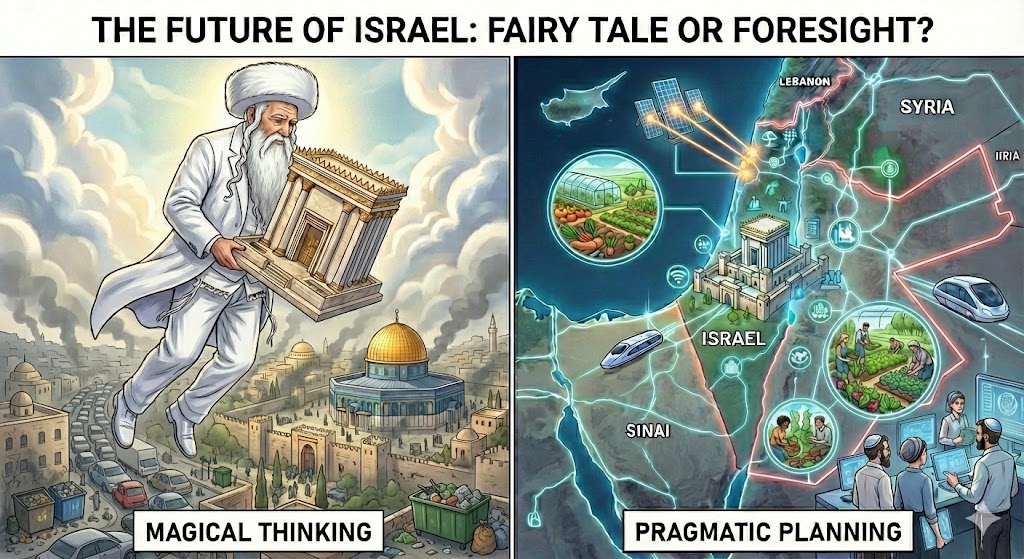
In recent weeks, reports have resurfaced regarding strategic interests in Greenland and the opening of the Northern Sea Route. Experts point to 2030 as a tipping point for year-round navigation in the Arctic—a shift that will redraw the maps of global trade and geopolitical power. While world powers are calculating moves for 30, 50, and 100 years into the future, a segment of the Jewish world remains tethered to a different kind of “future-casting”: the belief that at any moment, a magical redeemer will appear, a Temple will descend from the clouds, and all earthly problems will vanish.
As an Orthodox rabbi, I believe deeply in the concept of Mashiach. But we must confront a hard truth: if we allow a “magical” understanding of Geulah (redemption) to dictate our national policy, we cannot be trusted with the helm of the State of Israel.
The popular imagination of the Messiah—a supernatural figure who transcends the laws of physics—is largely the product of Midrashic allegory. However, when we look at authoritative sources like the Rambam (Maimonides), the picture is starkly different.
The Rambam defines the Mashiach primarily as a king – a political figure – who fights wars and restores sovereignty. In the Rambam’s view the Messiah is not necessarily a scholar or a miracle worker; he is a leader who operates within the realm of the real. The “supernatural” descriptions in our tradition are often pedagogical tools, not blueprints for statecraft.
When we treat these allegories as literal “wait-and-see” policies, we abandon the Torah’s core message: personal responsibility and man’s partnership with the Creator.
Consider the Greenland example. If the Orthodox leadership were at the helm, would they be planning for the shifting tectonic plates of global trade? Or would they dismiss such concerns as “nonsense” because the Geulah is imminent in the coming weeks as Rabbi Reuven Elbaz head of the Moetzet Chachmei HaTorah which is affiliated with the Shas party said this week.
A society that views the future through a lens of magical intervention is a society that fails to build. It fails to invest in the infrastructure, the science, and the technology required to survive in a volatile world. If you believe a building will fall from heaven, you don’t study urban planning. If you believe the economy will be managed by miracles, you don’t study global markets.
This mindset is not “religious fervor”; it is a dereliction of our duty to repair the world under the sovereignty of God. To repair the world, one must first understand how the world works.
The Torah demands that we engage with the “Laws of Nature.” Science and technology are not distractions from the Knowledge of God; they are the Knowledge of God in the physical realm. A “Practical Torah” is one that equips a nation to navigate the next century, not one that waits for the next miracle.
The purpose of Judaism is to bring the world to a state of peace and abundance through human agency blessed by Divine support. As the verse says, it is God who gives us the strength לעשות חיל (to achieve greatness/wealth). Note the phrasing: He gives us the strength to do. He does not do it for us while we sit idle.
We need a leadership that prays for Mashiach every day while actively cultivating the environment from which he can emerge. We must raise a generation of forward-thinking visionaries—leaders defined not by magical thinking, but by profound wisdom, unwavering honesty, and the strategic character necessary to persuade nations toward the good
We can love the idea of the Messiah and still recognize that the path to that era is paved with outreach, planning, and a deep commitment to the reality of the ground. Trusting in God’s plan does not mean having no plan of our own. On the contrary, the highest form of trust is to use the tools He gave us—intellect, foresight, and responsibility—to secure the future of the State of Israel and the Jewish People.