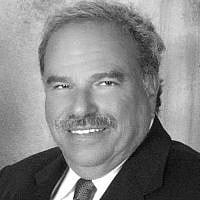
Sports, Politics, Broadcast and Media Specialist
Faith, Family, Football: Michael Weinstein AM, BEM
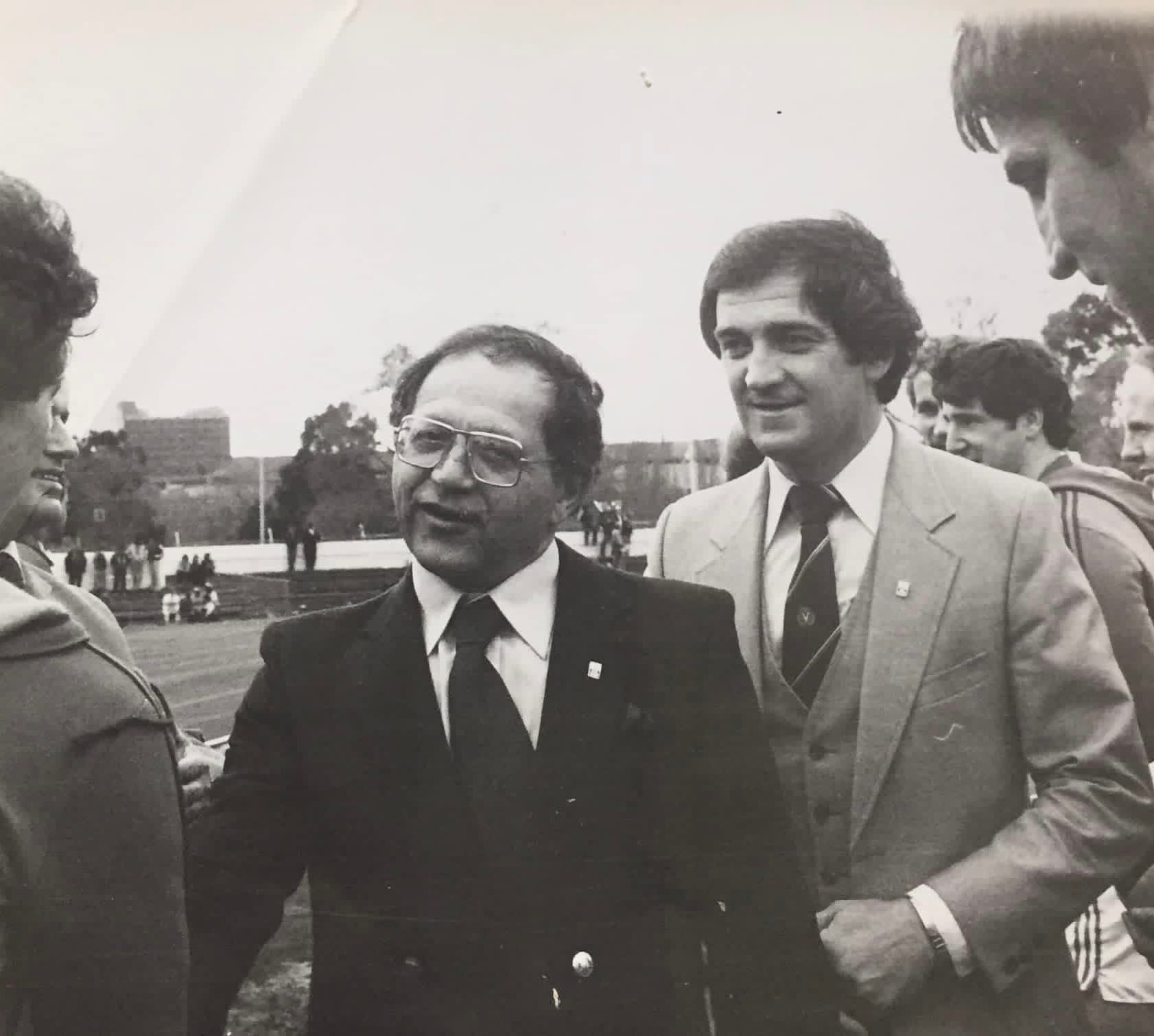
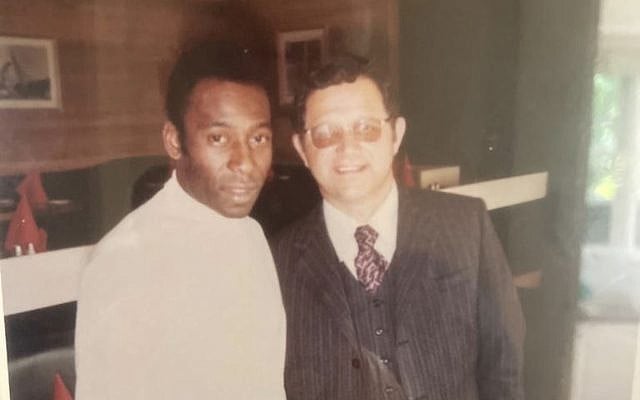
Source: National Football Archive — Description: Michael Weinstein (centre) beside John Dimtsis (right) - Pre game for a Victoria State League match at Chaplin Reserve in 1975
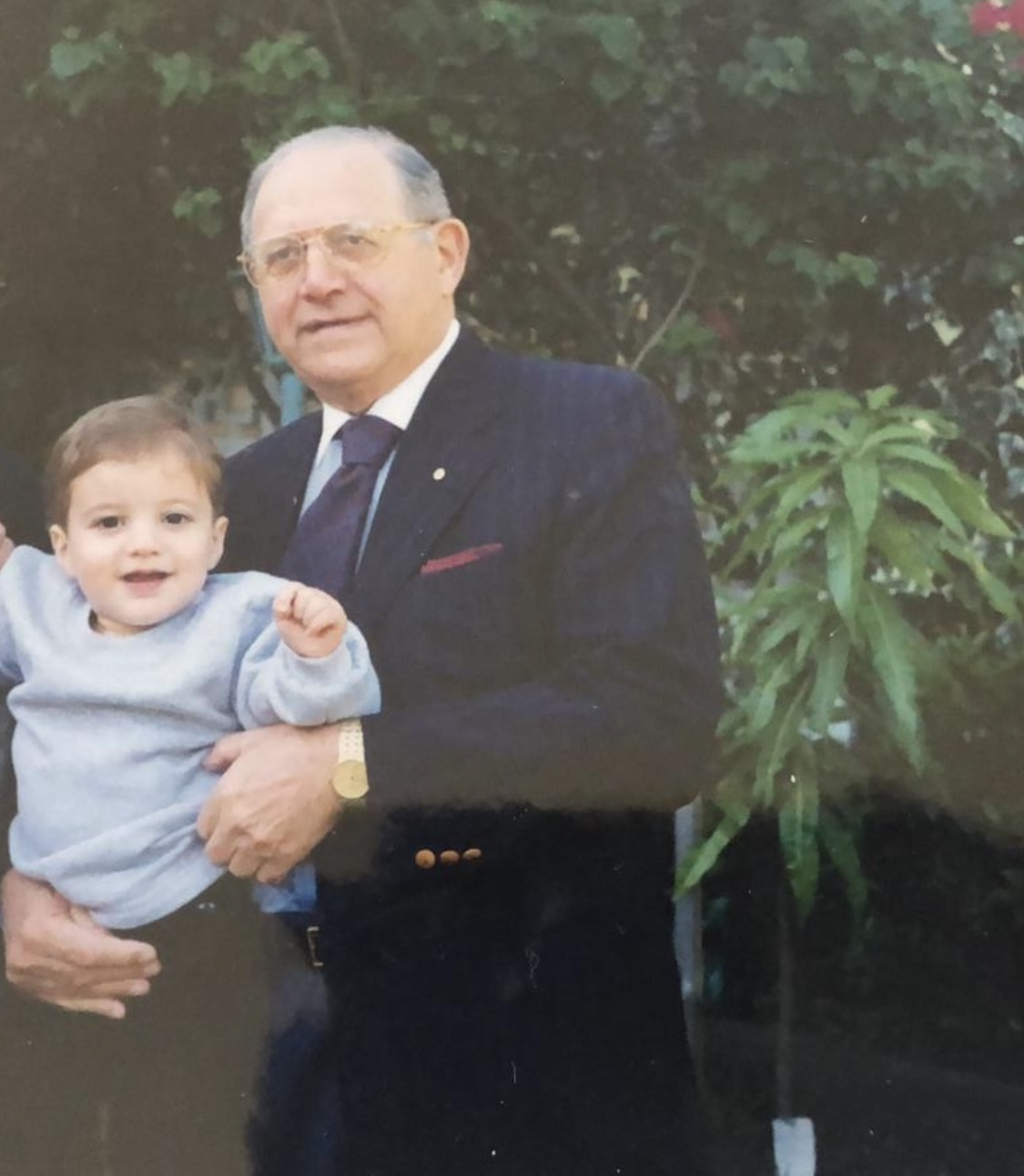
My grandfather, Michael Weinstein AM, BEM, (affectionately known as ‘Mikey’ by his grandchildren) was and always will be my hero and my North Star. A man who quietly built the foundation on which Football in Australia stands today. His contribution to Australian football was not loud or theatrical; it was steady, consistent, and deeply rooted in a lifelong instinct to step in, repair, and rebuild what needed to be fixed – an instinct shaped by experiences most of us can barely imagine.
A Life Formed in Hardship and Resolve
Michael was born in 1923 in Włocławek, Poland, into a close-knit Jewish family whose traditions and values became a compass throughout his life. It was durning his early years when at about the age of 10, Michael’s life long love affair with football began, when he went beyond just playing at school to taking management of his disorganised school team and ensured enough players turned up for every game. During his teenage years his family fled the early tremors of the war in Poland and made their way to Russia in September 1939, where he completed his schooling and even began a law degree. However, in June 1941 Germany launched Operation Barbarossa a three-pronged invasion of the Soviet Union, breaking the Molotov-Ribbentrop non aggression pact and the world around Michael abruptly changed forever.
He was accepted into the Soviet Army’s officer school and became a tank commander, a role demanding clarity and composure under difficult circumstances. By the end of the war, he fought almost all the way to Berlin and was part of the forces that liberated his motherland – Poland. During his years of service he survived multiple injuries, including the destruction of his tank in battle. He also lost a finger and carried shrapnel for the rest of his life, physical reminders of experiences he rarely spoke of. For his bravery and leadership, he received several Soviet military decorations – acknowledgements he never boasted about.
At the war’s end, he was placed in charge of the prosecutor’s office in Łódź, where a remarkable twist of fate changed the course of his life. In the streets he was recognised by a cousin who delivered the almost unimaginable news that his mother, Eva, and sister, Madzia, had survived Auschwitz and other relatives had survived the Warsaw Ghetto. It was through this reconnection with family that he met my grandmother Josephine (Ina), the woman who would become his partner, his confidant, his best friend, his teammate and the love of his life.
Their postwar years were defined by movement and uncertainty. Time in a displaced persons camp in Austria, marriage in 1946, an attempted journey to pre-state Israel foiled by the British blockade of Cyprus, and several years living and working in Italy. Meanwhile, Michael’s mother and sister had resettled in Melbourne, and in 1949 he and Ina made the decision to begin yet another chapter, boarding the Eridan ship bound for Sydney, Australia before moving onwards to Melbourne.
He arrived in Australia speaking four languages, one of which was not English. A challenge he and Ina tackled head-on like everything they did together, enrolling in English classes at the University of Melbourne. These two survivors with little belongings and only dreams were determined to not allow their past to dictate their future.
The Instinct to Fix Rather Than Complain
Michael began his Australian football journey at Hakoah St Kilda, initially as a player. However, in the way that would become characteristic, when he pointed out structural problems within the club, he was promptly asked to help solve them. It was not ambition that put him in positions of responsibility, it was competence. He accepted tasks because he believed that if something was broken, it could and should be repaired.
This philosophy, shaped by war, displacement, and a lifetime of rebuilding, became the quiet engine behind much of his influence. His leadership was never loud – it was grounded in reason, humility, and an ability to bring order to chaos.
A Steady Influence in Times of Transition
By the early 1960s, football in Victoria stood at a crossroads. The sport was fractured between competing bodies, and progress was being stifled by outdated structures. Michael became central to the effort to dissolve the Victorian Amateur Soccer Football Association and establish the Victorian Soccer Federation (VSF) in 1962. The process was delicate and often tense, but he approached it with the same calm and pragmatic reasoning that had defined him for decades.
His influence later extended nationally. As a founding member of the Australian Soccer Federation (ASF) in 1961, he helped guide Australia back into FIFA’s fold in 1963 – a task requiring diplomatic skill and unwavering persistence. As Vice-President of the ASF from 1975 to 1986, he played a decisive part in shaping the sport during a transformative era, bringing structure, stability, and quiet leadership where they were most needed.
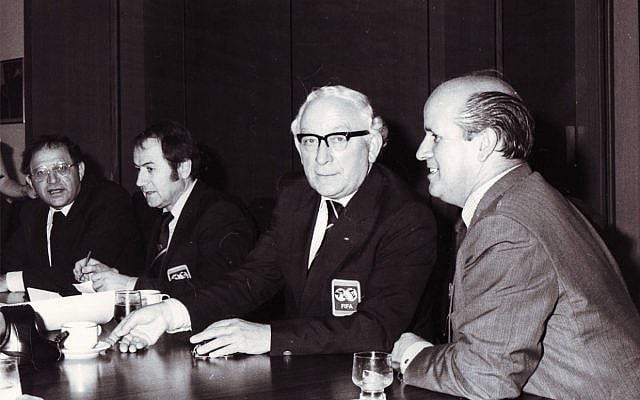
Description: Michael Weinstein (left) and George Wallace (right), respectively Chairman and Secretary of the Victorian Soccer Federation, flank Sepp Blatter (then General Secretary of FIFA) and Harry Cavan of Northern Ireland and Vice President of FIFA, during a 1980 planning meeting for the forthcoming World Youth Cup to be hosted by Australia in 1981
Work Guided by Character, Not Ego
Outside of football, Michael built an impressive business career. Along with Ina by his side and his extended family, he established Plator Nominees, which grew into him becoming a major shareholder in the respected home-building company Glenville Pty Ltd. True to his nature, he never viewed himself as exceptional – he simply worked, learned, absorbed, and improved. He wasn’t the best at anything, but he was good at everything he put his ‘Yiddishe Kopf’ (Jewish brain) to.
Anchored by Family, Curiosity and Love
Despite the scale of his achievements, the centre of Michael’s world was always his family. He and Ina had 3 daughters – Cynthia, Judy (z”l)(who tragically passed at a young age) and Dianne. Michael built his family home in Kew as a sanctuary for his family and friends. A place for laughter, shared meals, memories, celebrations and everything in between. In addition, he and Ina spent almost every summer in Surfers Paradise, a cherished ritual that became the highlight of the year for all his grandchildren. Those weeks were filled with trips to the movies, walks on the beach, home cooked meals by him and Ina, endless stories, and the unmistakable pride he radiated being amongst the people he loved and lived for. After a life marked by upheaval, these moments of joy and continuity meant everything to him.
As he grew older, he often reflected about the deep Jewish identity instilled in him by his grandfather. He was not outwardly “religious”, but he carried a profound sense of Jewishness and yiddishkeit with him throughout his life. His strong Jewish foundations helped him shape his inner resilience, values, ethics and love of family that structured every part of his life.
Michael was a man of many passions. One of his favourites was cooking elaborate meals, often with his dear friend Fred Villiers (z”l) from old favourites to to dishes from their favourite restaurants, as their wives Karen and Ina chatted – a truly modern twist. He also appreciated art and theatre; travelling the world with Ina; engaging in history, politics, and global events; and following sport with undiminished enthusiasm. He remained endlessly curious, informed, and always sought to learn more.
The Quiet Mark He Left Behind
Michael was honoured with the British Empire Medal (1977), made a Member of the Order of Australia (1986), granted life memberships across football bodies, and inducted into the Football Australia Hall of Fame (1999). In 1975, the Weinstein Medal was introduced to recognise the best Under-16 player in Victoria. There could not be a more fitting award to honour him. An award that recognises the next generation of footballing prodigy and their pathway to global stage – a pathway that was in no small part built by Michael himself.
But perhaps his greatest legacy lies not in awards, but in the structures he strengthened, the organisations he stabilised, the family he loved fiercely, and the quiet strength he embodied.
To our family, he was the steady hand – not strict, not loud, but unwaveringly dependable. He was the person we turned to, the man who could always find a solution, a way around an obstacle, or a path forward. To us, he was a hero filled with unwavering love.
Michael Weinstein’s life is a testament to resilience, responsibility, and a belief in building (literally and metaphorically) – families, institutions, communities, and futures. He helped shape Australian football not as its public face, but as its quiet architect, proving that change is often driven not by the loudest voices but by the most steadfast hands.
Here’s to You
So to my hero, my North Star, my Mikey. This December marks 14 years since you departed this world on an express ticket to Gan Eden and there isn’t a day i don’t yearn for just another day with you. I hope by telling your story and trying to be more like you every day it will be almost like you never left. I’m sure you’re looking down on us as your family continues to grow – you now have 4 great-grandchildren and we are looking after Ina as much as she is looking after us as she almost raises her bat for her century. We will never forget your legacy, I love you, Elliot.
Related Topics
Related Posts