London based entrepreneur, cybersecurity analyst doing a PhD in AI
Fake News – The Neuroscience of Misinformation.
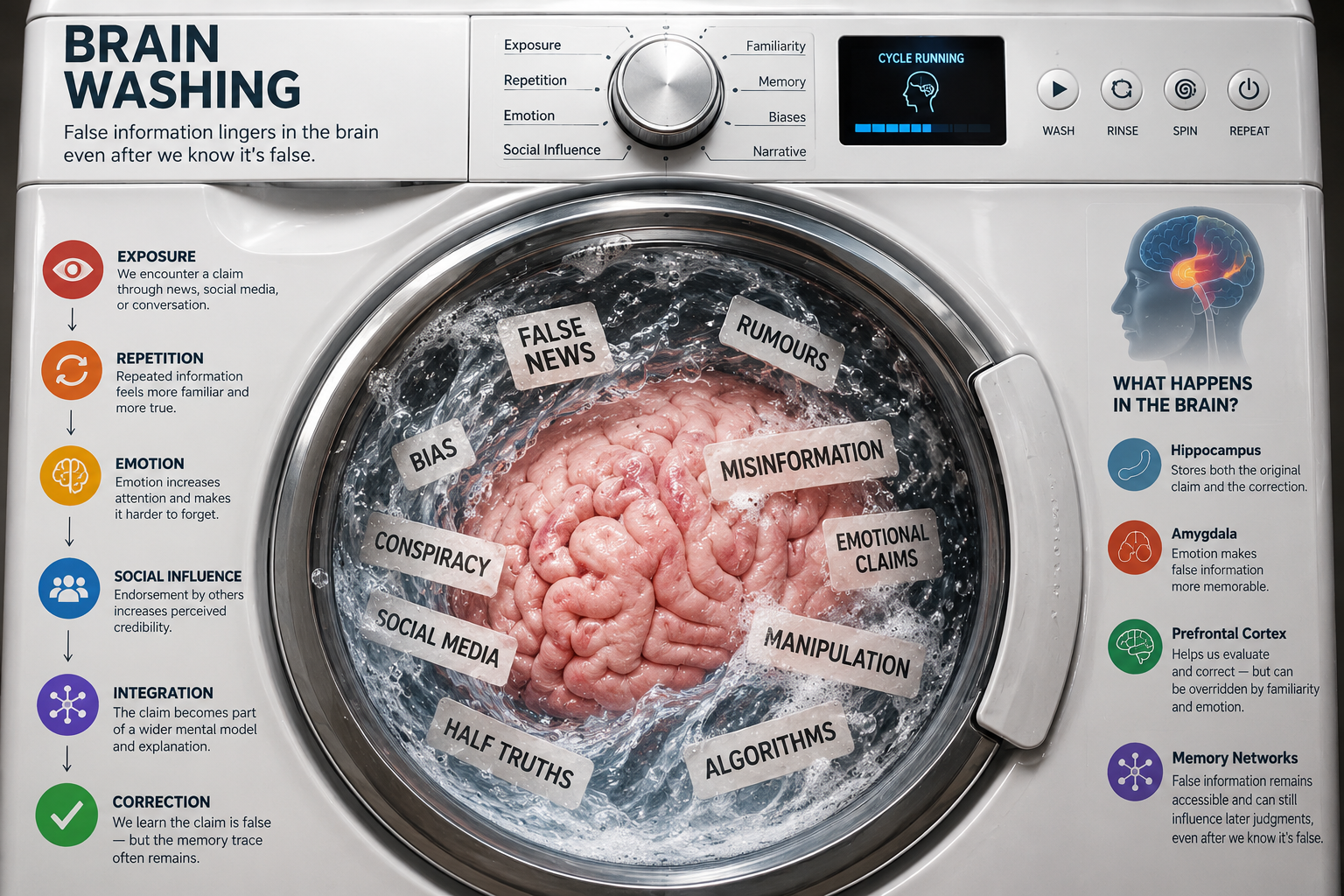
The effects of fake news can linger even after correction.
Brain Washing
Why false information remains in our minds even after we know it is false — and what cognitive neuroscience reveals about the extraordinary persistence of misinformation.
1. The Lie That Survives Its Own Correction
Imagine reading a news report about a fire at a large industrial warehouse.
The initial report suggests that improperly stored chemicals caused the fire. You immediately construct an explanation: hazardous materials, negligent management, inadequate safety precautions, and a preventable disaster.
Several hours later, the authorities issue a correction. There were no hazardous chemicals in the warehouse. The original report was wrong.
You accept the correction.
Yet when someone subsequently asks why the fire spread so rapidly, you might still mention inadequate chemical storage or poor handling of dangerous materials.
Something remarkable has happened.
You no longer believe the original information is true, but it continues to influence how you explain the event.
This is not merely a theoretical curiosity. It is a well-established psychological phenomenon known as the continued influence effect of misinformation.
For decades, researchers have demonstrated that people continue to draw conclusions from information that has been explicitly withdrawn, sometimes even when they accurately remember the correction.
The implications are considerable.
False accusations may leave reputational damage long after an individual is exonerated. Medical misinformation may influence health decisions after scientific clarification. Political narratives may shape public opinion despite repeated fact-checking.
To understand why this happens, we need to examine a fundamental misconception about the human brain.
Memory is not a database in which false information can simply be deleted and replaced with the truth.
It is a reconstructive biological system.
And that difference changes everything.
2. The First Principle: Remembering Is Not the Same as Believing
We frequently treat memory, knowledge and belief as interchangeable concepts.
They are not.
Three distinct cognitive processes are involved when we encounter information.
First, we encode the information, creating a memory representation of what we encountered.
Second, we evaluate the information, determining whether it is credible, plausible or false.
Third, we retrieve and use information when making judgments, predictions or decisions.
These processes interact but do not necessarily produce identical outcomes.
Consider the statement:
The Great Wall of China is visible from the Moon with the naked eye.
This familiar claim is false. Yet many people can remember encountering it even after learning the truth.
A person may simultaneously possess two representations:
- The original, familiar claim about the Great Wall.
- The corrective knowledge that the claim is false.
When asked directly whether the Great Wall is visible from the Moon, the person may correctly answer no.
The objective of misinformation does not always have to be permanent conscious belief. Sometimes merely establishing familiarity, associations or an explanatory framework is sufficient to influence subsequent thinking.
3. Mechanism One: The Illusory Truth Effect
One of the most extensively investigated findings in cognitive psychology is the illusory truth effect.
Its principle is deceptively simple:
Repeated information tends to feel more truthful than unfamiliar information.
Researchers commonly explain this through processing fluency.
When we encounter a statement for the first time, our brains must expend resources processing its words, meaning and relationship to existing knowledge.
On subsequent encounters, processing generally becomes easier.
The statement feels familiar.
And familiarity can be mistakenly interpreted as evidence of truth.
This creates an important cognitive shortcut.
Rather than independently verifying every claim, the brain may partially substitute the question, “Is this correct?” with the easier question, “Does this feel familiar?”
Experiment: Even knowledge does not always protect us
In a landmark 2015 study, Lisa Fazio and colleagues examined whether possessing accurate knowledge protects people against the illusory truth effect.
Participants encountered repeated statements, including claims contradicted by established facts.
The researchers found that repetition could increase perceived truth even when participants possessed the knowledge needed to identify a statement as false.
In other words, participants sometimes relied on familiarity despite knowing better.
The researchers described this as knowledge neglect.
A 2024 study by Felix Speckmann and Christian Unkelbach extended this understanding. Participants were more likely to believe that they had already known repeated information before the experiment, including repeated false claims.
Repetition can therefore affect not just our judgment of truth but our impression of where our knowledge originated.
However, repetition does not guarantee belief. Prior knowledge, attention, source credibility and explicit accuracy judgments can counteract the effect.
The danger is subtler: familiarity becomes one additional signal in our assessment of reality, even though repetition itself provides no evidence that something is true.
4. Mechanism Two: The Brain Stores Both the Lie and the Correction
If misinformation has been disproved, why does the brain not simply remove it?
To answer this, researchers have investigated how corrections are encoded and retrieved.
In 2019, Andrew Gordon and colleagues published two functional magnetic resonance imaging studies in NeuroImage examining the neural mechanisms underlying misinformation correction.
Participants read reports in which earlier information was subsequently confirmed or corrected.
They were then asked to identify information consistent with the verified facts.
The results were revealing.
Participants found it particularly difficult to reject misleading information that had appeared in the original report, compared with entirely new incorrect information.
Brain imaging showed increased activity in the left angular gyrus and bilateral precuneus when participants encountered previously corrected misinformation.
These brain regions participate in aspects of memory retrieval, integration and reconstructive cognition.
The findings supported what researchers call the concurrent-storage hypothesis.
Rather than simply overwriting misinformation, the brain may retain representations of both the original claim and its correction.
When we subsequently retrieve information, these representations can compete.
The underlying neural systems
Several brain systems are relevant:
The hippocampus supports the formation and retrieval of episodic and relational memories. It helps bind together information about events, their context and associated details.
The prefrontal cortex contributes to evaluation, cognitive control, conflict resolution and the selection of information appropriate to a task.
The precuneus and posterior cingulate regions participate in broader networks involved in reconstructing experiences, integrating information and constructing meaningful representations of events.
The amygdala contributes to the processing of emotionally significant information and can influence memory formation through its interactions with other neural systems.
These structures do not operate independently, and none constitutes a dedicated brainwashing centre.
What matters is their interaction.
When a familiar but incorrect representation is retrieved, successful reasoning may require us to recover the correction, connect it to the original claim and deliberately select the verified interpretation.
This can require more cognitive work than simply retrieving the first familiar explanation.
The neuroscience is still developing. Imaging studies identify patterns associated with these processes; they do not yet establish a complete neural mechanism explaining all forms of misinformation persistence.
5. Mechanism Three: The Brain Prefers a Coherent Story
Perhaps the most interesting explanation concerns how humans understand events.
We do not experience the world as isolated statements.
We construct narratives.
When something happens, we ask:
Who was involved? What caused it? Why did it happen? What happened next?
The brain uses these relationships to construct what psychologists call mental models or event models.
Return to the warehouse fire.
The original misinformation provides a causal explanation:
Hazardous chemicals → inadequate storage → fire → destruction.
When the authorities subsequently announce that no hazardous chemicals were present, they remove a crucial component of the explanation.
But they do not necessarily provide an alternative cause.
The brain is left with an incomplete story.
The original explanation, although discredited, remains readily available to fill that gap.
This is why the distinction between negation and replacement is so important.
Saying that a particular explanation is wrong does not automatically supply a new explanation.
The original experiments
Hollyn Johnson and Colleen Seifert demonstrated this principle in their influential 1994 research on the continued influence effect.
Their experiments showed that misinformation could continue to support causal inferences even after correction.
Importantly, providing a plausible alternative causal explanation reduced reliance on the original misinformation.
Simply withdrawing the false information was less effective.
A September 2026 paper by Markus Huff, Jan Pascal Göbel and Helen Fischer, published in Perspectives on Psychological Science, develops this principle further.
The authors propose that misinformation often persists because it becomes embedded within our mental representations of events.
A correction that removes information without restoring the causal structure leaves a model that is difficult to use for prediction and explanation.
This is a theoretical framework that integrates existing findings, rather than a newly established explanation for every instance of misinformation.
But its implications are powerful.
The brain does not merely remember what happened. It tries to maintain an explanation of why it happened.
When misinformation supplies that explanation, removing it may require rebuilding the entire story.
6. Mechanism Four: Emotion, Social Influence and Memory
False information does not enter the brain in an emotional vacuum.
Consider two claims.
The first concerns an obscure statistical error in an administrative report.
The second falsely accuses a trusted teacher of harming a child.
Even if both claims are subsequently corrected, they are unlikely to carry identical emotional significance.
The second claim can provoke fear, anger, disgust or moral outrage.
Emotion affects attention and memory. Events perceived as important or threatening may be encoded differently from routine information.
Research published in The Journal of Neuroscience in 2014 examined how misleading social influence affects subsequent memory correction.
The researchers found evidence linking amygdala-related modulation of hippocampal memory representations with reduced subsequent prefrontal activity associated with correction.
These findings suggest that socially influenced memory representations can become more difficult to revise under certain conditions.
However, this does not mean that emotional information is always remembered better, that every emotionally compelling accusation persists, or that emotion automatically defeats rational evaluation.
The relevant principle is that memory correction depends not only on factual content but also on how that information was originally encoded.
Social identity can introduce another complication.
A claim endorsed by respected colleagues, family members or community leaders may become connected to personal relationships and group membership.
Correcting it can therefore involve reconsidering not merely a fact, but also the trust placed in a source.
In certain circumstances, rejecting misinformation may feel socially or psychologically costly.
This is why emotionally charged misinformation can prove particularly consequential even when its factual foundations are weak.
7. The Cognitive Neuroscience of Brainwashing: A Unified Model
These findings suggest a useful way of understanding how misinformation develops and persists.
Consider the following pathway:
Stage 1 — Exposure
A person encounters a claim through conversation, news, advertising, an online video or an AI-generated response.
Stage 2 — Encoding
The claim becomes associated with words, images, emotions, events and contextual information.
Stage 3 — Reinforcement
Repeated exposure increases familiarity and may make the claim easier to retrieve.
Stage 4 — Integration
The claim becomes part of a wider explanation of how the world works.
Stage 5 — Correction
New evidence establishes that the claim is false.
Stage 6 — Competing retrieval
Both the original representation and the correction may remain available, while the earlier claim continues to influence related inferences.
This is a conceptual synthesis, not a literal sequence followed by every brain or every false claim.
But it captures a fundamental distinction.
Learning the truth and eliminating the influence of a falsehood are two different problems.
A person can successfully complete the first task without fully completing the second.
8. Why Modern Information Systems Make This More Important
Historically, repeated messages were distributed through newspapers, television, radio, political campaigns and interpersonal networks.
Digital platforms have greatly expanded the speed, scale and variety of information exposure.
A single claim can appear through multiple accounts, videos, articles, discussion forums and automated summaries.
This introduces several important risks.
First, repeated messages can create apparent familiarity even when the underlying evidence has not improved.
Second, messages repeated by seemingly independent sources can create an impression of widespread agreement. In reality, several reports may originate from one unsupported assertion.
Third, misinformation can become embedded in narratives, images and videos that make it memorable and intuitively coherent.
Fourth, corrections may circulate less widely than the original claim. People who encounter the misinformation are not guaranteed to encounter its eventual correction.
Artificial intelligence adds a further complication.
A generative AI system may produce a confident explanation based on inaccurate information. That explanation can then be reproduced in articles, presentations, conversations or other systems.
If later outputs repeat the same unsupported narrative, users may encounter it as apparently corroborating information.
The resulting risk is not that AI possesses some unique ability to brainwash the human mind. It is that modern information systems can amplify familiar cognitive vulnerabilities.
Repeated claims, credible presentation and incomplete source verification can become mutually reinforcing.
The appropriate response is not indiscriminate distrust.
Indeed, a 2025 meta-analysis covering more than 194,000 participants found that people generally distinguished verified true news from false news reasonably well in experimental settings.
The problem is not that human beings are incapable of recognizing truth.
It is that recognizing truth is only one component of maintaining accurate beliefs, memories and decisions.
9. Does Debunking Actually Work?
There is a widespread misconception that correcting misinformation inevitably makes people believe it more strongly.
This is frequently described as the backfire effect.
The evidence does not support treating such backfire as the normal outcome.
A 2024 review by Ethan Porter and Thomas Wood concluded that factual corrections generally improve belief accuracy across different political affiliations and demographic groups.
Cases where correction reduces factual accuracy appear to be exceptionally rare.
But another distinction matters.
Corrections can improve what people believe without entirely changing their attitudes, decisions or behaviour.
Correcting a false accusation, for example, may establish that the alleged event did not occur while leaving some residual suspicion.
This is not proof that the correction failed.
It demonstrates that beliefs, emotional responses, memories and judgments are related but separable outcomes.
We should therefore avoid two extremes.
The first is assuming that a correction erases misinformation.
The second is assuming that correcting misinformation is pointless.
Neither is supported by the available evidence.
The scientific objective is to make corrective information sufficiently memorable, accessible and explanatory that it guides future reasoning.
10. How to Counter Brainwashing: Replace, Don’t Just Reject
The central lesson from cognitive psychology is that effective correction needs to do more than attach the word false to an existing claim.
It should help people reconstruct an accurate understanding of events.
A practical approach involves five steps.
- Identify the claim. Separate the precise factual assertion from the broader story, suspicion or emotional response surrounding it.
- Verify the original evidence. Trace the claim to its source. Multiple repetitions of one unsupported claim do not amount to independent corroboration.
- Explain why the claim is wrong. Identify the contradiction, missing evidence, misleading inference or unreliable source, using clear language.
- Provide a credible alternative. Where evidence permits, explain what actually happened and why. When the truth is genuinely uncertain, acknowledge the uncertainty rather than inventing an explanation.
- Reinforce the accurate account. Make the correction understandable, memorable and easy to retrieve in future discussions.
The fourth step is especially important.
Suppose someone falsely claims that a company dismissed hundreds of workers because its business was collapsing.
A correction might merely establish that the company was not insolvent.
A stronger correction, if supported by evidence, might establish that the workforce reduction resulted from a previously announced relocation, explain the relevant operational changes and provide documentation.
The latter helps replace the inaccurate causal model rather than leaving a gap.
Experimental evidence supports this broader approach.
A 2022 study published in Science Advances tested short videos teaching people to recognize manipulation techniques such as emotional language, false dilemmas and scapegoating.
Across randomized experiments and a large YouTube field study, the researchers found improvements in participants’ ability to identify manipulation and make better sharing decisions.
This is known as psychological inoculation or prebunking.
Rather than attempting to correct every false claim after exposure, prebunking teaches people to recognize common methods of deception before encountering them.
It does not provide complete protection, but it offers a promising preventive intervention.
11. The Mind Cannot Simply Unhear What It Has Heard
This brings us to one governing principle:
To correct misinformation effectively, we must replace the false explanation, not merely reject the false statement.
The goal of critical thinking is not to become suspicious of everything or to pretend that human memory can be made infallible.
It is to develop the ability to revise our interpretations when stronger evidence becomes available.
Because in the end, the most dangerous misinformation may not be the lie we still consciously believe.
It may be the lie we have already rejected — but continue to reason with.
References and Further Reading
- Johnson, H. M., & Seifert, C. M. (1994). Sources of the continued influence effect: When misinformation in memory affects later inferences. Journal of Experimental Psychology: Learning, Memory, and Cognition, 20(6), 1420–1436. DOI.
- Fazio, L. K., Brashier, N. M., Payne, B. K., & Marsh, E. J. (2015). Knowledge does not protect against illusory truth. Journal of Experimental Psychology: General, 144(5), 993–1002. DOI.
- Ecker, U. K. H., Lewandowsky, S., & Tang, D. T. W. (2010). Explicit warnings reduce but do not eliminate the continued influence of misinformation. Memory & Cognition, 38, 1087–1100. DOI.
- Gordon, A., Quadflieg, S., Brooks, J. C. W., Ecker, U. K. H., & Lewandowsky, S. (2019). Keeping track of alternative facts: The neural correlates of processing misinformation corrections. NeuroImage, 193, 46–56. DOI.
- Edelson, M., et al. (2014). Brain substrates of recovery from misleading influence. Journal of Neuroscience. DOI.
- Ecker, U. K. H., et al. (2022). The psychological drivers of misinformation belief and its resistance to correction. Nature Reviews Psychology, 1, 13–29. DOI.
- Speckmann, F., & Unkelbach, C. (2024). Illusions of knowledge due to mere repetition. Cognition, 247, 105791. DOI.
- Jia, L., Jin, H., & Jin, X. (2024). Neural mechanisms of the continued influence effect of misinformation: Analysis based on fMRI causal connectivity. Neuroscience Letters, 836, 137861. DOI.
- Porter, E., & Wood, T. J. (2024). Factual corrections: Concerns and current evidence. Current Opinion in Psychology, 55, 101715. DOI.
- Roozenbeek, J., et al. (2022). Psychological inoculation improves resilience against misinformation on social media. Science Advances, 8(34). DOI.
- Pfänder, J., & Altay, S. (2025). Spotting false news and doubting true news: A systematic review and meta-analysis of news judgements. Nature Human Behaviour, 9, 688–699. DOI.
- Huff, M., Göbel, J. P., & Fischer, H. (2026). Misinformation as an Event-Model Problem. Perspectives on Psychological Science. Published online 21 September 2026. DOI.
Related Topics
Related Posts