


I write what I see
Farewell to Savta Judith
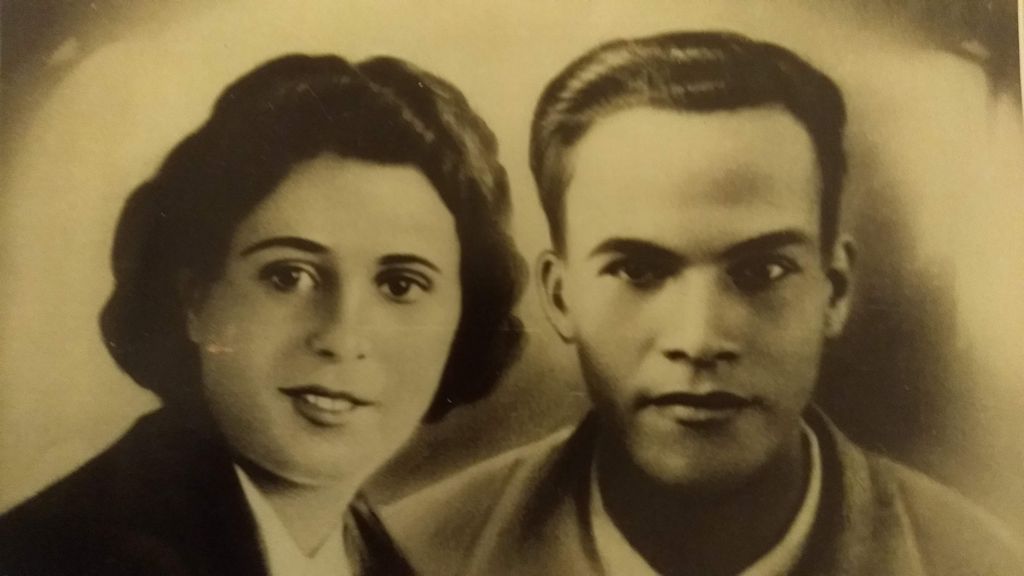
Judith and Zechariah Ratzaby
How ironic that my grandmother passed away during Passover Seder, a reminder that death catches all of us in the end, and does not pass over anyone, no matter how much I wanted my savta (granny) to live forever. I was lucky to have her for fifty-ywo years of my life, and she lived to be 100 years old—how many are granted such a long life? And yet, I’m still sad, feel sick actually, as though someone has just punched me in the stomach.
When she was still able to do so, she would phone me up but it was always in the middle of the night. She would wake me up at 2:00 a.m., 3:00, or 4:00, but I was never angry; I knew that it would not last and that one day these calls would stop. Nobody wakes me up anymore to tell me the mishmish (apricot) hanging heavy on the tree is waiting for me or that the bounty of shesek (loquat) ripening quietly in the garden has turned especially sweet this year.
Judith was something special, the first generation in my family to be born in Israel (Palestine back then). Her parents came from Yemen and settled in Sha-araim, Rehoboth, in 1914. She was a nurturer, working with students in the special-education program at a local school. Together with my grandfather she opened their home to foster children. They didn’t have much money, and space was scarce but they always made room for more.
They also helped shelter ma-apilim—Jews who escaped Nazi Germany; they fed them, clothed them and helped them acclimate to their new surroundings. Everyone contributed what they could to the establishment of the State of Israel.
The memories are flooding my mind at this moment, the reason I always choose to write the minute I’m hit with news—good or bad.
I remember the pigeons nesting in the trees that enveloped the house, and savta lifting me up to see them, pointing out their soft coos and careful movements. She never hurried me, never shooed them away. Standing there, balanced in her arms, I learned that attention itself was a form of care.
I would wake to the rooster next door, his coarse cry tearing through the quiet before the sun had finished rising. Savta never treated it as a nuisance. It was simply part of the morning, as natural and necessary as breath. In that house, animals were not background noise but participants, and somewhere between the pigeons in the trees and the rooster at dawn, my own way of paying attention took root.
When I was in the army I would spend the night in their home every couple of weeks, the rhythm of military life briefly softened by familiar walls and worn furniture. Judith would wake up before everyone else, by the time my eyes opened the house was already moving quietly, deliberately, as if not to disturb the little bit of rest I had left.
She would set a melawach (fried dough) drenched in honey on the table. I didn’t have the heart to tell her that I was never hungry in the mornings, so I ate slowly—letting the warmth settle in me before returning to the Kirya (army base), full in a way that had nothing to do with food.
Walking into their home always felt like stepping out of time. Nothing was rushed there. The pace of the outside world, wars, schedules, departures, fell away at the door. Objects stayed as they had always been, sounds repeated themselves, and rituals held everything in place. A familiar hum—the rhythm of song and prayer—the sense that Shabbat and holidays weren’t events so much as the way life was kept. Even when we lived elsewhere—England, America—this house remained my fixed point. Here, time was measured not by calendars but by Friday afternoons easing into candlelight, by blessings repeated until they became muscle memory. Leaving was always hard. When I was very young I cried when we drove away, as though I were being pulled from something that knew how to hold me.
My sense of who I was took shape through both of them, simply by being in their home. My grandfather had a beautiful voice—strong, musical, unmistakably Yemenite, carrying that particular bend and vibrato shaped by years of prayer and song. It came from somewhere deep and settled, and it moved through the room and into you. Even when he was old, that voice remained. I didn’t learn who I was from anything they explained. I learned it by being there, spending precious time with them.
They’re love was woven into the same rhythm. Sometimes savta would sit on my grandfather’s lap while he read aloud from his diwan, his book of poems and songs, his voice filling the room. Some of those songs were about her. They had been together since she was fifteen years old, their lives so closely woven that it was hard to tell where one ended and the other began. Watching them then, it was impossible not to understand what devotion looked like when it was lived, day after day, over a lifetime.
On Fridays, Judith prepared for Shabbat the way she always had, moving between the kitchen and the garden for extra herbs—kneading dough for kubana, setting pots to simmer, tasting as she went. The kubana bread baked slowly overnight, dense and fragrant, meant for Saturday morning, to be pulled apart and dipped into chicken soup, served with a dollop of hilbe, a spicy fenugreek paste. She baked challah as well, along with the Yemenite dishes that anchored every meal—foods my grandfather expected and trusted—though she would sometimes add a newer Israeli dish for the younger generation, which he rarely touched. The table held both worlds really.
When the weather was good, we ate outside beneath a canopy of grapevines. The table was set simply, the light shifting as afternoon gave way to evening. My grandfather’s voice rose into the open air, carrying ancient melodies of love, gratitude, hope—his singing a golden, melodic chime that lingered in the warm air. The vines seemed to hold the sound as it moved through them. It has been years since I’ve heard singing like that or sat at a table like ours, though my uncle Ami has kept a semblance of it alive. The feeling—the warmth, the ease, the sense of being held by something older than all of us—has never left me.
Passover was something special. My grandparents prepared the Yemenite matza together—saba constantly shaking the dough so it wouldn’t rise, while savta dipped her arm in water and, in one swift motion, tore off a piece and spread it along the sides of the tabun, the open-flame clay oven. Neighbors and friends crowded the veranda to watch, drawn by the heat, the scent, the ceremony of it. Her arms bore the marks of years spent reaching into that fire. I see those scars now not as damage, but as devotion—to food, to family, to keeping something ancient alive.
As evening settled in, the house filled and the Seder began. We sat on mattresses around low tables, the way Passover had been celebrated in Yemen, the room alive with prayer and song. The table was covered with leafy greens and herbs, reminders of bitterness and bondage, and with dishes savta had prepared for many people. Passover was hard work for her. She cooked for days, turning the night into a feast fit for kings. Most people don’t realize how sophisticated Yemenite food is—it isn’t just flour and water, as many assume. These are the very flavors that stir emotions and memories of a time long gone, recipes that for the life of me have never turned out the same. How could they, when granny would say: just add a little sugar, not too much, a cup or two of flour, and a few eggs.
As I stare into my phone, some part of me still expecting it to ring, I search for the next memory I want to hold onto. I see myself in a bathing suit, stretched out on the warm, patterned tiles outside my grandparents’ home, their heat still holding the sun. Savta moved the hose in slow, playful arcs, sending water skimming across the tiles as my cousins and I shrieked and slid, our laughter rising with the spray. It was nothing more than an afternoon activity and yet it held so much joy, the kind that comes from being watched over without being directed, from summer hours that seemed to ask nothing of us at all.
I also see Judith dancing to Yemenite music—the only kind of dancing she knew, the only kind she loved. Her feet followed the rhythm naturally, without thought or show, as if the music itself were carrying her. There was so much ease in it, so much quiet joy. This is the memory I want to end with, because it brings me peace—to hold her there, moving to music she loved, whole and alive.
I want to express my deep gratitude to Kalpana Siwakoti Sangroula, who cared for savta with such gentleness and devotion and never left her side. Sushila Rai was also there for her for many years, offering steady care and presence when my family and I were living abroad. Their kindness meant more than words can say.
Even now, I can still recall the scent of her skin and how soft it was. I will always miss my savta.
I love you savta.