


Middle East Forum Fellow/North Africa Risk Consultant
Felipe VI’s Ceuta and Melilla Visit Could Reopen Morocco’s Fight for the North
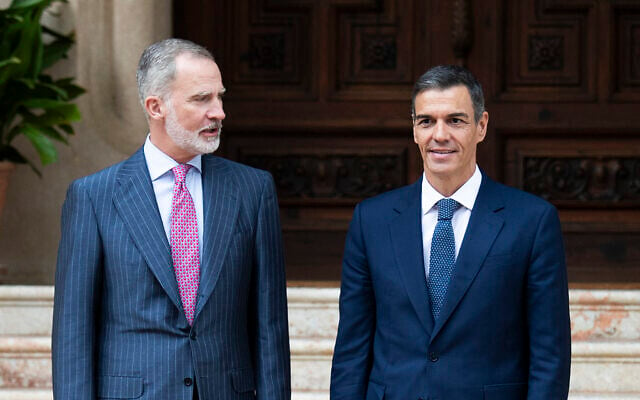
King Felipe VI of Spain (L) and Spain's Prime Minister Pedro Sanchez pose for photographs upon his arrival for a meeting at the Marivent Palace in Palma de Mallorca on July 29, 2025. (Photo by JAIME REINA / AFP)
A 72,000-person border rupture, a widening Madrid-Washington feud and Israel’s deepening defense ties with Rabat are turning Spain’s African enclaves into a test of the western Mediterranean order.
When the Spanish Royal Household announced that King Felipe VI and Queen Letizia will visit Ceuta and Melilla on October 13 and 14, Madrid presented the trip as a royal duty. The timing says something more. After the largest border rupture in Ceuta’s recent history, the first visit by Felipe to either enclave since becoming king is a deliberate assertion of Spanish control over territory Morocco has long claimed.
The crisis that brought this visit into focus was extraordinary. More than 72,000 migrants entered Ceuta from Morocco during July 30 and 31, according to Spanish government figures. More than 100 people were ultimately reported dead in the crossing. Thousands remained in Ceuta afterward, overwhelming reception facilities and exposing a frontier where Madrid struggled to maintain basic control. Protests followed, tensions with residents intensified and the political fallout reached the Spanish government’s own representative. Government Delegate Miguel Ángel Pérez Triano resigned on September 28 after weeks of scrutiny over the handling of the influx. Spain had already declared the situation a Situation of National Security Interest, the first use of that mechanism in democratic Spain.
For Israel, Ceuta is not an obscure Spanish-Moroccan quarrel. Gibraltar is a gateway between the Mediterranean and Atlantic, and Morocco sits astride the western approaches to the Mediterranean. Shipping, naval movement and security cooperation through this corridor matter to every power seeking influence across North Africa and the Mediterranean. Morocco’s position on the southern side of the Strait also gives Rabat a strategic relevance that extends far beyond its borders.
That is why Felipe’s visit matters. King Juan Carlos last visited Ceuta and Melilla in November 2007, provoking a serious diplomatic crisis with Rabat. Felipe then stayed away throughout his twelve-year reign. Now he is arriving immediately after a border shock that has exposed administrative weaknesses, strained Spain’s relationship with Morocco and forced Europe to confront the limits of its southern border system.
At a gala dinner for French President Emmanuel Macron on September 29, Felipe called the situation in Ceuta “unacceptable” and demanded greater European solidarity. His message was directed at Brussels as much as Rabat. Madrid wants Ceuta treated as a Spanish responsibility, but also as a European frontier whose burdens should be shared by the rest of the European Union.
The timing is even more consequential because Madrid is confronting Washington. Spain refused to permit U.S. forces to use Rota and Morón for offensive operations during the Iran campaign and has resisted the alliance’s new defense-spending targets. President Donald Trump responded with threats of economic punishment, while an internal Pentagon email discussed possible measures including suspending Spain from NATO. None of this means Washington has abandoned Spain. It does mean the old expectation of automatic American diplomatic sympathy is harder to sustain.
Ceuta and Melilla also sit in an unusual place within NATO’s legal architecture. Article 6 does not explicitly place the two North African territories inside the geographic scope of Article 5. That creates ambiguity, even though NATO’s Southern Neighbourhood representative Javier Colomina has said he believes the Alliance would respond if Spain invoked Article 5 over an attack on the enclaves. The important point for Madrid is not that Spain lacks allies. It is that political support and treaty obligations are not always the same thing.
That distinction matters for Morocco. Washington has not recognized Moroccan sovereignty over Ceuta and Melilla. But the issue is no longer confined to Rabat and Madrid. AEI scholar Michael Rubin has urged Washington to recognize the enclaves as Moroccan territory. Representative Mario Díaz-Balart has said Ceuta and Melilla are in Morocco and that such questions should be discussed between friends and allies. A House appropriations report went further, describing the Spanish-administered cities as located in Moroccan territory and supporting diplomatic engagement over their future status.
That is not recognition. It is something more politically significant for the future: evidence that the status quo is becoming discussable in Washington.
Israel has an interest in what happens next because its relationship with Morocco is no longer symbolic. In January, Israel and Morocco signed a joint military work plan for 2026 during the third meeting of their Joint Military Committee in Tel Aviv. The Israel Defense Forces called Morocco a key partner for regional stability. Security ties now give Jerusalem a practical stake in Morocco’s strategic position across North Africa.
The debate has already reached Israel’s own diplomacy. After the July crisis, Israel’s UN ambassador Danny Danon accused Spain of maintaining “colonial enclaves in Africa,” triggering a dispute with Madrid and a public clarification from Israel’s ambassador in Spain. Danon’s intervention was controversial, but it exposed an issue Jerusalem can no longer ignore: Spain’s territorial dispute with Morocco has become intertwined with Israel’s own argument about European double standards.
Israel does not need to become the referee of Spanish sovereignty. It does, however, have three ways to strengthen Morocco without turning the issue into a direct confrontation with Madrid.
First, Jerusalem can make clear that Morocco’s longstanding claim deserves serious diplomatic consideration. Israel need not endorse an immediate sovereignty transfer to reject the idea that Ceuta and Melilla are beyond debate.
Second, Israel can make the strategic case in Washington. Morocco is an increasingly important security partner, and closer U.S.-Moroccan alignment strengthens the western Mediterranean while expanding the network of states cooperating with Washington and Jerusalem.
Third, Israel can demand consistency from European governments. Spain is free to defend its sovereignty over Ceuta and Melilla. But Madrid should not expect other states to treat its territorial dispute as permanently closed while European governments regularly insist that questions of sovereignty, territory and international law remain central when judging Israel. The disputes are not legally identical. The principle of consistent scrutiny should nevertheless travel in both directions.
The strategic question is whether Europe can continue treating the enclaves as a frozen exception while demanding that territorial disputes elsewhere be resolved through negotiated political processes. Ceuta and Melilla have been under Spanish rule since the fifteenth and seventeenth centuries respectively, long before Morocco became the modern state. That history explains Madrid’s attachment to them. It does not make Rabat’s claim illegitimate, nor does it remove the dispute.
Morocco has repeatedly demonstrated that it can convert geography into leverage without relying on military confrontation. Its role in migration management, counterterrorism, Atlantic access and diplomacy gives European governments incentives to maintain working relations with Rabat. Its security relationship with the United States is also longstanding: Morocco is the United States’ oldest treaty partner.
That is why Jerusalem should avoid a theatrical policy. Israel gains little by declaring a territorial doctrine against Spain. It gains more by strengthening the Moroccan position through security cooperation, quiet diplomacy and coordination with Washington. Jerusalem can support discussion without promising an outcome it cannot deliver.
By placing Felipe VI inside the enclaves after the July rupture, Spain will draw attention to their geography, disputed status and dependence on European and transatlantic partnerships.
For Israel, the opportunity is not to manufacture a crisis but to recognize one that already exists. The western Mediterranean is becoming a more connected strategic theater, and Morocco is increasingly central to it. If Jerusalem wants the Abraham Accords to evolve from normalization into a durable security architecture, it cannot treat Rabat’s northern frontier as someone else’s problem.
Felipe’s October visit will not decide who ultimately controls Ceuta and Melilla. It can do something more immediate: put the sovereignty dispute at the center of European and transatlantic strategic debate. The royal palace is trying to demonstrate permanence. The surrounding facts suggest movement.
For Israel, that movement matters. Morocco is no longer simply a partner in an Abraham Accords framework. It is becoming an important defense partner at the western gateway of the Mediterranean. A border crisis has forced Spain to reveal vulnerabilities, Washington has begun questioning old assumptions, and Rabat has acquired greater strategic weight. Jerusalem should not remain a spectator while that new balance takes shape.