
Feminism at the Crossroads: Why Academia Must Stop Platforming Extremists
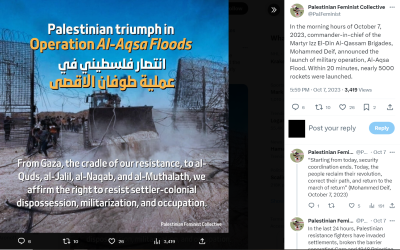 An academic debate is underway about the meaning of feminism today. At my college, the discussion focuses on the status and demands of a group that calls itself the “Palestinian Feminist Collective.” This collective is led by Nada Elia, an activist-scholar of ethnic studies.
I am offering my opinion here because of the significant constraints placed on my academic freedom at work since February of 2023 – eight months prior to the Hamas invasion the following October. (My radical colleagues would undoubtedly defend these constraints as a necessary rebalancing of “privilege.”)
We need to confront, without evasion or euphemism, what it means for our institution to platform figures such as Nada Elia and to present their worldview as academically or ethically aligned with our mandates. Elia is not simply a “controversial” speaker. She is a high-profile advocate for a movement that deploys defamatory rhetoric toward Jews (“colonizer,” “apartheid,” “genocide”), traffics in conspiratorial claims long recognized as antisemitic, and leverages tokenistic identity politics to deflect criticism. This is not a matter of interpretation; it is a matter of record.
Even for those who do not accept this assessment—and I encourage colleagues to evaluate the evidence themselves—the question remains: What are we endorsing, even implicitly, when we appropriate this ideological framework into our curriculum or our public programming?
Faculty who raise these concerns in good faith, relying on established scholarly norms, routinely face a punitive, procedural backlash that is as authoritarian as it is dysfunctional. Many of us have now witnessed, or personally experienced, Kafkaesque processes that prioritize ideological conformity over due process, evidence, or basic professional respect. This is corrosive to academic freedom and corrosive to the institution itself.
More troubling still is the attempt to rebrand Elia’s ideology as a form of “feminism,” allegedly aligned with Black, migrant, queer, and Indigenous struggles. This rhetorical move conscripts entire communities—often without their knowledge, let alone consent—into a political program marked by maximalism and an endless-war fantasy. It has already produced demonstrable harm in the Middle East; replicating that logic here, under the banner of solidarity, places vulnerable groups directly in harm’s way.
Indigenous communities in North America, Black and queer communities, and migrants living under rising xenophobia should not be involuntarily enlisted into an ideological agenda that treats antagonism as strategy and perpetual struggle as virtue. The costs of such alignment will not be borne by those promoting it from the safety of the podium; they will be borne by the communities we claim to protect.
Within our own institution, the selective elevation of incendiary voices—marketed as the “most oppressed”—has created a distorted ecosystem in which dissent is punished, nuance is erased, and faculty governance is subordinated to an ever-escalating performative moralism. These voices are elevated not because they illuminate, but because they satisfy the savior fantasies of a particular class of ‘white allies’ who crave moral prestige. Local “BIPOC” figures who echo the script are rewarded with platforms; dissenters are punished.
Institutions cannot function under these conditions. Students cannot learn under these conditions. Colleagues cannot work under these conditions.
We should be asking ourselves a simple question:
Why are we helping to build a system that destabilizes our workplace, delegitimizes our scholarship, and exposes our community to real and unnecessary risk?
Unless we are prepared to watch our institution continue down a path of ideological capture and internal hostility, we must be willing to tell the truth plainly.
This is not about silencing anyone. It is about protecting our academic mission, our colleagues, and our students from an ideology that punishes disagreement, erodes trust, and undermines the very values we claim to uphold.
I urge us to consider the long-term damage of allowing these dynamics to deepen unchallenged. We still have time to correct course. But only if we are willing to confront the problem honestly.