
Fences and neighbors
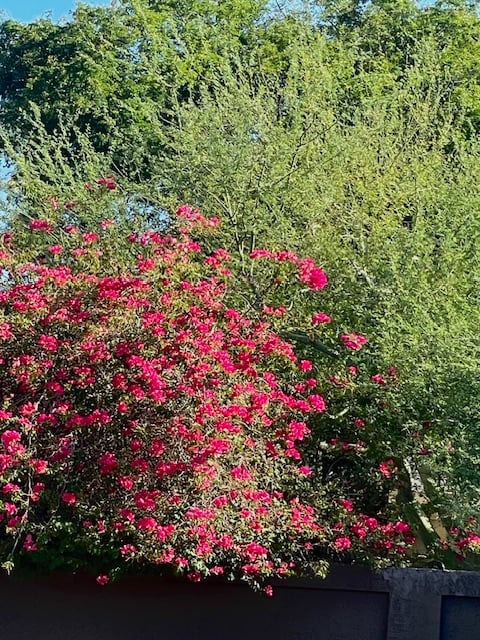
A new home, in a cozy neighborhood, a bright patch of green behind, hugging close to another just beyond.
A lovely openness, and yet, it’s a little less intimate, a little less private, a little less inviting for lazing in the sun with a book, for hosting a few friends or gathering family.
I listen as one of our offspring wrestles with the dilemma.
Maybe a stained wooden fence, or a handsome hedge, or a few tall flowering trees?
And yet.
Do good fences make good neighbors?
So I’ve been thinking about this as the world is sundered, nationally, globally, riven by anger and angst, as words become weapons and actions often seem to come from our darkest impulses. As wars rage, as chaos reigns, as peace seems ever distant.
And I am thinking how fences fundamentally make for safe spaces, for individuals, for families, for peoples. How they hold us in, root us, ground us, succor us, how they make us feel secure, safe, strong.
At home in the world.
And how they inscribe a sense of belonging, empower us with shared stories, aspirations, endeavors.
But, too, how those bounds encircle us, enclose us, separate us, divide us.
And while we may need such fences, we also need to peek over them.
I circle back to Margaret Renkl’s recent NYT column that nudges us to do just that.
Renkl reminds of the power of human connection and understanding, and its necessity, often unseen, now appreciating the thoughtfulness of her neighbor in choosing a fence that is attractive on both its sides, the flowering vines Renkl plants to enhance it, the wild life the greenery attracts for both to enjoy, the polite niceties exchanged over the leafy border, the ready neighborliness to respond in case of emergency.
She draws on Robert Frost’s poem The Mending Wall (I went back to that too, you also might want to take a look) that holds within it, for me, the infinite promise of finding our way beyond these fences.
It turns on two neighbors on either side of a fence walking its length and breadth in order to mend it.
Even as they remain convinced of the need for the fence – and therefore the need to repair it – they are also committed to the shared responsibility to mend it, together.
So it is the mending wall.
So it is in this broken world, where I wake up each morning and look for even a glimpse of progress toward ending strife, allaying hunger, diminishing hate, toward even a faint glimmer of light shining through, I remain hopeful.
That good fences make good neighbors.
That we can build them, that we can mend them — and see the other side.
May it be so.