Finding Light in the Darkest Season
In Vermont, winter isn’t coming. It’s already here. This year, the early winter feels a little harder. It’s harder to get outside with a spunky kid who refuses to wear her coat. It’s harder to adjust to the time change, especially as the darkness falls before 4 p.m. And it’s also feeling a little more challenging to approach the Christmas season — which is really what most folks mean when they speak of “the holidays.”
There is one aspect of Vermont winter culture that is as predictable as the annual L.L. Bean coat sale: Christmas celebrations. Shortly after Thanksgiving, a huge Christmas tree appears at the top of a pedestrian walkway in the city where I live. The Nutcracker always comes to the performing arts center. Schools and most businesses shut down between Christmas and New Year’s Eve. It’s an eerily quiet period that often leaves me feeling as though I’ve been left out of a party. And honestly, I sort of am.
Being Jewish at Christmas in Vermont is confusing. As a native Vermonter, I grew up with this confusion and this feeling of otherness, and I often felt as though Hanukkah was a consolation prize. I remember being asked by friends and classmates what I got from Santa and feeling ashamed to tell them that Santa didn’t come to my house — that instead, I played dreidel. One year, my mom hung stockings for me and my brother. As well intentioned as she was, I don’t think it helped.
I remember eating dry matzah during Passover in the cafeteria and looking longingly at the sandwiches of my friends. It felt a little like I was in trouble, being punished somehow — which is still how my anxiety feels.
My parents were proud of their Jewish heritage, and my mom especially was a pillar in her small Jewish community in Montpelier, VT. I didn’t feel any shame around being Jewish at home. That grew from the culture around me — a culture that didn’t understand that not all children wanted to be in the Christmas pageant in elementary school.
Later, while attending a youth leadership weekend as a high school student, I remember having to attend a mandatory Sunday Catholic service. Another time, I visited Washington, D.C. with a group of students from around the country and was asked by a girl from Alabama if Jewish people really grew horns. She had never met anyone Jewish before that day, and I cringed under the weight of being her “first.” As if I could possibly represent the entirety of Jewish experience.
Years later, I was stunned and overwhelmed by the vibrant Jewish culture at Tufts University. I loved meeting so many other Jewish students, even if I didn’t know whether I was Reform or Conservative (I still don’t!). After college, I lived in Brookline, MA while attending an MFA program. I remember walking around Coolidge Corner on Christmas Day and being stunned that the Jewish delis and grocery stores were open. It was just another day. The whole world hadn’t stopped. It was exhilarating. I had never experienced that before.
And then, much later, while working for a small college in Vermont, I had to use my vacation days to honor Yom Kippur, the holiest day of the Jewish calendar. As we all know, it is certainly not a vacation. Meanwhile, the college was closed on Christmas and Easter.
Today, I am grappling with how to raise a Jewish daughter in an interfaith home during a very challenging time. My daughter loves celebrating Hanukkah and proudly wears her Magen David, just like me. To her, she sees only the good. She doesn’t yet know the pain of all we have carried these past years. Recently, on a Zoom with some wonderful Israelis, I felt uncomfortable speaking about Jewish pain in America. I can’t compare my shattering sense of safety with all they have endured.
My daughter is also too young to understand the generational trauma coursing through our Jewish blood. In the not-so-distant future, she will learn about the Holocaust, and she will be one of the few Jewish students in her class, just as I was. I know this is coming, and I wish I could say I am ready with answers. I am not.
I hope that my daughter’s future teachers will understand when I ask that they include Hanukkah in their classroom celebrations. I hope she never has to endure being asked about horns or feeling embarrassed about her curly hair. I hope she feels safe in our increasingly terror-filled world. And I hope she has the courage to honor Jewish tradition however she feels called to do so.
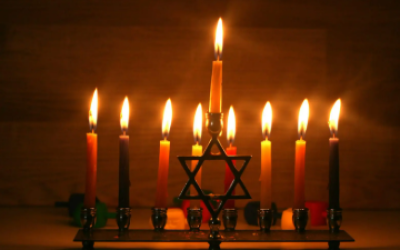
I’ve already received Christmas-themed emails from clothing companies and have seen posters for Santa’s visits. I’m starting to feel a growing anxiety about living through another season in which we don’t celebrate Christmas. But I remind myself that this is a time to cultivate peace within, to light the Hanukkah menorah with pride, with the gentle eyes of my daughter watching.
I hope that in the years to come, my daughter will feel the light of Hanukkah in the darkness of winter — and that in the midst of the Christmas frenzy she may realize that there is always, always light to be found.