


Finding Our Way Before GPS Found It for Us
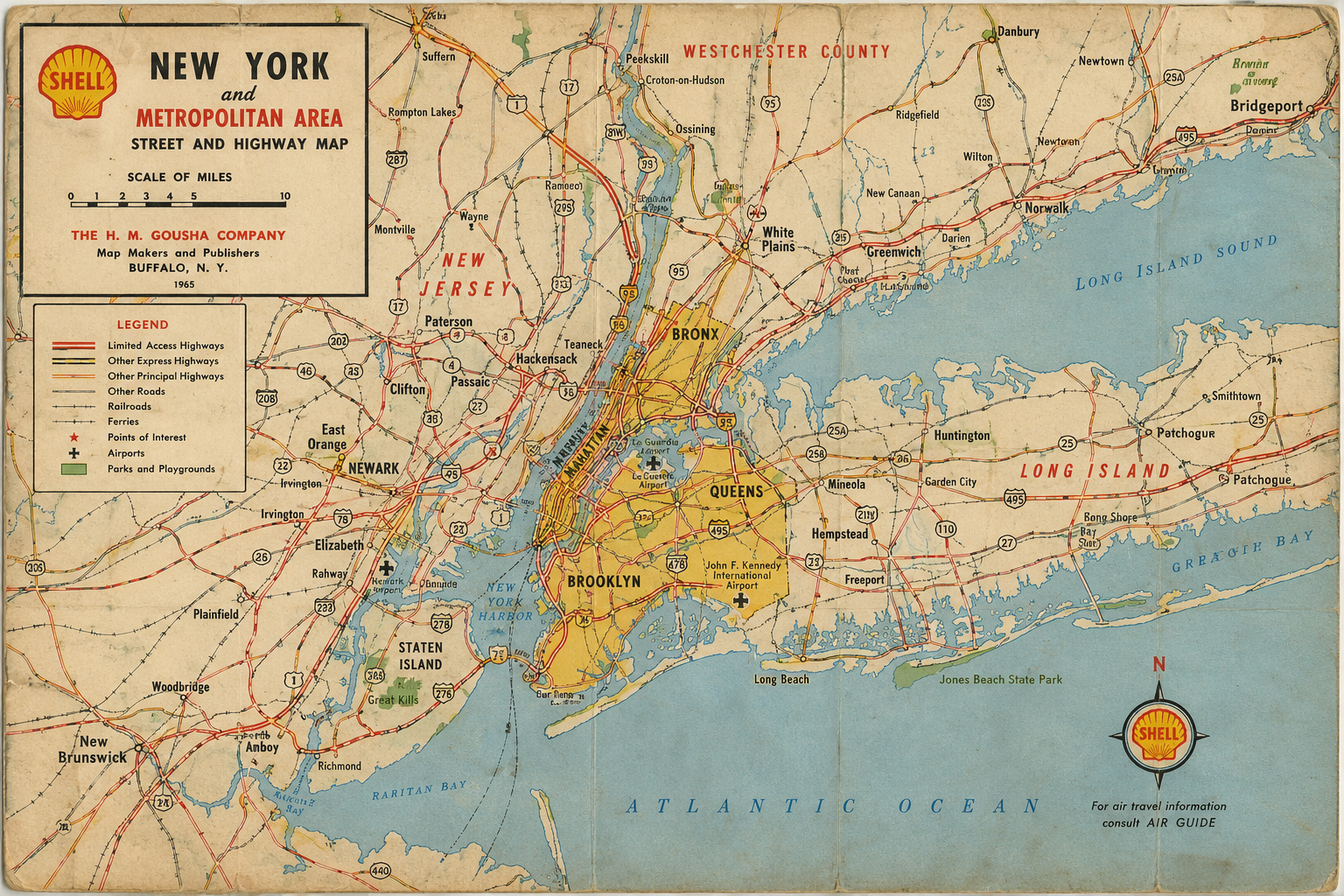
Remember the days – and it wasn’t too long ago – when getting somewhere new required a bit of courage?
I do.
Before a family trip, my father would stand beside our 1965 Rambler station wagon with one of his treasured road maps spread across the hood of the car. Sometimes it was folded neatly; more often it looked like a giant paper accordion that had already lost one too many battles against human hands. He kept several of them stuffed into the glove compartment — maps for New York City, Westchester, New Jersey, and the endless maze of parkways and expressways that crisscrossed the metropolitan area.
There were no GPS devices back then. No soothing electronic voice telling us to “turn right in 500 feet.” No colorful blue line reassuring us we were heading in the correct direction. My father had to figure out everything himself.
He would carefully trace the route with his finger, studying exits, estimating mileage, and calculating travel time with surprising confidence. “About an hour and fifteen minutes,” he might say, as though he were conducting a scientific experiment rather than making an educated guess. And somehow, most of the time, he was remarkably close.
Of course, getting lost was always a real possibility.
That was simply part of traveling in those days. If you missed an exit, there was no automatic recalculation. There was no smartphone in your pocket to rescue you. Sometimes you drove for miles before realizing something didn’t look right.
And that’s when another lost art came into play: asking for directions.
Usually there was a gas station nearby — often a Shell station, where attendants still pumped your gas and cleaned your windshield. My father would roll down the window and politely ask for help.
“Can you tell me how to get back to Route 17?”
The attendant, who somehow knew every local road by memory, would lean into the window and offer a series of detailed instructions involving traffic lights, diners, churches, and oddly specific landmarks.
“You go down about two miles till you see the old A&P. Make a left there — not the first left, the second left — then stay straight until you hit the circle.”
My father listened carefully, nodded appreciatively, and somehow managed to remember every word without writing any of it down.
The Shell station itself often provided free road maps, and my father collected them like prized possessions. Folded and refolded over the years, they became soft at the seams and worn at the corners, each one carrying memories of family trips, wrong turns, and eventually finding our way.
And then there were the traffic reports.
On long drives, WCBS radio became our co-pilot. We listened intently to the famous helicopter reports circling above New York’s highways, warning drivers about accidents and backups on the Cross Bronx Expressway, the Long Island Expressway, or the Northern State Parkway. Those airborne reporters sounded almost heroic to me as a child, guiding thousands of drivers through the daily chaos from somewhere high above the city.
Sometimes my father would change routes entirely based on those reports, taking side roads and alternate parkways in hopes of saving fifteen minutes. It felt strategic, almost adventurous.
Then came the late 1990s and the arrival of MapQuest — which at the time felt absolutely revolutionary.
Suddenly, you could sit at a computer, type in a starting address and a destination, and receive turn-by-turn directions printed neatly onto several sheets of paper. It seemed miraculous. Before leaving the house, people carefully placed those printed instructions on the passenger seat like sacred documents.
But even MapQuest now feels quaint and old-fashioned, another technological stepping stone swallowed up by time. Eventually Google Maps and Apple Maps arrived, followed by Waze, and navigation changed forever.
Today, Waze does almost everything for us. It maps out the route instantly, warns us about traffic, construction, police activity, and accidents, and calmly tells us exactly when to turn. If congestion appears ahead, it automatically redirects us to a faster route within seconds.
And honestly? It’s extraordinary.
I use Waze all the time, and I genuinely love it. It makes traveling easier, faster, and far less stressful. Ninety-nine percent of the time, it gets us exactly where we need to go with astonishing precision. What once required planning, estimation, and occasional luck now happens almost effortlessly.
But still, something has been lost.
Part of me misses the old uncertainty of travel. I miss the ritual of unfolding a map across the kitchen table. I miss the feeling that a trip required preparation and attention. I even miss the nervousness of wondering whether we had missed an exit or taken the wrong parkway.
There was satisfaction in finding your own way.
And perhaps there was something deeper too: a greater appreciation for arriving safely. In those days, travel demanded patience, awareness, and sometimes the kindness of strangers. You depended on your instincts, your planning, and occasionally the wisdom of a gas station attendant who knew the local roads better than any satellite ever could.
Today, we glide from destination to destination guided by invisible technology we barely think about. We take for granted that a calm digital voice will always lead us home.
But every now and then, I think back to my father in that Rambler station wagon, studying a paper map before a family trip, and I realize those journeys were about more than simply getting somewhere.
They were about learning how to find your own way.