NAnews - Nikk.Agency Israel News
Five Languages, 50 Poets: The Ukraine Israel Rarely Gets to See
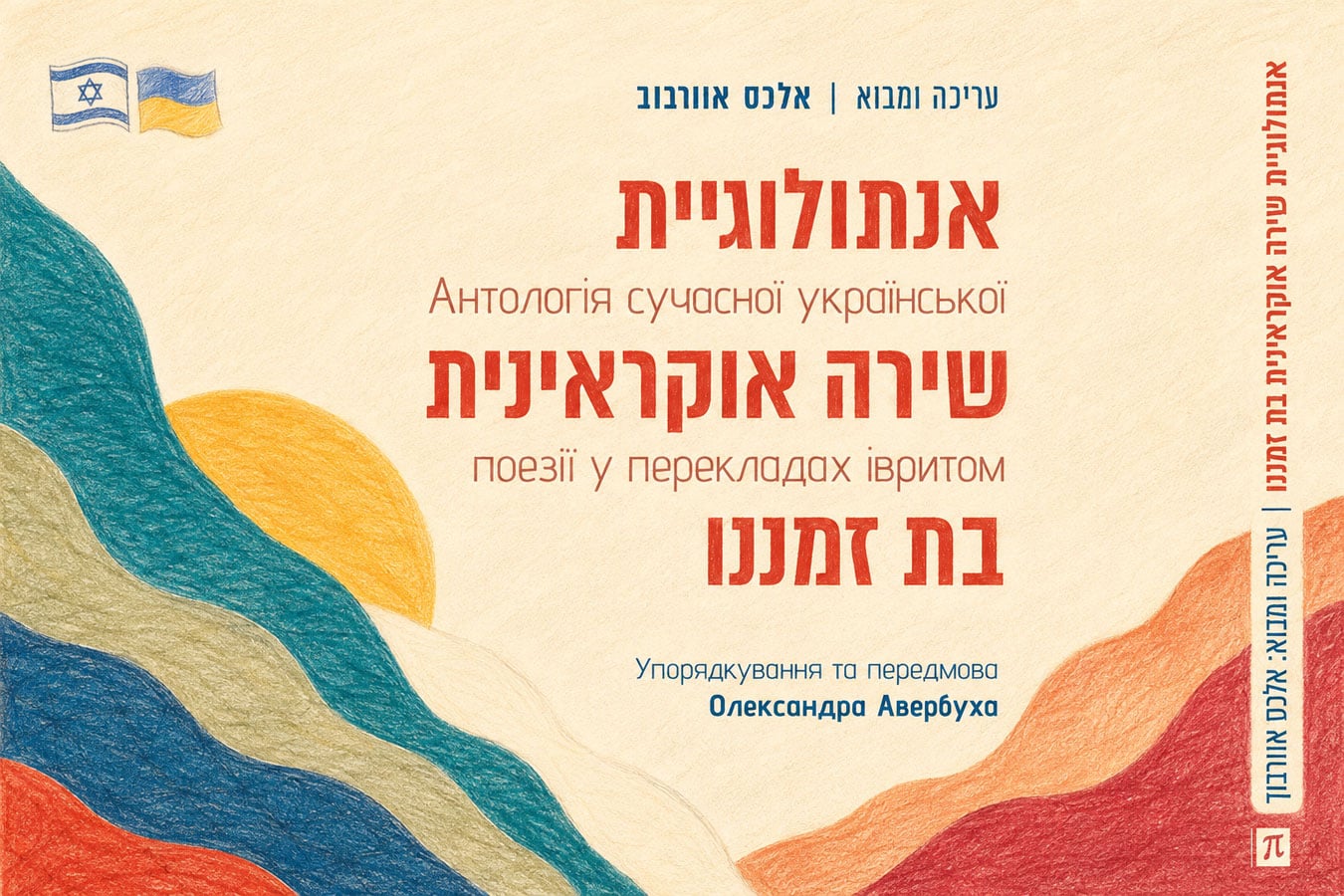
Five Languages, 50 Poets: The Ukraine Israel Rarely Gets to See. The image was created using AI.
A book of almost 400 pages is being prepared in Haifa.
That sentence does not sound particularly dramatic. There are no missiles in it, no diplomatic scandal, no emergency statement from Jerusalem or Kyiv.
And perhaps that is exactly why this story matters.
The independent Haifa-based publishing house Pardes is preparing a major anthology of contemporary Ukrainian poetry in Hebrew. It is expected to include works by 50 poets from several generations, from Emma Andijewska to some of Ukraine’s youngest contemporary voices.
But the number 50 is not the most interesting number in this story.
The more important one is five.
The anthology presents Ukrainian poetry originally written in five languages of Ukraine: Ukrainian, Crimean Tatar, Romani, Rumeika and Urum. The last two belong to the linguistic heritage of the Greeks of Ukraine’s Azov region — communities that most Israelis have probably never encountered in discussions about Ukraine.
This already makes the book something more than another collection of translated poems.
It presents a Ukraine that barely fits into the simplified image through which the country is usually seen abroad.
Alex Averbuch, the anthology’s compiler and one of its translators, described the project in a sentence that deserves to be taken seriously:
“For me, this is more than a book. This is my Ukraine — polyphonic, alive, indestructible.”
He has also explained that from the beginning, it was important to him that Ukraine should be heard through many of its own languages.
That distinction matters.
For years, many Israeli conversations about Ukraine have been reduced to a very narrow set of subjects: Russia’s war, relations between Jerusalem and Kyiv, Uman, Jewish history, antisemitism, political controversies and, increasingly, questions of security cooperation.
All of these subjects are real.
But they are not the whole country.
Sometimes a poetry anthology can reveal what diplomatic statements cannot.
Ukraine is more multilingual than many Israelis imagine
When Israelis hear the phrase “language question in Ukraine,” many immediately think of Ukrainian and Russian.
That is understandable. It is also incomplete.
Crimean Tatar is the language of an indigenous people of Crimea who survived Stalin’s mass deportation in 1944, returned to their homeland and then, after Russia occupied Crimea in 2014, again found their language, institutions and identity under severe pressure.
Romani brings another history into the anthology. Ukraine’s Roma communities have their own dialects and literary voices. One of the poets represented in the project, Yanush Panchenko, is also an ethnographer and researcher of Romani language and culture.
Then there are Rumeika and Urum.
These languages belong to the historical world of the Greeks of the Azov region. Rumeika is related to Greek, while Urum is Turkic. They developed within communities that lived for generations in what is now southeastern Ukraine.
That geography has acquired another meaning since Russia’s full-scale invasion.
Much of the Azov region became synonymous with destruction, occupation and displacement. Mariupol is no longer only a city on a map; it has become one of the defining symbols of this war.
So when poems from these linguistic traditions appear in Hebrew, the act of translation carries something larger than literary curiosity. It preserves voices from communities whose physical and cultural landscapes have been placed under extraordinary pressure.
Israel should understand this instinctively.
Hebrew itself is proof that a language can be more than a means of communication. Language can carry collective memory. It can preserve a community after displacement. It can connect generations that lived in different countries and under different regimes.
And sometimes keeping a language alive is itself an act of resistance to disappearance.
This is why I find it misleading to describe the Pardes project simply as “50 Ukrainian poets translated into Hebrew.”
The real question begins with the word Ukrainian.
Who fits inside that definition?
The anthology’s answer appears deliberately broad: Ukrainian, Crimean Tatar, Roma and Azov Greek voices all belong inside the same contemporary Ukrainian cultural space.
Pardes itself has described the anthology as the first Hebrew translation project of this particular kind — one presenting contemporary Ukrainian poetry as both multilingual and multigenerational.
That wording is important, because another tempting claim would be wrong.
This is not the first time Ukrainian poetry has appeared in Hebrew.
And that history makes the new anthology more interesting, not less.
Hebrew and Ukrainian poetry have been meeting for decades
In 2017, Ukrainian writer Kateryna Babkina presented her poetry collection Ask the Same for Everybody at the Jerusalem International Book Fair. Anton Paperny translated the poems into Hebrew, and the book was published by Khaver Laet.
At that fair, Ukrainian poetry was read from the main stage in Ukrainian and then heard in Hebrew — something Ukrainian Jewish Encounter described at the time as a breakthrough into the Hebrew-speaking literary world.
But even 2017 was not the beginning.
Back in 1990, the Kyiv publishing house Veselka released children’s poems by the Ukrainian-Jewish poet Moisei Fishbein alongside Hebrew translations by the Israeli poet and translator Manfred Winkler. In other words, the literary road between Ukrainian and Hebrew existed long before today’s political relationship between the two countries took its current form.
And there is an even more immediate correction to any “first-ever” headline.
Israel already received another substantial anthology of Ukrainian poetry in 2026.
The Persimmon publishing house released Why, Word, Are You Not Sharp Like Steel? From Skovoroda to Franko, a Hebrew anthology of Ukrainian poetry translated by Anton Paperny and edited by Assaf Bartov and Natalia Tymkiv.
It contains works by 25 poets — 18 men and seven women — representing Ukrainian poetry from the 18th through the 19th century. The National Library-style catalog in Nesher records 343 pages, while an Israeli bookseller lists 344, a charming reminder that even bibliography can produce its own small disputes.
The distinction between the two 2026 anthologies is therefore useful.
The Persimmon volume asks: Where did modern Ukrainian poetry come from?
The forthcoming Pardes anthology asks: What does Ukrainian poetry sound like now?
And its answer is not one voice.
It is 50.
The Pardes project also did not appear overnight.
Averbuch organized an online Festival of Contemporary Ukrainian Poetry in the summer of 2020. Sixteen poets participated in weekly readings during July and August. Among them were Marianna Kiyanovska, Ostap Slyvynsky, Halyna Kruk, Myroslav Laiuk, Iryna Shuvalova, Lesyk Panasiuk, Olena Huseinova, Yanis Sinayko, Daryna Hladun, Oleh Kotsarev, Váno Krueger and Sergo Mushtatov — names that later reappeared in the orbit of the new anthology.
After Russia launched its full-scale invasion in February 2022, this literary work acquired a direct Israeli dimension.
On March 10 and again on June 30, Ukrainian and Israeli writers participated in bilingual Ukrainian-Hebrew poetry events. Israeli poets and translators read Hebrew versions of contemporary Ukrainian poetry while Ukrainian authors read the originals.
The goal was stated openly: to support Ukraine, introduce its culture to Israel in Hebrew, and create direct contact between Ukrainian and Israeli writers.
By November 2023, Averbuch was already presenting the forthcoming anthology at the University of Michigan’s Frankel Center for Judaic Studies.
At that point the project contained works by more than 30 contemporary Ukrainian poets.
Today, the announced number is 50.
That timeline changes how I see the book.
This is not a hastily assembled wartime cultural project.
It has been growing for at least six years.
Averbuch himself embodies much of the Ukrainian-Israeli intersection behind it. Born in 1985 in Novoaydar in Ukraine’s Luhansk region, he spent roughly 15 years in Israel before continuing his academic career in North America.
He received his PhD from the University of Toronto in 2022 and is now Assistant Professor of Ukrainian Literature and Culture and an LSA Collegiate Fellow at the University of Michigan. His work focuses heavily on Eastern European and Jewish literature, culture, memory and Ukraine.
The university credits him with more than 60 published selections of literary translations across Ukrainian, Hebrew, Russian and English. His poetry collection The Jewish King was a finalist for the Shevchenko National Prize, Ukraine’s highest state award in culture and literature.
So when Averbuch says this anthology is “my Ukraine,” there is a personal history behind those words.
Why this belongs in an Israeli conversation
Israeli poet and editor Efrat Mishori has pointed to another dimension of the project: Ukrainian poetry in Hebrew creates an opportunity to revisit Ukrainian-Jewish memory — not only its closeness and shared history, but also rupture and violence.
It would be easy to write another sentimental paragraph about “building bridges between peoples.”
The Ukrainian-Jewish story deserves better than that.
There were pogroms.
There was the Holocaust.
There was Soviet repression.
There were wars, displacement and assimilation.
But there were also centuries of coexistence, cultural influence, shared cities, mixed intellectual worlds, families whose histories cannot be separated neatly into a Ukrainian box and a Jewish box.
Averbuch’s own scholarly and literary work repeatedly returns to these complicated intersections rather than trying to make them comfortable.
And something else happened after October 7, 2023.
At discussions around Averbuch’s translations, observers noted that poems originally written in response to Russia’s aggression against Ukraine began to resonate differently for Israeli readers after Hamas’s attack. Experiences of war, loss, fear and survival suddenly had another point of reference.
This does not mean Ukraine and Israel are the same.
They are not.
Their histories, enemies, wars and political dilemmas are different.
But literature does something politics often cannot: it allows two experiences to stand next to each other without pretending they are identical.
There is also a very local Israeli detail here.
Pardes was founded in Haifa in 2000 and has spent more than two decades publishing poetry, fiction, nonfiction and experimental literature. This anthology is therefore not entering Israel through an abstract diplomatic cultural program somewhere far from Israeli life. It is being produced inside the country’s Hebrew literary ecosystem, by a Haifa publisher.
And as of August 28, there are still things we do not know.
I have not found a confirmed final Hebrew title, retail price, ISBN or precise publication date for the new anthology. The available information says it is being prepared for publication, not that it is already on sale.
The project announces 50 poets, while the published list currently contains 36 names. The remaining 14 should be confirmed by the publisher or compiler rather than guessed from earlier events.
Those details will come.
The more important part is already visible.
In 1990, Ukrainian poetry appeared alongside Hebrew translation in Kyiv.
In 2017, Ukrainian poetry was heard from the stage of the Jerusalem International Book Fair.
In 2020, Averbuch brought together 16 contemporary Ukrainian poets.
In 2022, Israeli and Ukrainian writers read the same poetry in Hebrew and Ukrainian while Russia was invading Ukraine.
In 2023, the planned anthology contained more than 30 voices.
In early 2026, Israel received a major Hebrew anthology of Ukrainian classics from Skovoroda to Franko.
Now Haifa is preparing nearly 400 pages of contemporary poetry by 50 authors.
There is also a broader international pattern. This year the British independent publisher Linen Press released War-Torn Voices: Ukrainian Women’s Poetry, bringing together 50 poems by 12 contemporary Ukrainian women, some written from the battlefield itself.
Ukrainian literature is increasingly being translated abroad not as a curiosity from a country at war, but as a literary culture worth encountering on its own terms.
That may be the most important point.
Ukraine does not consist only of the images that reach us through breaking news.
It is not only destroyed buildings, diplomatic arguments, military maps and casualty figures.
It is also Ukrainian, Crimean Tatar, Romani, Rumeika and Urum.
It is Jewish memory and Crimean Tatar memory.
It is poets from different generations who do not necessarily tell the same story of their country.
And soon, if Pardes completes this project as announced, many of those voices will be available to Israelis in Hebrew.
A political statement may survive for a news cycle.
A book can remain on an Israeli shelf for decades.
That is why almost 400 pages of Ukrainian poetry being prepared in Haifa deserve more attention than the usual culture-page footnote.
They may tell Israelis something about Ukraine that years of headlines have failed to explain.
Source and expanded research: NAnews — Nikk.Agency Israel News published the detailed background and fact-checking behind this column on August 28, 2026. Read the full NAnews investigation.
Related Topics