
Urban sociologist and geopolitical commentator
Flight FZ1073: The Script That Didn’t Run
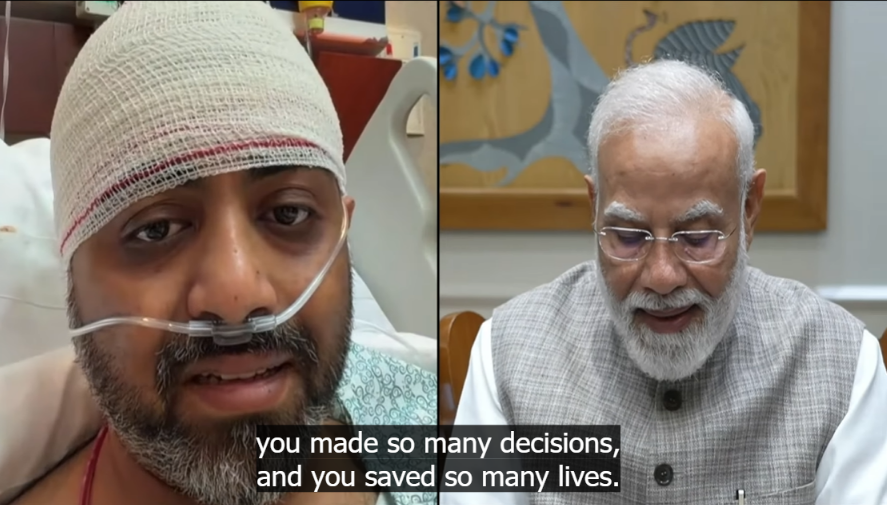
Prime Minister Narendra Modi spoke with Captain Smit Machchhar over a video call. October 2, 2026 (Credit: PIB India/X).
Whatever was planned for Flydubai Flight FZ1073, the world was ready to tell one story, and India should ask why.
Consider the version of 30 September that didn’t happen.
Captain Smit Machchhar does not reach the door release. The aircraft does not land at Tabuk. 174 people die, the captain’s voice is gone, and the only witnesses are a black box and a surviving narrative. In that world, the headline writes itself: a pilot from India, a Hindu, drove a passenger jet into catastrophe, and his colleague died trying to stop him.
Whether that story would have been true is beside the point. It would have been available, fully formed, with a villain who fits an existing prejudice. And a story that arrives that fast, in a climate already thick with hostility toward India and Indians, deserves scrutiny.
Why the script was ready
Prejudice needs a pretext. For some time, anti-India rhetoric abroad has had plenty of grievance and little narrative. It trades in contempt, visa hostility and resentment of Indian professionals. Contempt sells, but it has a ceiling.
What lifts a prejudice from contempt to mass fear is an atrocity with a face. After 9/11, a nation of a billion people was not merely disliked in the Western imagination, it was securitised. Every traveller with a certain name became a suspect. The mechanism, not the specific people, is what India should study. A single catastrophe, correctly framed, can reclassify a population from rival to threat.
Now place that mechanism beside a country in its own turmoil, with protests in the streets and a government criticised for its silence after a massacre. A “Hindu terrorism” narrative landing on top of that would have attacked India from two sides at once: abroad as a pariah, at home as a state that had lost the argument. I find it difficult to imagine a more efficient blow to a country’s standing, or to the safety of Indians overseas.
What I can say, and what I can’t
I cannot prove this script was written. I can say that the pattern is plausible enough, and the stakes high enough, that dismissing it as paranoia would be negligence. Every claim that follows is a question the investigation owes us:
- Who first framed the incident for the public, how quickly, and with what evidence?
- What is the full provenance of the cockpit recordings, flight data and forensic material, and has it been independently examined?
- Is the co-pilot’s background, communications and financial trail consistent with a “lone actor”, or with outside direction?
- Were there parallel efforts, online or in media, to push a communal or national narrative within hours of the event?
- If the aircraft had been lost, who would have controlled the evidence?
That last question is the heart of it. The danger of the counterfactual is not that someone would have lied. It is that, with the captain silenced, nobody could have contradicted the lie. That is the reading the National Investigation Agency (NIA) should adopt as a working hypothesis: not that a conspiracy is proven, but that a conspiracy was possible, and the evidence must be handled as if someone might later try to rewrite it.
The Ahmedabad question
The same logic applies to how Indian pilots are discussed after disasters. Preliminary findings are not verdicts, and a profession should not be indicted by innuendo. Whether or not the Ahmedabad inquiry was handled properly, the lesson from both cases is the same: when evidence is thin and the public is hungry, blame lands on whoever cannot answer back. India should demand rigorous, transparent, independent review in every such case, and should stop treating them as unrelated.
Providence, and what comes after it
Many Indians will see in Captain Machchhar’s survival the hand of providence, and no one should begrudge them that. He is wounded, he is a hero, and he changed what the world was told.
But gratitude is not a security policy. A narrow escape is not an all-clear. If the possibility of a narrative attack is real, the correct response is to treat it as live.
For Indians abroad
Be alert, not afraid. Register with your embassy. Follow official advisories. Document and report harassment and threats. Resist the urge to circulate unverified claims, because rumour is the raw material of the very narrative we fear. And expect that the next event, whatever it is, will be framed within hours. Don’t repeat the frame until the facts are in.
The standard India should set
The best answer to a hostile script is not a counter-script. It is a record so solid that no script can override it. Let the NIA investigate the co-pilot, the evidence trail and any wider network. Let it test the coordination hypothesis openly, and publish what it finds, including what it fails to find.
If a playbook exists, evidence will expose it. If not, we will have lost nothing by checking.
Providence kept the door open this time. The rest is on us.
Related Topics