Psychology, Medicine, Physics, Politics, Sociology, Philosophy, Judaism, etc.
For beginners: Jewish Prayer, G^d and Idol worship
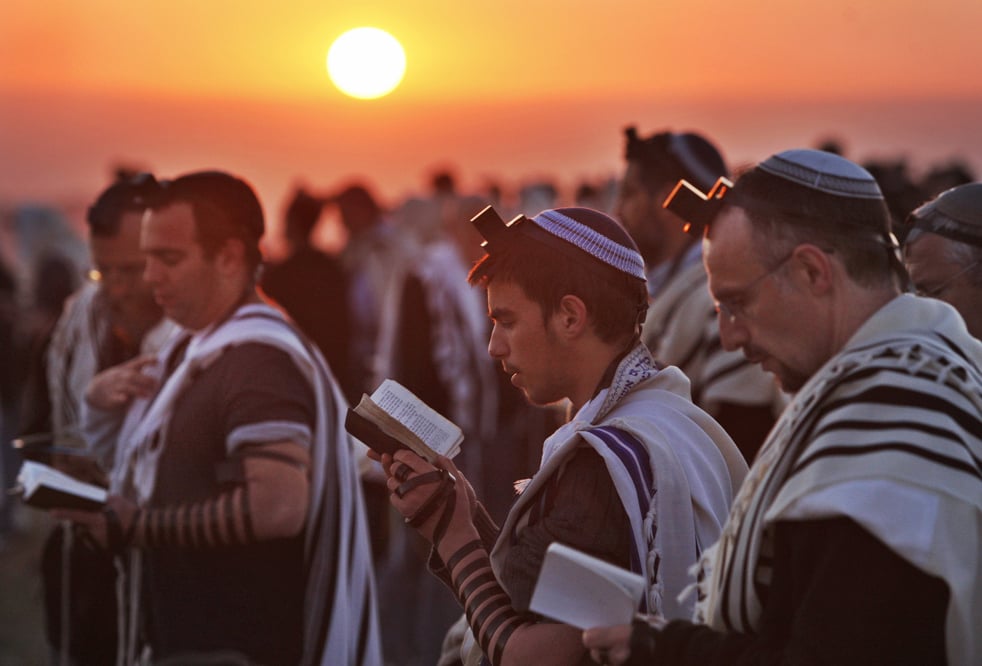
Jewish worshippers wrapped in prayer shawls, participate in the special "Blessing of the Sun" prayer at sunrise on the Eitam Hilltop near the West Bank Jewish settlement of Efrata, Wednesday, April 8, 2009. Devout Jews around the world on Wednesday observed a ritual performed only once every 28-years, saying their morning prayers under the open sky in the "blessing of the sun", called the Birkat Hachamah in Hebrew. (AP Photo/ Kevin Frayer)
Let’s honestly look at some of the peculiarities of Jewish Prayer.
Jewish women should pray but only are obligated every day to say privately a few things: I remember You, I thank You and Please help me. Something like that. Some Jewish women actually say all or most of Jewish men’s prayers or read certain Psalms, but that’s all voluntary.
For Westerners, the obligation part may seem stranger. Well, Western Society is built on mutual/general rights, while Jewish life is powered by obligations for everyone. The Jewish way seems not as “nice” but it does produce nicer people. Who would you appreciate more – people who insist on their rights and entitlement all the time or who responsibly try to answer their obligations around the clock? Exactly! This lifestyle comes in handy as Jewish Law tries to turn us from just needy towards becoming giving (if possible: generous) people. If all get their rights, we all are fortunate but if all are giving, we also all receive. We should strive to resemble our Creator, Who lacks no giving as all comes from Him.
To make big distinctions between men and women also may seem strange to Westerners. It reminds us of discrimination and sexism in particular. However, Judaism doesn’t put women down, but designated different obligations for each biological sex. Women would then exercise their leadership inside the joint household with a husband (who is obligated to marry – women are not) while Judaism would try to protect them from sexism outside the house. (This does play into the sexist narrative that women would be weaker and less smart, which needs to be addressed. Also, societal discrimination against women needs to be fought.) Because generally women are on a higher level biologically, spiritually and emotionally, they have (need) far fewer religious obligations than men. Men more need to be controlled until they know to control themselves.
Anyway, Jewish men’s prayers are lengthy daily affairs. Their prayers were written/prescribed 2000 years ago. This because it’s hard to know what we should pray and pray for. Praying Jewish prayers compares to modern artists playing classical music. They need to be creative and artistic in the now while being faithful to the music of then. The set Prayers are created by very wise men (Prophets among them) and are supposed to contain anything we ever would want (and should) say to G^d. (About G^d: see below.)
The core of the Jewish men’s Prayer Service is a Standing Prayer said thrice daily within a group of at least 10 Jewish males over the age of 13 years, in the daytime with a repetition. Not seeking group prayer still leaves Jewish men obligated to say such prayers privately – though without repeat. In a synagogue or at the Western Wall is far better than in a non-consecrated area (though repeated communal prayer consecrates an area somewhat too), although some prefer prayer in a forest or nature (the seashore, a mountaintop) to better connect to the Beyond.
Each Standing Prayer consists on weekdays of 19 (sometimes 20) set Blessings, on the most Festive days of 7 Blessings and on special days a fourth Standing Prayer of 7 Blessings is added (on Yom Kippur even two extra ones of 7; on Rosh Hashanah the extra one has 9 Blessings – the longest Prayer of the year). The first of these Blessings is always the most important. (The middle one of the seven on Special Days is special and therefore draws attention but it does not become more prominent than the regular First one.) It is a summary of all the following Blessings but highlights especially our proof for G^d’s “existence” (G^d is actually beyond existence; we may only find His footprints and fingerprints everywhere): the continuous miraculous (despite it all) existence of the Jewish People (that He shields).
The Prayers are preferably said in Hebrew, which is such a holy language that even if one doesn’t understand the words, our Soul gets it and it still counts. Yet, if one wants to pray more from the heart, Jewish men are allowed to pray from an expert translation but only in a language that they understand well.
Also, we need to think about the words we say and not say them on the automatic pilot. This asks much concentration for those who pray regularly. We are adviced to pray pretending that we see this Prayer for the first time. (Actually, that is not pretense. Pretense is acting as if there is nothing new and we are the same as a minute ago. Learn from small children for whom all is new all the time – though routine calms them.) The result: Orthodox-Jewish men are great at choosing and concentrating. Not always we’ll be able to pray with great concentration and intention, but that doesn’t mean that those prayers are optional or of no value.
Most importantly, the verb to pray in Hebrew is fundamentally different from the English one. It is reflexive. That means that we are supposed to hear ourselves when praying. G^d already knows what we feel, think, want and will pray – it is us who need to be transformed by our words and us who need to ask for and thank Him for meeting our – collective – needs (we don’t pray just for ourselves). G^d is the Ideal Therapist. He’s not moved by anything but still very interested, loving, patient and there for us.
G^d isn’t a man but Hebrew uses the male pronoun for the neuter. Also, Judaism sees G^d’s Actions as from a powerful male, but in addition regards G^d’s Presence as from a nurturing female, neutralizing the idea that only the male is powerful and the female secondary. (This does reinforce traditional role patterns – there is no perfection in this world.)
In any case, G^d should be Someone we could relate to. That connection should help us to become who we truly are. We (hopefully) add to our set Prayers our thoughts and at some places, we may also insert heartfelt personal words when we need to.
Some moderns are bothered that G^d doesn’t talk back. (Some are really bothered by thinking that G^d does talk to them.) When the era of Prophecy came to an end, the Hebrew Bible was sealed and we needed to start learning what was said already. However, that doesn’t mean that we’re ignored, abandoned, on our own, getting the silent treatment. How can you learn Jewish stuff and not realize that He might be listening in? How could we prove that our newest thoughts didn’t come from Him? Don’t we hear Him when we read the Shumma’ twice a day or when someone reads for us from the Torah four times a week? And – best of all – when we really pour out our hearts (instead of rushing through the old words so that He doesn’t get a word in, so to speak), He will answer us. Not by words, we’ll hear but in thoughts that will come up, between the tears. But we need to slow down and talk honestly. G^d never hides – if He seems absent, Heaven forbid, we are hiding (Genesis 3: 8-9).
We are commanded to pray daily and this Commandment is not dependent on other obligations and actions. So, it is not true that prayer is only for the very committed and not for the beginner. (If we are weak in Commandments, like learning Jewish stuff, keeping kashrut or Shabbat (or prayer!), it may be good to pray for success in these areas.)
Let me end with a question I don’t have an answer to. The Sages took away the Evil Inclination that made us feel attracted to Idols. We have no idea anymore how anyone ever could be so involved with fake gods. But if our Prayers should transform us, and Idol worship is foreign to us, then why is our Prayer text so full of us addressing G^d? Why doesn’t it let us just make declarations to ourselves? The whole G^d focus gives a false impression as if G^d would need our Prayers, perish the thought.
Now, I know that it helps many people to think that they help G^d. “Will you carry the bag with the cucumbers and bring it into the kitchen to help me,” the parent asks and the child is very happy to “help.” (A very good way to understand why G^d would create a Universe at all is concluding that G^d wants to express His limitless generosity by giving us as much and best as possible, so He left Creation unfinished and invites us to join Him in completing it, so that He can reward us and we won’t need to feel like beggars getting free gifts.)
Also, I know that this relational prayer breaks our isolation that’s so bad for Jews. But we could connect ourselves in prayer to Jews of the future who will be completely cleansed of any Evil Impulse. Yet, we need to train ourselves to be humble enough (a little pride goes a long way but arrogance is isolating and disastrous) to admit that we have needs and to ask for them and be grateful enough to thank for everything we have. Is then not the proper (and only) address for that just the Lord?
Still, in our time, many people are not used to talking to G^d outside of prayer time. Talking to the Almighty is strange to them. Would they not be helped by a prayer text that is less G^d-centered? Yet, I wouldn’t know how to write such a text. Maybe it’s easier to advise Jews to start talking to G^d constantly. Throw away all books on building trust in G^d. Just talk to Him. All the time. Thank you. Please help. If you wish. Please forgive me. Why? Why not? Talk to Him!
Also in that way, our connection with G^d is like a typical relationship between husband and wife. The husband can’t ignore her all day and then, whenever he wants, suddenly start becoming intimate with her.
Related Topics
Related Posts