


For Showing the Israeli Flag
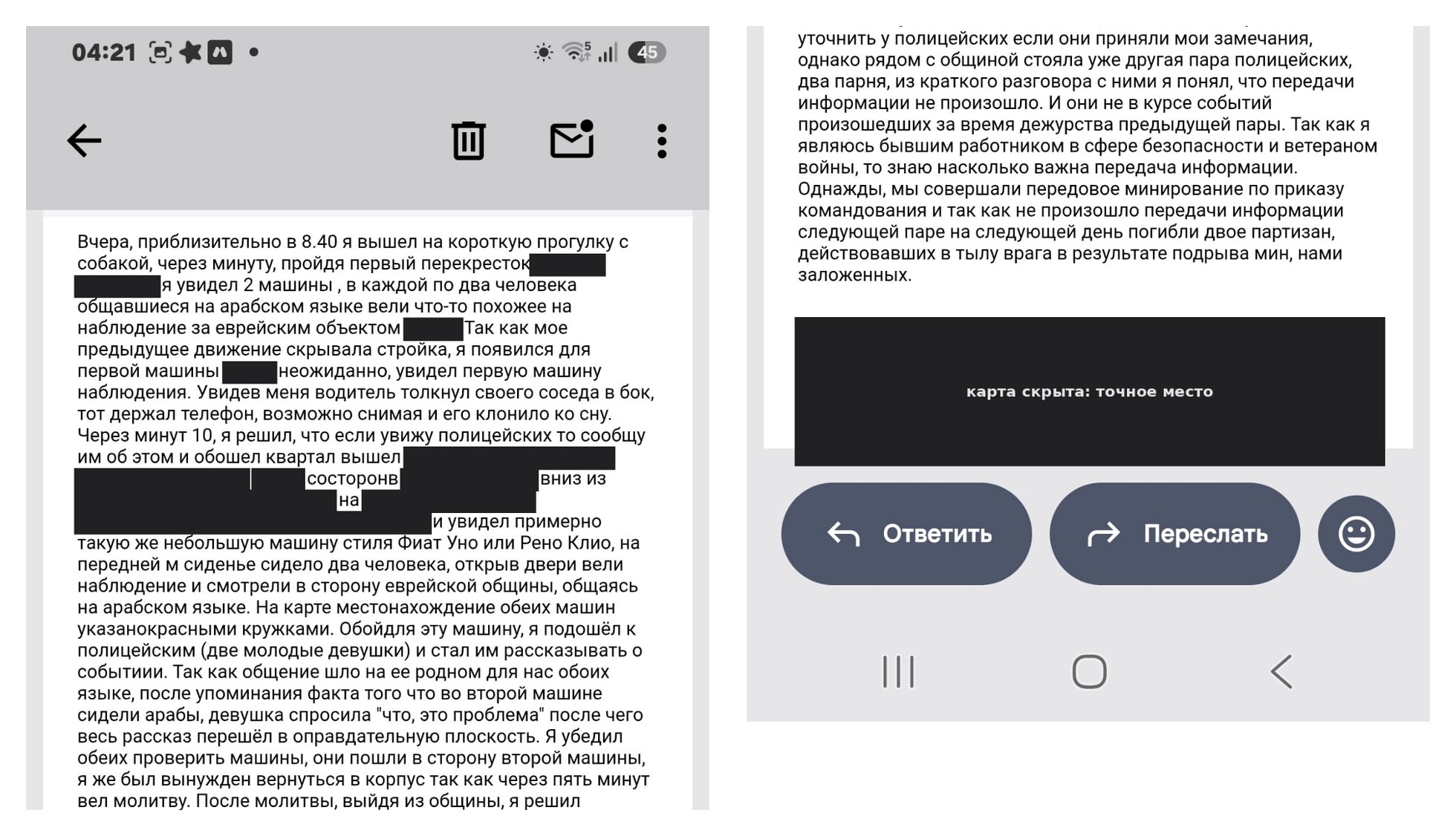
The Warning I Sent before October 7
On August 14, 2023, at 22:46, I sent an email to the security office of the Jewish community in Stuttgart. October 7 was seven and a half weeks away. Nobody knew that yet.
The email is in Russian as it is the working language of 95% of the Jewish community in Germany, including the security apparatus.
The email described what I saw the morning before — Sunday, August 13, around 8:40, when I went out with my dog. Two cars standing near a Jewish site, two men in each, watching it. One of them held a phone up. Filming — or that is how it looked. Earlier that morning I had noticed the same men, four of them, walking together. A few minutes later they were sitting in two separate cars, both with a clear view of the same entrance. In the email I described the cars, the positions, the sightlines, how they moved. I attached a map. I still have a dated copy. The version I can publish is redacted — no addresses, no exact location, nothing operational — but the date, the time and the substance are all there.
I did not write it as a nervous neighbor. My background is military and security work, including years of training others to observe, to report, and to pass information up the chain. And I knew the ground. I lived at that location for months. A city-center street has a rhythm, and you learn it fast. Sunday morning before nine, that street is empty. The last of the Saturday night crowd is gone by four or five, nothing opens for hours. As a rule there is nobody there at that hour. Sometimes a police car. That is all. Surveillance detection is not intuition and not paranoia, it is baseline and anomaly. Two occupied cars, static, at an hour when nobody parks there, with a view of one entrance and a phone held up toward it — that is an anomaly worth reporting anywhere in the world. Do I know that most suspicious behavior turns out innocent? Of course. Any professional can be wrong, and I can be wrong too. That is exactly why the right answer to such a report is not belief and not dismissal. It is process. Log it, check it, escalate it, and answer the person who filed it.
That same morning I did what a citizen is supposed to do. I went to the two police officers on duty nearby and reported what I saw: the positions, how long it was going on, the filming. Among the details I mentioned the language the men were speaking. The answer I got — I wrote it down in my email the same evening — was a question. Something like: and is that a problem? From that moment the conversation turned upside down. Instead of my report being assessed, I stood there explaining that I am not a racist. That a language is not a threat and an ethnicity is not evidence — but two static cars with a view on a Jewish site and a raised phone, that is behavior, and behavior is exactly what security services exist to assess. In the end I convinced the officers to take a look. I saw only the beginning of it — a short exchange through a car window — because I had to go inside. The rabbi was away that morning, and I was asked to lead the prayer. What happened after that, I cannot say.
What I can say is what I found when I came out. A new pair of officers stood at the same spot. I asked if there was any problem. They cheerfully asked if I had one. From that short dialogue everything was clear: nothing was passed on from the previous shift. In the Golani Brigade, and later in counterterrorism work, I was taught a rule that every functioning security organization lives by. Information is passed on. Always. Even when it looks trivial — especially then, because the person who receives a report is not the one entitled to decide it means nothing. I saw the price of breaking that rule in Ukraine in 2022, when two partisans were blown up on mines we ourselves had laid, because the information about them was not passed on. People die from a skipped handover. On that street in Stuttgart, my report evaporated within hours.
Then came October 7.
And then came the German cases. In December 2023, the Federal Prosecutor General announced arrests of alleged longstanding Hamas members in Berlin and Rotterdam. According to the prosecutors, the suspects had been searching for an underground weapons cache the organization had built in Europe; the weapons were to be brought to Berlin and kept ready for potential attacks against Jewish institutions in Europe. According to the same announcement, that search began no later than spring 2023. Months before October 7. In March 2026, a Berlin court convicted four men in that case, with sentences between four and a half and six years, and became the first higher court in Germany to rule that Hamas is a terrorist organization under German criminal law; the verdict is not yet final. And in late 2025 and early 2026 came a further series of arrests — in Berlin and beyond — of alleged foreign operatives of Hamas, again in connection with weapons, including an assault rifle, for possible attacks on Israeli or Jewish targets in Germany.
Here I have to draw a line, and I will draw it clearly. I cannot prove that what I saw in Stuttgart was connected to any Hamas network, and I do not claim it. What I can prove is narrower, and I think more important. I reported what looked, to me as a professional, like possible surveillance of a Jewish site — weeks before October 7 — and I documented it. The threat environment German federal prosecutors described later was not hypothetical. Neither was my email.
In March 2024, after I saw the news about those arrests, I forwarded my August email to a member of the community’s board. I have kept that forward too; it carries its own date. Soon after, my phone started ringing from an unknown number, again and again. The board member told me the head of the community was urgently trying to reach me. When I called back, the first thing I heard — as I remember it — was not an introduction. It was a statement: the head of the community had not known about my email. I am not accusing anyone of anything, and I will not guess what happened inside the organization. I simply do not know. But the statement raises a question that does not depend on anyone’s motives. How can a written warning about possible surveillance of a Jewish site, sent to the community’s security address, fail to reach the people responsible for decisions about that site — for seven months, until I sent it again myself? If the answer is that no procedure required it to reach them — that is not a reassurance. That is the problem itself.
One more scene, from June 2024. A Palestinian demonstration was passing through the city, and I stood at a distance with an Israeli flag. I was ordered to leave the area — until 10 that evening. I left. The police handed me the order in writing: a Platzverweis under § 30 of the Baden-Württemberg police law. In the field “reason / disruptive behavior,” the officer wrote by hand: “Zeigen der Flagge von Israel.” Showing the flag of Israel. Not an accusation of any offense — a flag, named as the disruption. I have kept that document too. And I understood the arithmetic around me. A Jew visible in public was treated as a public-order problem — something to move, to manage, to remove. And a documented warning about possible hostile surveillance of a Jewish site was treated as — what, exactly? Till today I do not know what became of it.
The dispersal order (Platzverweis) issued by Stuttgart police on June 8, 2024. The handwritten reason: “Zeigen der Flagge von Israel” — showing the flag of Israel. (courtesy)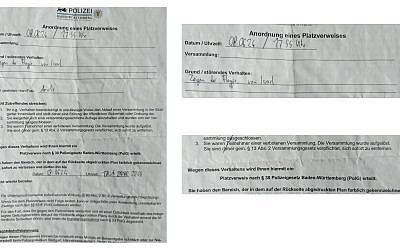
The dispersal order (Platzverweis) issued by Stuttgart police on June 8, 2024. The handwritten reason: “Zeigen der Flagge von Israel” — showing the flag of Israel. (courtesy)
There is a tactical footnote here that every professional will recognize, and it needs no secrets to state. Across Germany, the standard visible model of protecting Jewish sites is a police car parked outside, with the officers sitting in it. This posture survived years in which real attacks on Jewish institutions in Germany actually happened. Any basic protective-security course explains why it fails. Guards who sit for years in a parked car, in unbroken calm, are not a defensive layer. They are the first casualties of the attack they are supposed to prevent. The most dangerous condition in protection work is not threat. It is routine — because the attacker chooses the moment, and the guard stopped expecting one long ago. A guard who patrols, who changes position, who stands inside the building, can react. A guard behind a windshield cannot. I am deliberately saying nothing here about any specific site. I write this not against individual officers; they follow the protocol they are given. I write it because a protocol that stays unchanged after real attacks belongs to the same pattern this article is about — structures that look like security without functioning as security.
Jewish security in Europe developed a reflex, and October 7 should have broken it. The reflex says: do not wear the kippah on that street, do not carry the flag near that square, avoid that neighborhood on that day. Sometimes this advice saves lives, and the people who give it are usually not cowards — they work with the tools they have. But advice about where Jews should not go is not a security system. A security system collects reports, logs them, assesses them, escalates them, and answers the person who filed them. A security system leaves a paper trail, so that months later nobody discovers by accident that a warning ever existed. The measure of Jewish security cannot be how efficiently Jews are advised to disappear from public space. It has to be how seriously the system treats information about the people who might make them disappear.
My warning may have been about nothing. I honestly hope it was. But “probably nothing” is a conclusion a system has the right to reach only after it did the work — received the report, assessed it, escalated it, closed it with a record. Skipping the work and arriving at the same words is not the same thing. One is security. The other is luck.
The email existed. The date is preserved. The question is what happened after I pressed send — and whether, the next time someone like me writes such an email, anyone will be able to answer that question.